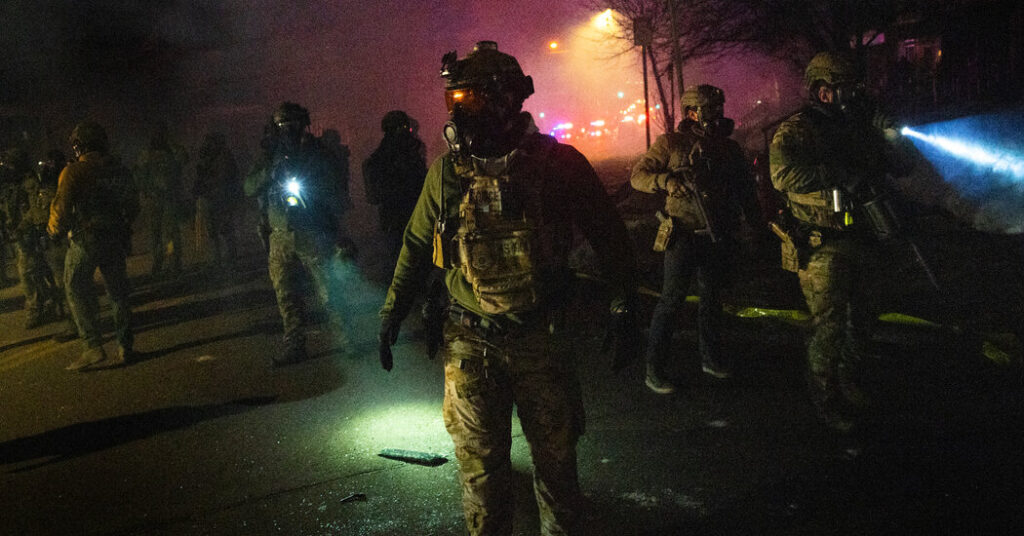
Journalists like me spend a lot of time focusing on the leaders of countries. Fair enough — they set the agenda and need to be held accountable. But it’s the people below them who carry out that agenda. And in the case of autocracies, where carrying out the work of the state can involve tasks like intimidation or even torture, there have long been questions about why anyone would sign up to be, in effect, a sinister bureaucrat.
Today my colleague Amanda Taub writes about some fascinating research that points to a surprising answer.
The engines of autocracies? Mediocre employees.
By Amanda Taub
Even the most capable autocrats cannot rule alone. Vladimir Putin has his loyal Russian oligarchs. Iran has the Revolutionary Guards. Viktor Orban built Hungary’s “electoral autocracy” with help from a handful of judges, enforcers and tycoons.
But the day-to-day work of consolidating power — perhaps surveilling neighbors, intimidating judges or disappearing dissidents — falls to a much larger group of midlevel officials. Until recently, researchers assumed those people cooperated out of ideology or fear.
New research points to a more banal explanation. The same desire for career advancement that motivates employees everywhere turns out to be enough to convince some bureaucrats to enable torture, murder and the slow strangulation of democratic institutions.
The people who do this dirty work don’t have to be extremists. Often, they are mediocre workers looking for a way to get ahead.
The mediocrity of evil
“Making a Career in Dictatorship,” a new book by the German political scientists Adam Scharpf and Christian Glassel, reads as if you crossed Hannah Arendt’s ideas about the “banality of evil” with a business school guide on how to get the most out of low performers.
The authors built their case on an unusual archive: data from Argentina’s “Dirty War” in the ’70s and ’80s, when the military published the graduation ranks, promotions and retirements of every officer. That included the members of Battalion 601, an army unit that carried out the regime’s brutal secret police work, including torture and extrajudicial executions.
Most Argentine military officers who underperformed fell behind their peers and were forced into retirement. But Battalion 601 offered a chance for a do-over. Low performers could transfer in, collect promotions by doing the regime’s most horrific work, and then return to the regular army, leapfrogging the peers who stayed clean. They retired with longer careers, higher salaries and better pensions than similar performers who hadn’t taken the career detour.
The worse an officer’s academic record, the more likely he was to join the unit. The lowest performers were assigned to the most brutal squads, where the career rewards were the greatest. A tour as a torturer could rehabilitate the most disastrous underperformer.
A common pattern
Comparable data sets do not exist for most regimes, but the pattern recurs. Scharpf and Glassel found that the Nazis recruited men with disciplinary records, questionable “racial purity” or a lack of military experience for its mobile killing squads, known as the Einsatzgruppen. Stalin’s NKVD, which killed hundreds of thousands of people, “deliberately recruited individuals with poor formal skills and knowledge” who often had no more than a primary-school education.
Erica Frantz, a political scientist at Michigan State, calls such foot soldiers “loyal losers.”
“The leader knows that people are going to be more likely to be loyal if they don’t have many other career options, so when I say losers, I kind of mean it literally,” she said.
For autocrats who win at the ballot box and then dismantle checks and balances from inside, the mechanics may be less violent, but the staffing logic is the same. In Hungary, Prime Minister Viktor Orban relied on a few handpicked loyalists at the top, plus a small percentage of ambitious strivers at the midlevel who saw politics as the route to success.
Attila Vincze, a researcher at Masaryk University, estimates that 5 to 10 percent of Hungary’s Orban-era judges — “the careerists” — were doing “the ‘dirty job’ to get along with their career.”
Venezuela took a more violent path. Hugo Chávez and his successor, Nicolás Maduro, leaned on the National Guard, which Alejandro Velasco of N.Y.U. called “the lowest rung of the armed forces,” and on the armed gangs of civilians known as “colectivos.” After Maduro stole the 2024 election, those units killed dozens of opposition supporters and detained thousands, according to Human Rights Watch.
The American case
Frantz sees the Trump administration in its second term staffing security forces like ICE and the F.B.I. with loyalists whose résumés would be unlikely to land them such roles under any other president. That “tends to be something that we see once a system has already transitioned to authoritarianism,” rather than one like the United States that is still undergoing democratic backsliding, she said.
The autocratic playbook, Scharpf and Glassel say, is to set up a “second ladder” for promotions, resource it generously, signal impunity for those who climb it and lower the bar for entry.
The administration seems to tick those boxes, even if Trump’s intentions are obscure. ICE is focused on immigration, but Scharpf and Glassel see concerning similarities between the playbook and ICE’s recent history. Its budget will soon dwarf other federal law-enforcement agencies, and the administration publicly promised immunity after officers killed a protester in Minneapolis.
At the same time, it has become easier than ever to become an ICE agent. A former training academy instructor testified that new cadets are graduating despite widespread concerns among training staff that they “cannot demonstrate a solid grasp of the tactics or the law required to perform their jobs.”
TOP NEWS
Raúl Castro was indicted in the U.S.
The Justice Department unsealed charges against Raúl Castro, the former president of Cuba and brother of Fidel Castro, increasing pressure on the government in Havana.
Castro and five other people were charged in connection with the fatal downing 30 years ago of two planes operated by a humanitarian aid group. Castro is 94 and no longer holds any official title, but he still wields enormous power, experts say. Cuba accused the United States of “building different pretexts for military aggression.”
Secretary of State Marco Rubio, a son of Cuban immigrants, is ramping up pressure with an appeal to Cubans to align with the Trump administration, my colleague Michael Crowley reports. Watch the video.
EXCLUSIVE
The U.S.-Israeli plan to install a hard-liner in Iran
Days after Israeli strikes killed Iran’s supreme leader at the start of the war, President Trump mused publicly that it would be best if “someone from within” Iran took over the country. It turns out he had a very surprising someone in mind: Mahmoud Ahmadinejad, the former Iranian president known for his hard-line views.
But U.S. officials say the plan quickly went awry. Ahmadinejad, who had been recruited to take part in the effort, was injured by an Israeli strike in Tehran that had been designed to free him from house arrest, according to U.S. officials and an associate of Ahmadinejad. After the near miss, he became disillusioned with the regime-change plan.
OTHER NEWS
-
During a chummy visit in Beijing, Xi Jinping and Vladimir Putin signed documents condemning much of what Trump is doing in the world.
-
The head of the W.H.O. said there was little risk that the Ebola outbreak in Africa would develop into a pandemic. The number of suspected cases has risen to nearly 600, and 139 people have died.
-
OpenAI is preparing to file for an initial public offering in the coming weeks.
-
Israel’s far-right national security minister posted a video of himself taunting pro-Palestinian activists while they were handcuffed on the deck of a ship.
-
Barney Frank, the liberal Democrat who for decades was the most prominent gay politician in the U.S., died at 86.
WHAT ELSE IS HAPPENING
-
A man heading for a morning swim on a beach in Sydney inadvertently became Australia’s most talked-about runway model.
Top of The World
The most clicked link in your newsletter yesterday was about the impact of aid cuts on poor countries.
SPORTS
Football: Southampton was expelled from the EFL Championship playoff final after admitting to spying on three opponents.
DISCOVERY OF THE DAY
A Stone Age root canal
A 59,000-year-old Neanderthal molar with a deep hole was found in southern Siberia a decade ago. A recent study suggests that the tooth’s owner most likely received a torturous, anesthesia-free root canal with a stone drill to treat a bad toothache. The discovery pushes back the earliest evidence of dentistry by more than 40,000 years.
MORNING READ
“Taiwan Travelogue” won this year’s International Booker Prize, which recognizes outstanding fiction translated into English. It is the first book originally written in Mandarin to receive the prize, and the first win for a Taiwanese author.
The novel — written by Yang Shuang-zi and translated by Lin King — opens in 1938 during the Japanese occupation of Taiwan. A young Japanese novelist arrives on the island hoping to eat her way through all of Taiwan’s culinary specialties. Soon, she falls for her female translator. Read a review here.
AROUND THE WORLD
World Cup fever in New York
It’s the summer of football in New York City. With the World Cup set to sweep the region, the city is racing to address a longstanding shortage of places for regular New Yorkers to play.
There’s a million-dollar rooftop pitch in Brooklyn and four restored fields on Randall’s Island. There’s even a man wondering how he can build a field on a ferry. “Once the World Cup is gone and all the excitement is over, we want to leave a lasting legacy,” said Jennifer O’Sullivan, who works at the New York City Football Club. “You never know where the next Messi or Ronaldo is going to come from until you put a ball at their feet.” See where the next star might come from.
RECOMMENDATIONS
Watch: The comedian Martin Short talks about finding joy while surviving tragedy in a new documentary.
Discover: They call Ava Pickett “the Charli XCX of young playwrights.” Here’s why.
Listen: This week’s playlist has new songs from a Danish punk band, the former Beastie Boy Mike D and more.
RECIPE
This take on the classic Persian dish adas polo — lentils and rice scented with warm spices and layered with fried onions — is from the owner of Sofreh in New York City. A dollop of yogurt on top adds a tart and creamy touch.
WHERE IS THIS?
Where is this temple?
TIME TO PLAY
Here are today’s Spelling Bee, Mini Crossword, Wordle and Sudoku. Find all our games here.
That’s it for today. See you tomorrow! — Katrin
Amanda Taub was our guest writer today.
We welcome your feedback. Send us your suggestions at [email protected].
Katrin Bennhold is the host of The World, the flagship global newsletter of The New York Times.
The post Autocracy’s ‘Loyal Losers’ appeared first on New York Times.