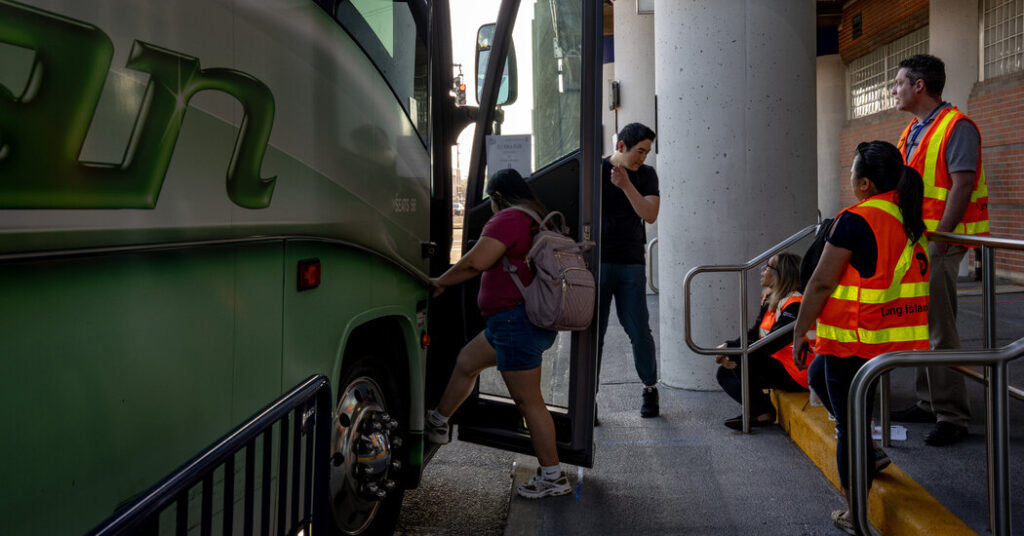
Ivan DeLeon, 26, a student in a tech program at LaGuardia Community College, faced another long commute to school on Tuesday morning, hours after transit officials and unions representing Long Island Rail Road workers agreed to a new contract, ending a three-day strike.
Though a deal was reached on Monday evening, service remained severely limited Tuesday morning. Full service was set to return to all lines by 4 p.m., in time for the evening rush, according to the L.I.R.R. president, Rob Free.
Mr. DeLeon had driven from his home in Merrick and parked at Citi Field to access the subway at Mets-Willets Point. He said that, in addition to having a longer commute, he had to pay for gas at a time when prices had surged.
“I’m getting certified this week,” he said, adding that others were sitting their finals. “We don’t have a choice.”
Rashida Omar, 39, a high school math teacher from Forest Hills, Queens, added 40 minutes onto her regular commute to her school in Newark, N.J., on Tuesday morning, having done the same the day before.
“It’s the last few weeks of school, so you have state testing,” she said, as she hustled up the stairs at Penn Station to catch her NJ Transit train. “You have to be there. Your students depend on you.”
Few commuters said they felt that they could opt to stay at home during the strike. Martine Hackett, 56, a consultant for the New York City health department, said that she had to commute to the city from Uniondale on Tuesday to be at an in-person training at a homeless shelter on the Upper West Side. Her co-workers do not live on Long Island, she said, and are not fully aware of what she had to do just to get to work.
“At the end of the day, nobody really cares; you just have to show up and do your job,” Ms. Hackett said.
But relief was on the horizon for the evening commute, and workers were thrilled.
India Garone, 26, who works in construction, had stayed over with a friend in Melville and drove two towns over to pick up her co-worker, Sean Higgins, 42, in Rockville Centre on Tuesday morning. They also drove to Citi Field, where they could transfer to the No. 7 train before taking a different subway to the Upper West Side.
While Mr. Higgins could take the Long Island Railroad back this evening for a smoother, shorter commute, he said he had decided not to.
“Traffic is always brutal heading back in the afternoon,” he said, estimating that the trip would take at least three hours compared with this morning’s two. He turned to Ms. Garone with a smile and said, “I can’t let you do that by yourself.”
Claire Fahy reports on New York City and the surrounding area for The Times.
The post Workers Endure Tough Commutes Even After L.I.R.R. Strike Deal appeared first on New York Times.