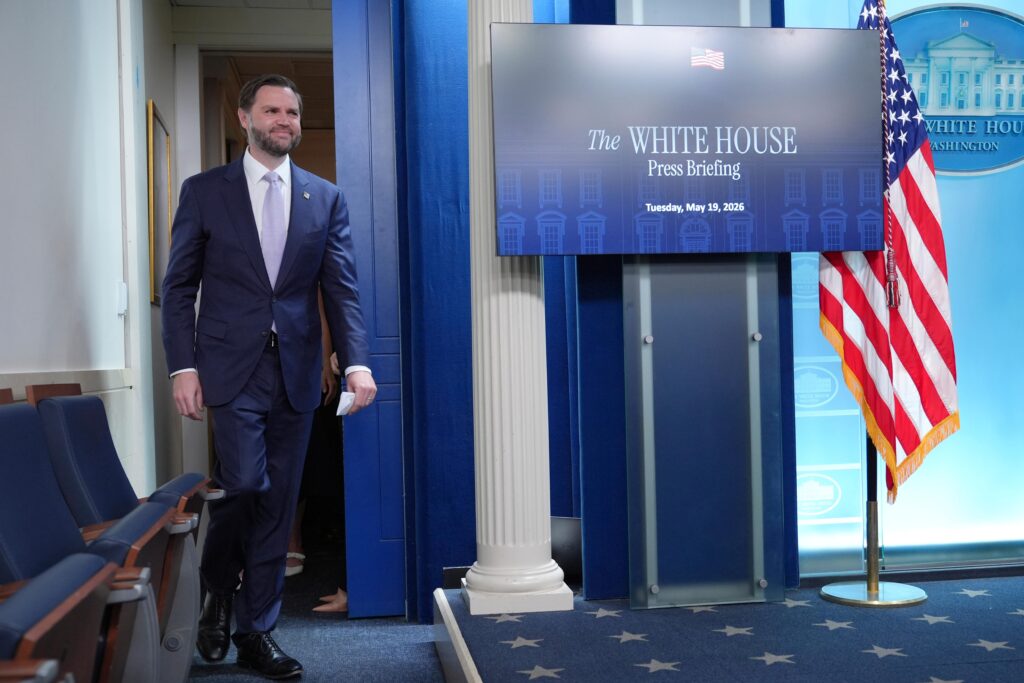
The White House briefing room has turned into an unlikely testing ground for the next generation of Republican presidential hopefuls, as two potential 2028 contenders have leveraged turns at the lectern to improve their national profiles.
Tuesday’s White House briefing gave Vice President JD Vance an opportunity to demonstrate not only that he could fill in for press secretary Karoline Leavitt, but that he could project himself as a future leader of the Republican Party. Vance followed Secretary of State Marco Rubio, whose turn at the lectern two weeks ago prompted a flurry of news stories about his ambitions and glowing reviews from some Republicans suggesting he looked like presidential material.
The two men are part of a rotating cast of administration officials who are scheduled to fill in for Leavitt while she is on maternity leave.
Both struggled with command of the room and how to decide whom to call on while dozens of reporters clamored for a question. They tried to describe journalists by what they were wearing — “white jacket” or “orange,” Vance said, acknowledging that “the pointer finger is not as precise as I thought it was.”
Rubio apologized for not knowing the names of the reporters. “Can you put name tags on?” he had asked at one point, drawing laughter from the packed room. “That would help.”
The parallel briefings offered a preview of the distinct styles of two men poised to shape the future of the Make America Great Again movement once President Donald Trump’s grip on the party loosens. Trump has at times stoked a rivalry but also repeatedly suggested they could run as a ticket.
Both Vance and Rubio are staunch defenders of Trump who will inherit the legacy of the administration’s policies, but each represents different elements of the president’s coalition. They could offer competing visions for where the Republican Party goes next.
“Well, first off, I’m not a potential future candidate, I’m a vice president,” Vance said in response to a reporter who referred to him as a future candidate. “And I really like my job, and I try to do as good of a job as I can.”
Rubio told Vanity Fair last year that if Vance runs, he would “be one of the first people to support him.” He reiterated that comment in recent days in an interview with NBC, saying Vance “would be a phenomenal candidate” and that he would support him if he runs.
Vance has similarly denied any rivalry between the two, telling reporters last week that Rubio is a “very, very dear friend” and that he is not focused on what office he will seek next.
The briefing room sessions may have played to Rubio’s advantage. From the moment he entered the room by cautiously poking his head out from the doorway, he repeatedly defused reporters’ questions with humor. Most of the questions during his 49-minute session focused on the future of the administration’s broadly unpopular war in Iran and provided the secretary of state with a platform to show off his deep knowledge of foreign affairs.
He also was ready with a campaign-style sound bite when a reporter from a conservative Christian news network asked him about his hope for America. The resulting viral moment was swiftly clipped by his social media account and promoted by influential members of his party, including Republican megadonor Elon Musk.
On Tuesday, Vance remained at the lectern several minutes longer than Rubio, taking questions for 55 minutes.
The vice president, however, faced a series of questions about past positions he has taken — how he squared Trump’s multimillion dollar stock market transactions in 2026 with his past calls to ban public officials from trading stocks, for example. He was also questioned about his past comments about people who assaulted police officers on Jan. 6, 2021 needing to face consequences and why he wouldn’t rule out offering settlements for those same individuals from the administration’s new $1.8 billion “anti-weaponization fund.”
The vice president tried at times to insert levity into the briefing and also drew some laughs. But one of the most notable moments — an exchange that was clipped and shared by the White House and Vance officials on social media — was his criticism of a reporter who delivered a lengthy statement about Trump’s alleged corruption as he asked Vance a question about stock trading.
“I want to just observe there are different ways to ask a question,” Vance remarked. “Okay, you can just ask a question, and try to get your answer, or you could do, like, a speech, where you say, ‘You know, Mr. Vice President, you know, you’re a terrible human being, and so is the president, so is the entire Cabinet.”
“And then I’m like, what’s your question? And then your question is, ‘How dare you?’ Come on, man. Have a little bit of objectivity in the way that you ask these questions.”
It was the type of stick-it-to-the-media moment that Trump and his aides have embraced over the past decade, and a contrast with the inspirational clip that went viral for Rubio.
At another point, Vance spoke at length condemning religious and political violence, declaring that “a fundamental principle of all the great faiths is we are all children of God, and because of that, we are endowed by certain rights that are unique to our status as human beings.”
The message was the kind that, like Rubio’s, could easily be touted by Republicans in a general election campaign as an effort to unify Americans. But it did not achieve the kind of traction online Tuesday that Rubio’s stated vision for the country did.
As Vance walked out of the room at the end of the briefing, a reporter in the back shouted a final question: “What’s America to you?” she asked.
“Marco Rubio,” she added with a laugh and shrug, trailing off as she tried to add context.
Vance continued walking.
The post Vance and Rubio step behind the lectern — and deeper into 2028 territory appeared first on Washington Post.