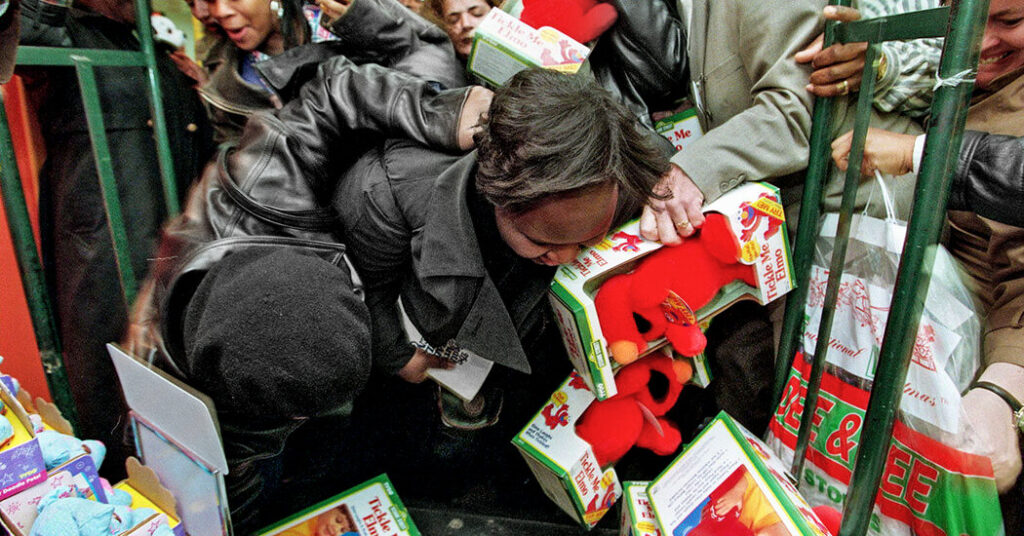
It was just a simple toy: Tickle Me Elmo, a plush doll that giggled when it was squeezed.
What it sparked, though, was far less innocent, a frenzy that spilled into chaos as people clawed and shoved one another in a desperate attempt to get their hands on the coveted item.
During the 1996 holiday season, Tickle Me Elmo became one of the most striking examples of consumerism gone wild.
We were inspired to look back at the hysteria after the death, on May 1, of Greg Hyman, a toy inventor who created Tickle Me Elmo with Ron Dubren.
The concept kept evolving and Tyco decided to try it on a different character. With his childlike voice and disarming sweetness, Elmo became an ideal vessel for a toy built around emotional response.
Perhaps too ideal.
Demand overwhelmed supply almost immediately. Stores sold out. Lines formed overnight. In some places, the scramble got out of control, with customers pushing, shouting, even stampeding through already-stripped aisles. The police were called to manage crowds.
The press had a name for it: Elmo-Mania.
Elmo arrived at a moment of economic optimism. But that abundance only raised the stakes. Toys were no longer merely purchases; they had become a symbol of parental devotion and social status.
Tickle Me Elmo didn’t create the ugly side of American consumer culture. It revealed it, in a preview of every sneaker drop, PlayStation launch and Taylor Swift ticket rush to come.
Then Christmas was over, and so was the adrenaline of the hunt. Now there was just Elmo in the living room. Laughing. Again and again.
Soon, all people wanted was for it to stop. In late 1996, a radio station in Washington, D.C., auctioned off the opportunity to flatten Tickle Me Elmo under a steamroller. The winner paid $800.
In the years since, the doll has been a recurring object of mock violence and parody. In 2006, a “Mad TV” commercial featured Emo Elmo from Depress-a-me Street. “South Park” introduced a Stop Touching Me Elmo in 2013. In 2017, the Canada Science and Technology Museum stripped an Elmo doll of its fur in a video that went viral.
And in 2024, another viral video showed the doll connected to a high-voltage battery, the power turned up until poor Elmo’s laugh sounded more like a scream.
Amisha Padnani is an obituaries editor and the creator of Overlooked, a series that tells the stories of remarkable people whose deaths were not originally reported by The Times.
The post Tickle Me Elmo and the Frenzy That Consumed America appeared first on New York Times.