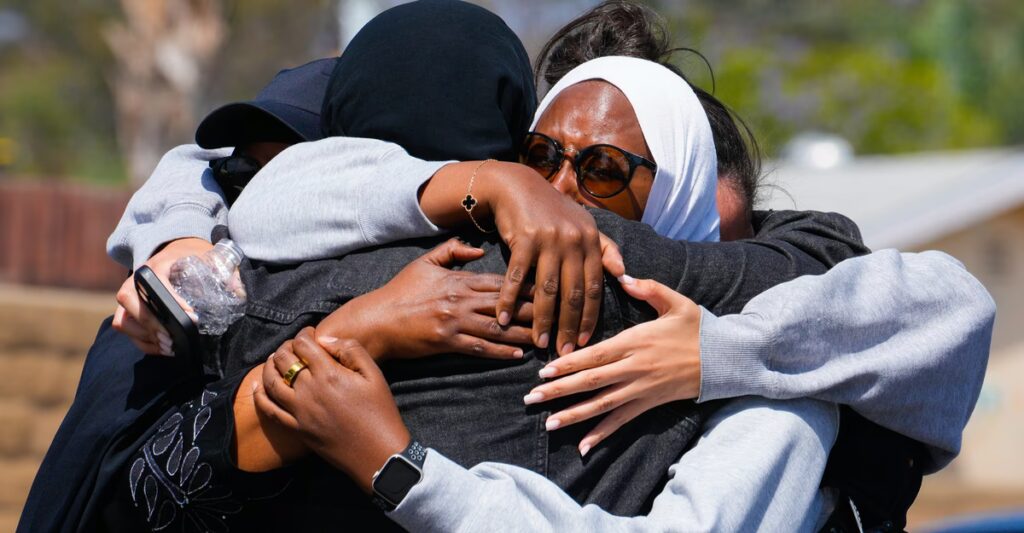
Yesterday in California, the physical world and the world of free-floating grievance and ideological bluster met once again, when two teenagers attacked the Islamic Center of San Diego, killing a security guard and two others, before taking their own lives. The attack is being investigated as a hate crime; according to police, the words hate speech had been scrawled on one of the weapons, and a suicide note left by one of the attackers contained discussions of racial pride.
The incident exemplifies an all too common form of terrorism: attacks by people who have easy access to weapons and a desire to use violence to make a statement. Some of these attacks come from the left, or from people with inscrutable worldviews. In recent years far-right extremism has proved more frequent and more deadly than the left-wing version. The killings in San Diego took place amid a documented increase in anti-Muslim incidents in the United States since October 7, 2023.
[Read: The Trump counterterrorism strategy makes America more vulnerable]
This reality is not reflected in the latest version of the United States Counterterrorism Strategy, which the Trump administration released earlier this month. The report, periodically updated, is meant to inform the American public about the current nature of the terrorist threats facing the country and to advise state and local officials about how to plan and train. This year’s document makes no mention of right-wing extremism or of victims who are targeted because they are not white Christians. Once a serious document written by serious people, the counterterrorism strategy has been hijacked by the Trump appointeeSebastian Gorka, who used the document to assert that the greatest challenges to the American homeland come from Islamist terrorists, drug cartels, and left-wing extremists. Each is a threat, of course, but the report is striking for overlooking the violence perpetuated by those on the ideological right.
Upon its release, the strategy was criticized for its slipshod quality and lack of strategy recommendations. It might have been quickly forgotten but for the tragic reality check in San Diego.
Many communities in America are far better attuned than Gorka and his colleagues are to the homegrown radicalization that surrounds us. Synagogues have been forced to ramp up their own security due to violence from the left and the right; major mosques must take greater precautions as well. The Islamic Center’s guard, identified by community members as Amin Abdullah, was killed trying to protect the facility, which includes a school. He is reportedly the father of eight children. Pictures from the scene show children being escorted out in the familiar pattern of post mass shooting evacuations, in a single line, hand to shoulder, to be reunited with family members far from the scene. The police response was described as fast and efficient after the first calls from the Islamic Center.
[Jake Tapper: Trump’s purge of terrorism prosecutors]
But those weren’t the first notifications that police received. In a press briefing, the authorities said that two hours before the shooting, the mother of Cain Clark, called police. She described her 17-year-old son as suicidal, and reported that he and a friend had gone out dressed in camouflage and in possession of three guns and her car. A hate-filled note left behind didn’t target the Islamic Center but, according to San Diego Police Chief Scott Wahl, covered a “wide gamut” of “general hate speech.” The mother understood the reality of what could occur and perhaps, the danger of the ideologies that motivated her son.
Americans are gaining too much experience with this kind of violence. We deserve a counterterrorism strategy that responds thoughtfully to trends that endanger not only religious minorities but the country as a whole. “Houses of worship must always be sanctuaries of peace, safety, and prayer,” Bishop Michael Pham of the San Diego Roman Catholic Diocese said in the wake of the local tragedy. “An attack on one faith community is an attack on the sacred dignity of all human life.” This is America’s shared reality, even if it isn’t shared by the White House.
The post San Diego’s Tragic Lesson About Terrorism appeared first on The Atlantic.