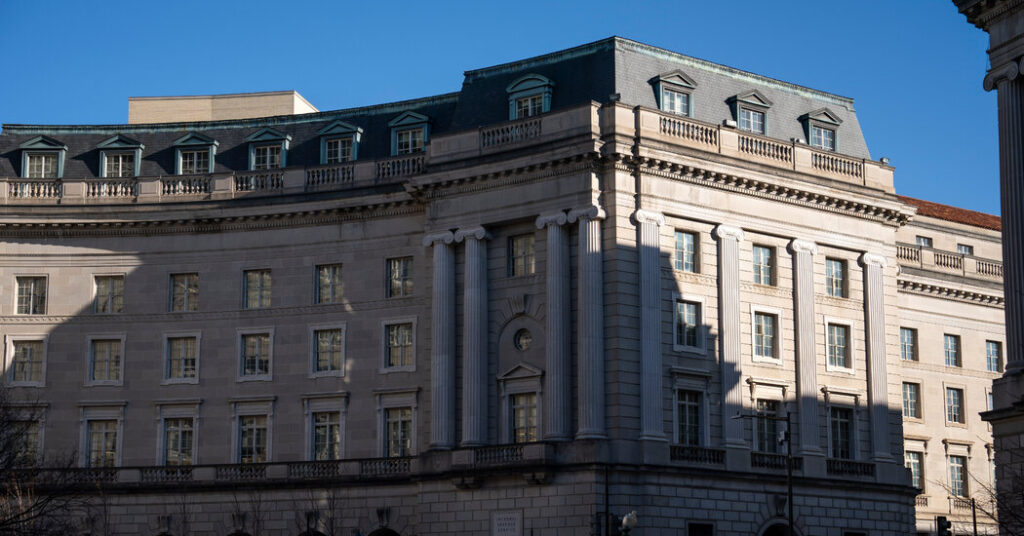
The Trump administration announced on Monday the creation of a $1.8 billion fund to compensate those who claim they were targeted by the Biden Justice Department and Democrats, forging a pipeline to funnel taxpayer money to President Trump’s allies.
The highly unusual “anti-weaponization” fund was denounced by critics as a slush fund and as a brazen misuse of a once-independent Justice Department to carry out the president’s personal and political agendas.
The announcement provided few details of how the disbursement would work or who would be eligible. But the arrangement raised the possibility that American taxpayers might end up writing checks to those prosecuted for the attack on the Capitol by a pro-Trump mob on Jan. 6, 2021, and others the president has cast as victims of Biden administration actions.
“This is one of the single most corrupt acts in American history,” said Donald K. Sherman, president of Citizens for Responsibility and Ethics in Washington, a nonprofit legal watchdog group that has been critical of the administration.
The fund was announced shortly after Mr. Trump withdrew his lawsuit against the Internal Revenue Service demanding at least $10 billion in damages for the unauthorized disclosure of his tax information.
In addition to withdrawing his suit against the I.R.S., Mr. Trump will also drop separate administrative claims. Those include his demand that the government pay him $230 million for investigations into his 2016 campaign’s potential ties to Russia and into his handling of classified documents after he left office.
Administration officials said Mr. Trump, two of his sons and his family business, who sued the I.R.S. together, would receive an apology but would not be paid out of the new fund.
“The machinery of government should never be weaponized against any American, and it is this department’s intention to make right the wrongs that were previously done while ensuring this never happens again,” Todd Blanche, the acting attorney general, said in a statement. Mr. Blanche, who as Mr. Trump’s personal lawyer defended him during multiple prosecutions, added that the department sought to “make right the wrongs that were previously done while ensuring this never happens again.”
The cash value of the fund was set at $1.776 billion, an apparent nod to the nation’s founding. The Justice Department added in its announcement that its creation was intended “to provide a systematic process to hear and redress claims of others who suffered weaponization and lawfare.” The Justice Department has the legal authority to pay claims using taxpayer money.
It is not clear whether any individuals or groups will have standing to challenge the arrangement in court.
Mr. Trump and the department’s leadership have repeatedly accused Democrats of weaponizing federal law enforcement against their enemies. They have yet to provide evidence of illegality, or political animus, in the two federal prosecutions of Mr. Trump or in investigations into his allies.
The president revisited those claims in a news conference on Monday, saying that the likely beneficiaries had “gone bankrupt, their lives have been destroyed and they turned out to be right.”
Mr. Trump, insisting that he knew “very little” about the fund, declined to say whether people who had committed violence against Capitol Police officers could be paid from the fund, saying a committee would decide. “These were people that were weaponized and really treated brutally by a system that was so corrupt, with corrupt people running it,” he added, saying the fund would be used to cover their legal fees “and other things they had to suffer.”
Mr. Trump’s decision to drop his suit against the I.R.S. appeared to be intended to strip Judge Kathleen M. Williams, who had been overseeing the I.R.S. case in the Southern District of Florida, of her appointed role in approving a formal settlement agreement. By dismissing the case in its entirety, Mr. Trump was able to reach an agreement with his own appointees without risking the rebuke of an impartial and independent arbiter. Judge Williams, tacitly acknowledging her hands were tied, accepted the president’s dismissal of the suit and formally closed the case by the end of the day.
A memo signed by Mr. Blanche, just over one page in length, offered only the vaguest outline of how the fund would operate. It did not define “weaponization,” specify the process by which claims would be assessed or even enumerate the actual amount of money that would be distributed.
The amount specified in the department’s news release — with its symbolic value — “does not represent the value of any claim by plaintiffs, but rather is based on the projected valuation of future claimants’ claims,” Mr. Blanche wrote in his memo.
Money for the fund will come from a special, unlimited account available to the Justice Department for settling lawsuits. That pool of money gives the department the authority to make monetary settlements without needing approval from Congress. A group of five people, selected by Mr. Blanche, will oversee the operations of the fund, though Mr. Trump can fire its members at will. It will stop processing claims on Dec. 15, 2028, weeks before Mr. Trump leaves office.
Creation of the fund, which could be used to compensate Trump supporters who ransacked the Capitol on Jan. 6, 2021, is sure to please a president who has demanded not only retribution but recompense. But it could create major political problems for congressional Republicans already dealing with the political ballast of his unpopularity — and who will now be forced to say if they support or oppose allocating taxpayer cash to his allies at a time when many Americans are struggling economically.
Stacey Young, the founder of Justice Connection, a network of former department employees, said the fund fit a larger “pattern of corruption that is eroding D.O.J.’s integrity and Americans’ faith in the rule of law.”
Potential recipients were thrilled.
Mark McCloskey, a St. Louis-based lawyer best known for having brandished an AR-15-style rifle during a racial justice protest outside his home six years ago, had tried for nearly a year to get compensation from the government for about 430 Jan. 6 defendants but repeatedly ran into opposition from Mr. Blanche and others in the Justice Department.
But Mr. McCloskey hailed the announcement of the fund, saying that he would seek money from it for his current clients and that he expected more Jan. 6 rioters to come forward asking for payouts.
“I was somewhat skeptical at first because lots of things get said,” Mr. McCloskey said. “But it looks like this is a done deal. I’m really excited to see what they come up with.”
Judge Williams had been considering dismissing Mr. Trump’s I.R.S. suit on her own because he effectively controls both his personal lawyers bringing the complaint and the government lawyers who are supposed to respond to it. She had ordered the Justice Department, which has yet to make an appearance or filing in the case, and Mr. Trump’s lawyers to brief her by Wednesday to explain whether they were actually in opposition — or were colluding to achieve a mutually agreeable outcome.
In their filing on Monday, Mr. Trump’s lawyers said their dismissal meant that “no judicial analysis is appropriate” for the suit.
The substance of Mr. Trump’s suit stems from the leak of his tax returns to The New York Times in 2019. Mr. Trump, two of his sons and his family business argue that the I.R.S. should have done more to prevent a former contractor from leaking tax information to The Times and ProPublica.
While federal law allows for people to sue the I.R.S. when their tax information is leaked, legal experts saw clear flaws in Mr. Trump’s suit and said the Justice Department had defended other, similar cases brought by plaintiffs who were not the president.
Just minutes after Mr. Trump’s lawyers informed Judge Williams of their intention to dismiss the suit, 93 Democratic lawmakers filed court papers accusing the Justice Department of having “colluded” with Mr. Trump and asking the judge to throw out the case herself.
“Never in the history of the United States has a sitting president sought a monetary settlement from the government he leads — let alone sought many billions of dollars in taxpayer funds,” lawyers for the lawmakers wrote.
The filing by the lawmakers suggested how jarringly Mr. Trump’s move had short-circuited normal court business. The president’s lawyers essentially beat the lawmakers to the draw by dismissing the case on their own, hamstringing the lawmakers’ ability to stop a settlement from going through.
Karoun Demirjian contributed reporting.
Glenn Thrush covers the Department of Justice for The Times and has also written about gun violence, civil rights and conditions in the country’s jails and prisons.
The post Justice Dept. Sets Up $1.8 Billion Fund That Could Funnel Money to Trump Allies appeared first on New York Times.