Mayor Zohran Mamdani has spent months promoting his goal of expanding New York City’s public preschool offerings into a free universal child care system. He has marketed the city’s programs for 3- and 4-year-olds on his social media accounts, on Link NYC sidewalk kiosks and on televisions in yellow cabs to encourage more families to apply for seats.
But despite the media blitz, roughly the same number of New York City parents applied to the preschool programs this year as they did last year, when then-mayor Eric Adams was hardly publicizing them, according to application data shared with The New York Times.
More than 94,400 applications were submitted for seats in the 3-K and pre-K programs this fall, about 400 fewer than last year. The year before that, there were about 103,000 applicants. Pre-K offers were released last week, while those for 3-K will come out on Tuesday.
The flat numbers raise questions about demand for child care in the city and about how the Mamdani administration can bolster its outreach efforts to boost enrollment. The mayor has made expanding child care the central pillar of his affordability agenda.
Enrollment in the city’s preschool programs has leveled off in recent years, most likely driven by several factors, including a decline in births, an increase in the number of families moving out of the city and a decrease in the number of migrants coming into it.
There were about the same number of children eligible to apply for pre-K this year and last year, and about 1,000 fewer children eligible to apply for 3-K this year than last year, a drop that the decline in the number of applicants mirrored, according to city data.
Only about half of eligible families applied to 3-K and 60 percent applied to pre-K in each of the last two years.
After an influx of migrant students during the pandemic, international migration into the city dropped significantly last year, while birthrates and out-migration appear to have steadied, according to census figures and the city’s birthrate data.
The argument that families are clamoring for more free child care — and that providing it can help stem the exodus of families out of New York City — is central to Mr. Mamdani’s reasoning for creating a universal child care system for infants and toddlers.
The mayor has promised to make the 3-K program truly universal in the short term and plans to begin piloting a similar program for 2-year-olds starting in the fall. He hopes to eventually offer seats for children as young as 6 weeks old.
Emmy Liss, who runs the city’s child care office, said she was gratified that tens of thousands of families had applied for preschool seats, but added that the administration had to restore trust in the program in order to see higher enrollment.
Mr. Adams cut funding for pre-K during his mayoralty, and the backlash to his seeming ambivalence toward the popular program helped spark a pro-child care advocacy movement that buoyed Mr. Mamdani’s candidacy.
“We inherited a system that had been, in terms of the outreach apparatus, systemically defunded and dismantled,” Ms. Liss said. “Over time, that really deflated the confidence that families had in the program.”
Ms. Liss said she was eager to see final enrollment data later this summer, which she said would help give the city a better sense of demand.
The data shared with The Times did show a bright spot for Mr. Mamdani’s early efforts to make 3-K more accessible.
For years, parents have lamented that they were offered 3-K spots far away from where they lived or worked. That was especially true for families in relatively well-off parts of the city, where 3-K programs often had wait lists, whereas seats sat empty in some poorer neighborhoods. Overall, pre-K enrollment has tended to be higher in more affluent neighborhoods.
This year, 70 percent of families got their first choice for a 3-K seat, compared with 65 percent last year. The city has reduced the average distance that families have to travel for a 3-K seat and has shrunk the 3-K wait lists.
City officials also announced this week that they would add about 2,000 new 3-K seats for the fall, doubling their original estimate. And the city is opening a handful of centers that were built years ago and left vacant by the Adams administration.
Implementing universal child care would be by far the most expensive piece of the mayor’s platform; his campaign estimated it would cost $6 billion annually. He has argued that New York State would need to approve a tax increase on wealthy New Yorkers to pay for a long-term expansion of the system.
Gov. Kathy Hochul, who is running for re-election, rejected that tax this year, and instead gave more than $1 billion to help the city expand its pre-K offerings.
But Mr. Mamdani is sure to revive the argument during next year’s budget cycle, especially considering there is no funding plan in place for an expansion after next year.
And when he does, he will have to make the case that a tax increase is necessary because of overwhelming demand for more child care.
“On the one hand, I would have expected that after a robust outreach campaign we would have seen a higher number of applications,” said Grace Rauh, the director of the watchdog group Citizens Union and a child care advocate.
“But I also wonder about the residual lack of trust in government, and in this program, because of the Adams administration,” she added. “We know that some parents weren’t applying to 3-K in high-demand neighborhoods, for example, because they just assumed they wouldn’t get in or wouldn’t get a spot reasonably close by.”
Now that Mr. Mamdani is mayor, he has to contend with a slew of cracks in the city’s roughly decade-old pre-K system that are not his fault, but are his problem.
One of the most glaring issues is figuring out how to get more families to enroll, especially parents who could benefit most from free child care.
When former Mayor Bill de Blasio created the universal pre-K system in 2014, the city built an outreach apparatus to help encourage low-income and Black and Latino families in particular to sign up.
A so-called outreach war room dispatched nearly 40 city employees to churches, playgrounds and parades to try to persuade parents to give the city’s new initiative a chance. Some parents were wary about sending their young children to public pre-K rather than relying on informal child care networks or trusted local private providers.
That effort largely ceased during the Adams administration. But the Mamdani administration deployed about 15 people for outreach and worked with an outreach team that a vendor provided.
The city’s advertising budget for pre-K also dropped during the Adams administration, but rose from just over $700,000 last year to $960,000 this year. The city spent nearly $2 million on pre-K advertising in 2020.
There are a few budding philanthropic efforts that could help the city determine where there is more demand for child care and how to reach families who may not know about their options or who are hesitant to participate. One group, the Robin Hood Foundation, is funding a parent survey to learn more about what kinds of options families want. The mayor is also hoping to raise $20 million in private donations for pre-K, in part to help fund outreach efforts.
But for now, Mr. Mamdani has leaned heavily on his social media accounts, which have been crucial political tools for him, to promote pre-K.
He peppered his millions of followers on Instagram and TikTok with reminders ahead of the application deadline in late February. He filmed a video about the deadline with Representative Alexandria Ocasio-Cortez that was aimed at Spanish-speaking families, which included lots of self-deprecating laughter about his facility with the language.
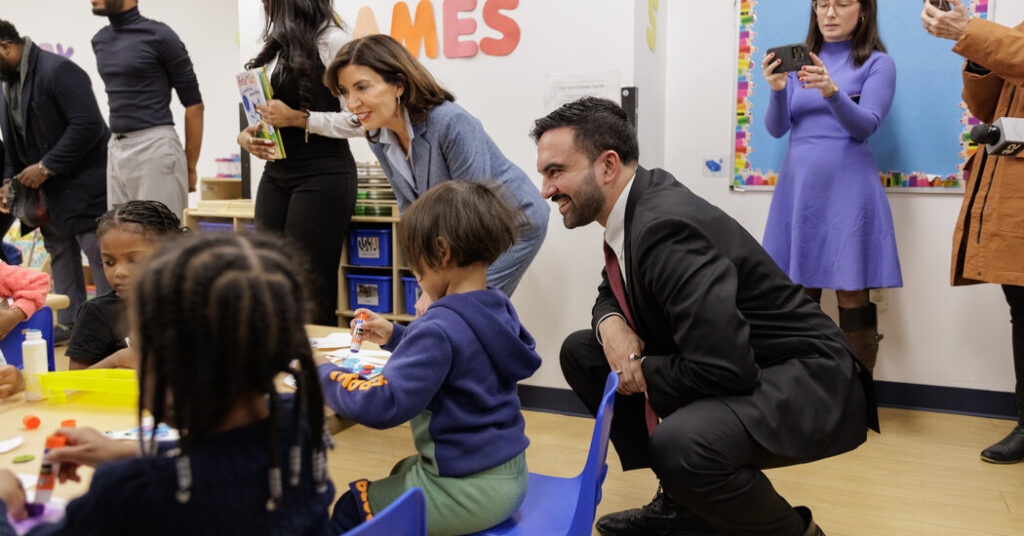
The mayor listed the three ways parents could apply in a separate video filmed in a pre-K classroom, while tucked into a tiny toddler chair. He also reminded families to apply at news conferences held throughout the city.
But it is possible that those messages largely reached families who were already planning to sign up, or that they failed to convince others who were on the fence.
Ms. Liss said that the mayor’s social media could reach many families, but also that the city recognizes “that government is not always the most trusted messenger for families, and that is only more true now given the federal climate.”
That means the city will have to work with community organizations, religious leaders and others to persuade skeptical families to sign up.
Mr. Mamdani is hoping to significantly expand the pool of applicants over the coming years, starting with the thousands of families in five parts of the city whose children are now eligible for the new program for 2-year-olds, which has a separate application process.
He recently recruited Cardi B to judge a competition to come up with the best jingle to advertise the program, known as 2-K. To promote the contest, he turned to a familiar platform: Instagram.
Eliza Shapiro reports on New York City for The Times.
The post Interest in N.Y.C. Pre-K Programs Is Flat, Despite Mamdani’s Outreach appeared first on New York Times.