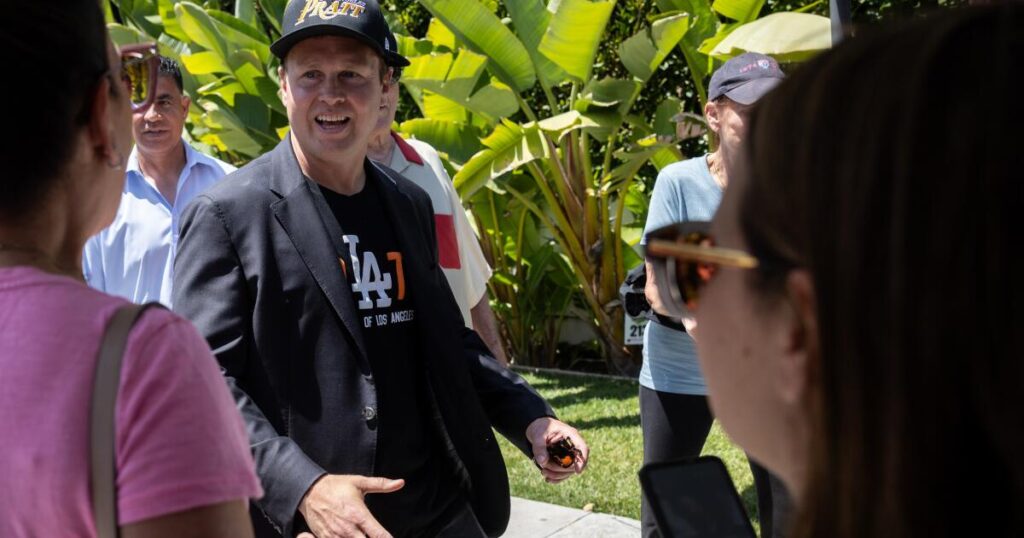
Los Angeles mayoral candidate Spencer Pratt says he wants to get tough.
The reality TV personality contends that the root cause of Los Angeles’ homelessness crisis is drug addiction and mental health and pledged to use the police and other coercive efforts to clean the streets.
“Once you start enforcing the law, things are going to move quick,” Pratt said on Joe Rogan’s podcast. “We’re going around and we’re just arresting people and the people that aren’t getting arrested, we’re getting to mandatory medical treatment.”
“The reality is no matter how many beds you give these people,” he said this month at a mayoral debate. “They are on super meth, they are on fentanyl.”
Such an effort would represent a sharp shift away from the city’s current policy of largely voluntary measures and clash with the vision of Pratt’s two main opponents in the race, incumbent Karen Bass and especially City Councilmember Nithya Raman, who has repeatedly voted against anti-camping zones.
“Making it illegal and arresting people is not the way to solve this problem,” Bass said at the debate on KNBC-TV.
“When they’re offered shelter, they go inside,” Raman said at the same debate.
In public statements, Pratt has broadly characterized his solution to homelessness as enforcement, but has provided little detail on how he would get 27,000 people off the streets in the face of civil rights protections, limited jail capacity, budgetary constraints and lack of city control over already overwhelmed treatment services.
And experts in city law and social services say the policies he has advanced — including mandatory treatment and arrests — face huge legal, financial and practical hurdles.
“There’s only so much a sitting mayor can do,” said Elizabeth Mitchell, an attorney representing a group of mostly business and property owners in a landmark homelessness case against the city.
Pratt has framed his plan in black and white terms, asserting during the debate, “It is illegal to live on the street.”
In fact, Los Angeles had a citywide anti-camping ordinance, but the City Council repealed it in 2021 after a federal appeals court ruled that the constitutional protection against cruel and unusual punishment prohibits the arrest of a person for sleeping on public property if no suitable shelter is available.
“That law was repealed as a failed policy,” said Shayla Myers, an attorney for the Legal Aid Foundation of Los Angeles who has represented homeless litigants in lawsuits challenging city homeless policies. “Unfortunately, tens of thousands of people in Los Angeles have no other option but to sleep outside in public places.”
The revised ordinance known as 41.18 restricts sleeping near schools, day-care centers or other sensitive locations designated by the City Council. In addition, across the entire city, the law bans blocking sidewalks in ways that would impede a wheelchair or within several feet of a driveway or building entrance.
The U.S. Supreme Court later reversed the appeals court ruling in another case, but the City Council has not reinstated the blanket anti-camping law.
Pratt’s campaign did not respond to questions seeking to clarify his positions, including whether he wants to arrest people for the act of sleeping on the streets or only if they are using illegal drugs or committing some other illegal act.
If Pratt wanted to stop camping citywide, he’d need to get the City Council to do so, which could prove difficult given the current membership.
Raman and Bass have said they don’t support arrests as a way to get people off the street. Raman voted against the limited prohibitions in the revised 41.18 and routinely votes no on the creation of new 41.18 zones, earning the ire of some of her colleagues, though she says as mayor she wouldn’t oppose efforts by council members to use the law in their own districts.
Bass said she does support 41.18 as currently enforced.
The Los Angeles Police Department’s enforcement guidelines say officers must first seek voluntarily compliance by educating the person sleeping on the street and asking them to move. If the individual refuses or moves and later returns, officers can issue a citation or make a misdemeanor arrest.
Mitchell, who represents the LA Alliance for Human Rights in the landmark homelessness lawsuit, said a mayor could take some minor steps to increase 41.18 enforcement such as speeding up the placement of anti-camping signs needed to enforce the law in some places.
However, she said that the ordinance does not allow police to use arrests as the first option of enforcement, and that Pratt would need to convince the City Council to change the law if that’s what he wanted to do.
A mayor could work with the police chief to crack down more on public drug use, but that effort would also run into the limits of the criminal justice system.
Simple possession of a controlled substance without a proper prescription, or illegal drugs such as fentanyl and cocaine, typically carries a maximum penalty of one year in county jail, with greater penalties for repeat offenders. In practice, possession of small amounts generally receives much shorter sentences.
“A lot of them are released really early because bed space is taken up by felons awaiting sentencing,” said Mike Webb, a former Redondo Beach city attorney who created a homeless court.
Any effort to increase enforcement — either of 41.18 or drug laws — will also come with the challenge of an understaffed Police Department in a city with budget constraints, Mitchell said. Then there’s the cost to process people through the criminal justice system, including any stints in jail.
“Criminalization and arrests of people being unhoused is the most expensive response to homelessness that you can possibly have,” said Jed Leano, senior policy advisor at Inner City Law Center.
It’s also ineffective and inhumane, he argued, because people arrested will simply end up back on the streets.
Pratt’s candidacy comes as many voters have grown frustrated over the lack of progress in cleaning up the streets despite billions of their dollars being spent to get people into shelters and permanent housing. Since 2023, unsheltered homelessness has fallen by 17.5%, according to the Los Angeles Homeless Services Authority, but nearly 27,000 still remain on the sidewalks, parks, RVs and elsewhere on the street.
A 2025 poll from Politico and the UC Berkeley Citrin Center found 61% of California voters supported or somewhat agreed with arresting homeless individuals if they refused offers of shelter.
Benjamin Henwood, director of USC’s Center for Homelessness, Housing and Health Equity Research, said many in the public believe drug addiction and mental health problems to be the main causes of homelessness, because those issues are highly visible on city streets. But he said research consistently shows that while those issues play a role, the main driver is the high cost of housing.
After all, people struggle with addiction and mental health in lots of cities, but those places don’t have the high rates of homelessness as Los Angeles.
A recent study by the Benioff Homeless and Housing Initiative at UC San Francisco found that about 37% of homeless people were using illicit drugs regularly, and 25% said they had never used drugs, Just over 65% reported having regularly used at some point in their lives, and 27% had started after becoming homeless.
Bass has credited her Inside Safe program, which cleans encampments and moves people into motel rooms, for driving the recent decline in street sleeping. And to improve, she has said she wants to increase social services offered to those in the program and do more to trim costs to provide shelter.
Raman, who has criticized Inside Safe as too expensive, says she wants to deploy street medical teams to help people facing drug addiction and mental health challenges, potentially by partnering with Los Angeles County, which provides such services. She also wants to rely more on temporary rental subsidies to get people into housing cheaper.
Pratt on his campaign website says too much money has been spent on trying to get people inside first and not on addressing drug addiction and mental health. Under his administration, he said, he would require treatment to receive “city-funded assistance” and reserve long-term housing for people who are sober.
In a candidate questionnaire, Pratt told the Southern California News Group that he would redirect money from homeless programs he called ineffective and spend it on mandatory treatment that “address the root causes of street disorder.”
Those ideas face huge hurdles.
For one, homeless dollars are often required by law or regulation to be spent on specific things such as permanent housing or shelter and a mayor can’t change that on their own.
Leano said the mayor also can’t unilaterally mandate people receiving city-funded housing assistance enter treatment. He said doing so was likely illegal even if the City Council agreed to it, because of “housing first” policies codified in state law.
Treatment services are also run by the county and not the city. And pretrial and posttrial diversion programs — where someone undergoes treatment in lieu of incarceration — would also need the cooperation of the court system, which the mayor does not control.
Webb, the former Redondo Beach city attorney, said the L.A. mayor could implement such a diversion program but only in concert with the city attorney, and then its success would depend on providing services.
“If he is successful as mayor and tries to obtain greater resources for mental health, it could work and it could be a good thing,” Webb said.
Another avenue Pratt put forward in an interview posted on YouTube is using the expanded definition of gravely disabled in a law championed and signed into law by Gov. Gavin Newsom in 2023. The amendment to the state conservatorship law adds substance use and inability to provide medical care as the basis for placing a person under the mandatory care of a relative or public guardian.
“If you can’t manage your own mental state, you can come in and have a hold, a psych hold for 72 hours, and if it seems like this person needs real treatment, it can go to 45 days and then it can go up to a year conservatorship,” Pratt said.
But longer holds require a psychiatrist’s recommendation and court order. And because step-down facilities for longer holds are in short supply, patients often remain in expensive emergency rooms for longer periods or are merely released.
The vast majority don’t go beyond the 72-hour hold, said Dr. Gary Tsai, director of the county bureau of Substance Abuse Prevention and Control.
“The likelihood that someone would go through that entire process all the way up to yearlong conservatorship, it’s low,” Tsai said.
Notwithstanding the legal complexities and dearth of resources to implement his proposals, Pratt has alluded to a blanket workaround: a local version of the Trump administration’s call for self-deportation of illegal immigrants.
“Once you start enforcing the law, first off, people who want to do drugs, live on the street, they will leave L.A,” he said in the YouTube video. “They’ll see, ‘Oh, this mayor’s not playing around. We need to go somewhere else.’ ”
Staff writer James Queally contributed to this report.
The post Forced treatment and jail: Spencer Pratt’s pledges to end homelessness stir up mayor’s race appeared first on Los Angeles Times.