When students invited a self-described “white advocate” to a Maryland campus last month, it opened a rift among college Republicans in the state.
The state’s college Republican group welcomed the speaker, Jared Taylor, to Salisbury University, where he warned that white people face extinction.
College Republicans elsewhere were appalled.
Blake Ruszala, the finance chair for the University of Maryland’s college Republicans chapter, said his organization was damaged by the association with Mr. Taylor.
“It’s going to hurt all of us,” Mr. Ruszala said. “We’ve lost people wanting to affiliate with us.”
The conflict in Maryland is the latest in a debate that has been dividing college Republicans everywhere: whether to avoid or embrace the far right.
Groups at several campuses across the country, including Harvard, Georgetown, the University of Illinois, and the University of Florida, have been tied to racist speakers, rhetoric or social media postings. The nation’s fastest-growing college Republican group, the College Republicans of America, recently named a political director, Kai Schwemmer, who is known for his past ties to the white nationalist Nick Fuentes.
Riley McArdle, chairman of the College Republican Federation of Alabama, said his group had been considering affiliating with the College Republicans of America but had been unsettled by Mr. Schwemmer’s appointment.
“What I have seen on him has been pretty alarming,” said Mr. McArdle, a senior at the University of Alabama. “I don’t want to go total Groyper, which is what the Nick Fuentes followers call themselves.”
As midterms approach, the conflicts have become more intense, and also more worrisome for some Republicans. Mr. McArdle is concerned that disagreements among college Republicans nationally will weaken their effectiveness in advancing the party in a year when getting out the vote of young people, particularly men, is essential to success.
The College Republican National Committee was once a cohesive national organization with headquarters on Washington’s K Street, known as the center of the nation’s lobbying industry. It had more than 250,000 student members and spawned dozens of political stars. Among its alumni were Rick Santorum, the former senator from Pennsylvania; Paul D. Ryan, the former House speaker; and Bobby Jindal, the former governor of Louisiana.
The committee was also a party asset, a fund-raising powerhouse known for its enthusiastic get-out-the-vote efforts and campaign door-knocking.
The C.R.N.C. still exists, but around 2019, it began unraveling amid leadership struggles, claims of financial misconduct and division over support for the Trump presidency.
By 2023, at least three national college Republican groups were competing for dominance on U.S. campuses, including the College Republicans of America, regarded as the most MAGA of the organizations.
In a news release last year, the College Republicans of America declared that its membership had eclipsed the other two groups, with 280 campus chapters, including 62 new campuses in nine states.The group, which in 2023 had been the first to endorse President Trump, sought formal recognition from the Republican National Committee as the official college Republican group. No recognition has been forthcoming, and a party spokeswoman, Kiersten Pels, declined to comment for this article.
There have been stirrings of concern among others in the party.
In Maryland, Shannon Wright, a candidate for governor, objected to the invitation of the white nationalist to a state campus. “This is not representative of the Republican Party,” she said.
Others criticism has been indirect. In February, the California Republican Party circulated a memo internally urging vigilance against a divisive movement working to take over the party from within, although it did not mention the college groups.
The memo, which was leaked to the media, characterized the movement as white nationalist, critical of MAGA and President Trump, opposing the civil rights of women, gays and racial minorities and promoting the idea that America should be “reorganized around an ethnically and culturally identity-based order, modeled closely after Nazi Germany.”
Its self-proclaimed leader, the memo said, was Mr. Fuentes, and his followers, primarily young men, had already taken over some party positions.
The College Republicans of America said it chose Mr. Schwemmer, a student at Brigham Young University, for his effective political organizing skills, adding that he has moderated his tone since he returned from a two-year mission trip for the Church of Jesus Christ of Latter-day Saints.
“Kai hasn’t said anything off the rocker since he got back from the mission,” said Martin Bertao, a student at the University of California, Berkeley, who heads the College Republicans of America.
Mr. Bertao said his group “disavows overall bigotry, racism and antisemitism” and is not aligned with Mr. Fuentes’s movement. As for the Maryland event featuring Mr. Taylor, he said, his organization had asked that it not carry branding connecting it to the College Republicans of America.
“C.R.A. did not endorse the event,” he said, adding that the national group does not control the activities of local chapters.
In a telephone interview, Mr. Schwemmer declined to discuss his current relationship with Mr. Fuentes. But he said he condemned “all forms of hatred, including antisemitism” and that comments he had made as a teenager should not be taken to reflect his present-day views.
Mr. Schwemmer’s appointment, announced in March, prompted a public outcry on social media from Jonathan Greenblatt, chief executive of the Anti-Defamation League, who called on Republican leaders across the country to “speak out” against the decision.
No such disavowal has materialized, even as division seems to grow. One public rift happened on the campus of the University of Florida in Gainesville earlier this year when a photo was released revealing a student gesturing in a Nazi-style salute.
Before that, according to documents the state college Republican organization submitted to the University of Florida’s administration, college Republicans had hosted a panel discussion that concerned some campus conservatives.
Billed as a tribute to Charlie Kirk, the event featured Elijah Schaffer, the right-wing founder of RiftTV, a conservative media platform. Other members of the panel included a Jan. 6 rioter who had been pardoned.
Mr. Schaffer introduced himself by saying that he had been labeled “a neo-Nazi and a racist,” but he added, “I’m not that cool yet,” according to a tape of the event.
At another point, he said, “We are tired of having our country occupied by a foreign nation running our politics, our geopolitics. We are tired of that,” Mr. Schaffer said.
Panelists poked fun at citizens of largely Jewish Florida communities and used the term “j-pilling,” a slang term for skepticism of Jewish influence. Attendees complained that the event veered from antisemitic to misogynistic, with Mr. Schaffer quipping, “Most girls don’t need to be doing algebra, right?”
A Spanish professor who attended the presentation, Crystal Marull, objected. “I am just so saddened by the antisemitism I hear coming from you,” she said during a question-and-answer session.
The state’s college Republican organization submitted a complaint to the university about the campus chapter. It included a screenshot, supposedly of a group presentation calling for a “Christian government,” along with the picture, ostensibly of a member delivering a Nazi salute.
Mr. Bertao denied that the student was a member of the University of Florida college Republicans group.
University officials moved to deactivate the chapter. The campus Republican group then filed a lawsuit, on First Amendment grounds, accusing the school of discriminating against it for its viewpoints. The group has also claimed it was not a member of the Florida umbrella organization that moved to eject it, the Florida Federation of College Republicans.
After the state split, the national group, the College Republicans of America, gushed on Instagram: “College Republicans of America is proud to welcome the University of Florida CRs @ufcollegerepublicans to our movement!
A year later, the growing coalition looks shakier.
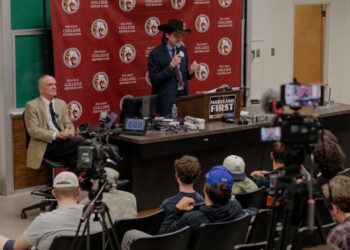
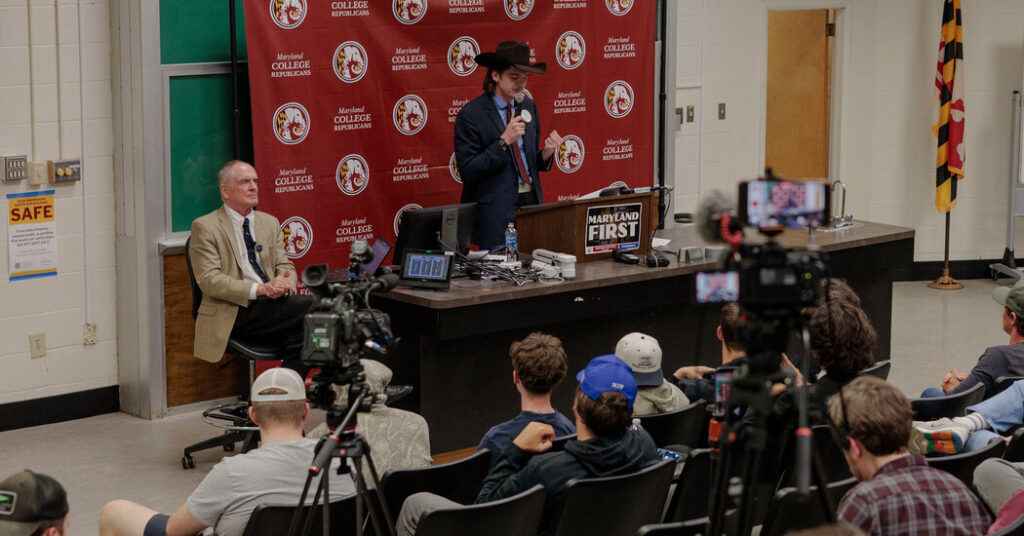
Maryland was one of the nine states whose college Republicans joined the C.R.A. last year. Even as some members at other campuses in the state objected, the Maryland College Republicans invited Mr. Taylor to Salisbury University, a public school in the state’s eastern shore region, in April. The university had denounced Mr. Taylor’s viewpoints as “extremist” but said it had no choice but to let the event proceed on First Amendment grounds.
The head of Maryland College Republicans, Colin McEvers, a Salisbury student, introduced Mr. Taylor as someone who might have the key to “save our country, to keep it from becoming a non-English-speaking hellscape where white people are spit at, despised and persecuted.”
Under heavy security, Mr. Taylor spoke to the mostly male audience of fewer than 100 people. A group of several dozen protesters had gathered outside.
“Our habitat is diminishing as more and more nonwhites push into white society,” Mr. Taylor said, even as some in the audience quietly walked out to the waiting protesters.
“We’re simply just here to say that this is wrong,” said Jacob Griffin, a Salisbury student who helped organize the protest.
Stephanie Saul reports on colleges and universities, with a recent focus on the dramatic changes in college admissions and the debate around diversity, equity and inclusion in higher education.
The post College Republicans Split Over Whether to Embrace the Far Right appeared first on New York Times.