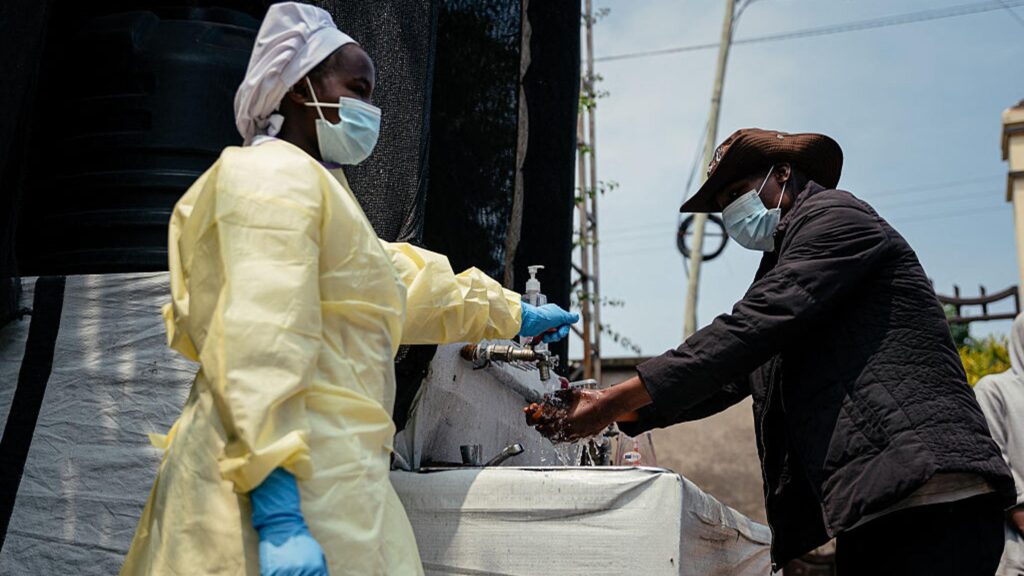
There are at least two major viral outbreaks underway in the world right now: the Andes hantavirus outbreak that began on a cruise ship and now involves people from more than 20 countries, and the Ebola Bundibugyo outbreak in Democratic Republic of Congo (DRC), which was only very recently announced but which has already killed 131 people and crossed at least one border. No vaccines exist yet for either of these rare strains of already rare diseases.
The world is underprepared for threats that are already here, global-health experts argue. Will we be ready for whatever comes next?
This is the type of question that consumes the Coalition for Epidemic Preparedness Innovations (CEPI), a group of world governments, pharmaceutical companies, and foundations, which hosted a gathering at the 79th session of the World Health Organization’s World Health Assembly in Geneva on May 19. “We now have the chance, and I would say the responsibility, to change what happens next,” said Jane Halton, CEPI’s chair, at the session. “My call to everyone here today—to all of your organizations, all of your governments—is simple but urgent. The threats are out there. So let’s secure the future together. Let’s build a world where the next viral outbreak to pose a pandemic threat meets systems that are ready.”
CEPI was founded in 2017. Back then, a multi-year outbreak of Ebola had just killed more than 10,000 people. And while billions of dollars in global damages were incurred, alongside untold human suffering, an extremely effective vaccine proceeded slowly through tests. By the time it was finally manufactured and deployed, the outbreak had been raging for a year, ruining lives and economies. CEPI was founded to try to prevent such tragedies in the future, by preparing for outbreaks long before they start.
The “100 days” mission
In 2021, CEPI launched the 100 days mission, a goal to build the infrastructure to deliver vaccines against a novel pathogen within 100 days of its genome being sequenced. Moving at record speed, the world took 326 days to develop and launch effective vaccines against COVID-19, said Aurélia Nguyen, CEPI’s deputy CEO. But it wasn’t fast enough to prevent the virus spreading worldwide and causing serious pain and hardship. Developing a vaccine within 100 days of SARS-CoV-2’s arrival, for example, would have saved more than 8 million lives, CEPI calculates.
The strategy starts with building up knowledge of the pathogen families deemed most likely to fuel dangerous outbreaks, which include Ebola viruses. It also involves stress-testing vaccine development, including adapting the mRNA systems used for many COVID shots but also more traditional approaches, like using dead viruses to educate the immune system about a threat. It requires having vaccine factories already up and running before emergencies occur. In 2025, Moderna, a CEPI partner, opened an mRNA vaccine manufacturing facility in Oxfordshire, in England. It will make respiratory virus vaccines for the U.K. But it will also stand ready to be deployed if needed in a future pandemic.
The idea is that when Disease X, as this mystery pathogen is known, explodes onto the scene, all the modular pieces of a vaccine will be available, with factories standing by to make them. All that will be needed is the pathogen itself, and the decision of which portion of its anatomy will be the best target for the vaccine.
For that, CEPI says it needs 2.5 billion dollars. “That’s not an abstract number. It is the investment our coalition needs to push forward with partnerships and investments, and that is for the whole world,” Halton said. “This will help us build the capabilities to protect lives and economies in every society.”
During the meeting, the minister for health of Singapore, Ong Ye Kung, announced that his government was committing $12 million over the next four years to CEPI. Dr. Florika Fink‑Hooijer, head of the European Commission’s Directorate‑General for Health Emergency Preparedness and Response Authority, revealed that the E.U. would be committing nearly 74 million Euros over the next 2 years. “Even for us, it’s a big sum,” she said. Dr. Chris Elias, the president of global development at the Gates Foundation, stated that the organization would continue to support CEPI financially. (No representatives of the U.S. government spoke at the meeting.)
As large as those numbers are, they are just a small portion of what will be needed. Halton referred to the commitments as investments, and the governments as investors, marking a shift in the language increasingly used in public-health circles. “You notice I did not use the word ‘donor’—I have a swear jar for the word ‘donor,’” she said. “Everyone is investing in this collective security, every political leader in this room.”
Learning the lessons of COVID
The hantavirus and Ebola outbreaks are on everybody’s mind these days, including the global-health leaders at the CEPI meeting. The deputy head of Africa CDC, Dr. Raji Tajudeen, noted that the organization’s head was no longer at the meeting in Geneva. “He headed back to DRC yesterday to support the effort to bring that outbreak under control,” he said.
While neither of these two viruses share the features that made SARS-CoV-2 such a potent pandemic virus, the collective response to the outbreaks so far reveals that we still remember what it felt like, in 2020, when it became clear that COVID would change everything. “COVID-19 showed the world the devastating cost of being unprepared,” Halton said.
The post Behind the Mission to Stop Viral Outbreaks Within 100 Days appeared first on TIME.