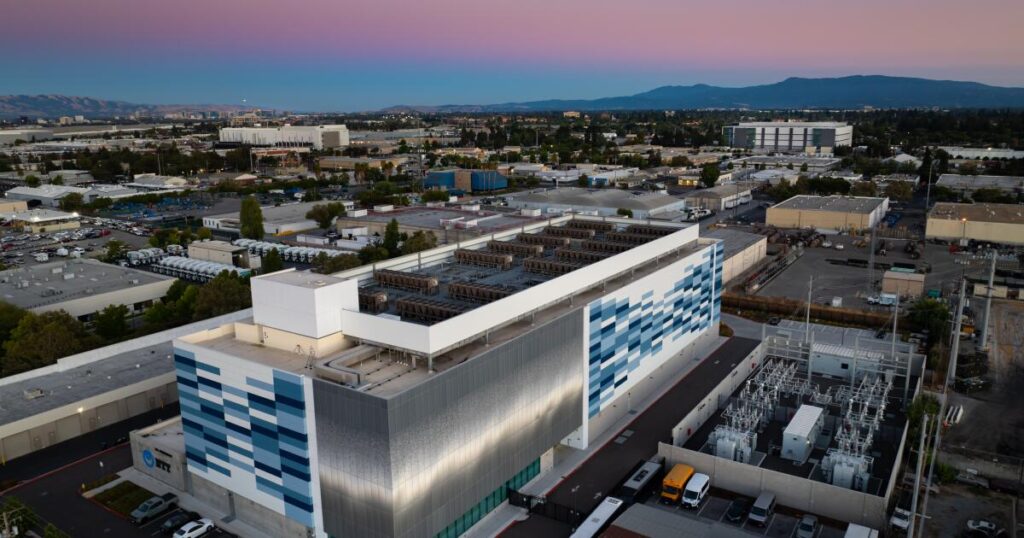
Those big data centers being built for artificial intelligence firms are in bad odor nationwide.
Seven in 10 Americans oppose projects in their local communities, according to a recent Gallup poll. More than a dozen, valued at some $64 billion, have been blocked or delayed by local opposition in recent years.
But what happens when the people directly affected by these project plans don’t get a vote?
That’s the quandary faced by 49,000 residents living on the California side of Lake Tahoe, mostly in the city of South Lake Tahoe. The surge in construction of data centers in Nevada is prompting the Nevada utility that supplies 75% of the Californians’ electricity to cut them off next year.
The California-regulated utility that carries the electricity over the state line to their homes and businesses has assured them that it will find alternative sources to protect them from losing service — but hasn’t promised that their rates won’t increase because of the transition.
“It’s like we don’t exist,” Danielle Hughes, the head of a local energy nonprofit and an advocate for the customers, told me. The crisis facing those residents is just the latest in a long line of indignities they have suffered thanks to several unique characteristics of their energy market, Hughes says.
For one thing, they are permanent residents of the community — teachers, firefighters, police, and service workers at the hotels, restaurants and resorts that bring in a tidal wave of visitors every winter. The latter, as well as vacation-home owners and renters, generate seasonal electricity demands that drive up power costs year-round.
That means that the permanent residents are in effect subsizing the visitors, even though they’re lower-income ratepayers than the generally well-heeled vacationers.
Before delving deeper into the issues for the permanent residents, let’s examine the effect of the large-scale data centers being built and proposed in Nevada, and more generally coast to coast.
Nevada has emerged as a prime location for data centers, in part due to the wide open, undeveloped acreage available for construction. More than 60 data centers have sprung up around Reno and Las Vegas, with many more slated to rise in the northern part of the state, according to a survey by the Desert Research Institute, a Nevada nonprofit.
“We’re right at the epicenter for global expansion” of data centers, observed Sean McKenna, a co-author of the report.
The existing data centers consumed 22% of Nevada’s electric generating capacity in 2024, DRI calculated. If all those under construction and on the drawing board are completed, that figure would rise to 35% by 2030. NV Energy, the Nevada utility that provides the electricity for the California side of Lake Tahoe, estimates that the electricity demand for just the 12 projects being planned would come to 5,900 megawatts — nearly three times the generating capacity of Hoover Dam.
That construction frenzy is likely to bring some of the same drawbacks that have provoked local communities to militate against data centers — not only pressure on existing electricity capacity, but also a voracious appetite for water due to the cooling needs of the computerized equipment managing the data for AI applications. Residents in the neighborhoods of data centers have also complained of incessant noise coming from their 24/7 operations.
With global warming driving up temperatures in Nevada’s semiarid and desert zones, they add, residents will find themselves in a contest with data center owners for an already inadequate supply of power in the state. DRI warns: “Local utilities and ratepayers in data center cluster regions like Northern Nevada also risk bearing the costs of subsidizing AI and computing services as power grids expand their infrastructure.”
In many communities, the result has been a vigorous and vocal backlash, including in California. They’ve packed town halls, prompted state and local political leaders to legislate limits on their growth or even to ban them.
That brings us back to the situation around Lake Tahoe.
In terms of its electric utility service, the region has long been an outlier. About 25% of its power comes from two solar farms operated by Liberty Utilities, but the rest comes from NV Energy; the reason is that it’s unconnected with the California transmission grid but accessible via a line from Nevada.
As a result, it falls into the cracks among energy regulators. Because it’s not part of the California grid, the California Public Utilities Commission has only limited jurisdiction over its service, although it has the authority to approve its electricity rates. The Nevada Public Utilities Commission doesn’t oversee the customers’ service at all, because they’re not Nevada residents.
The region is also unusual because its peak energy demand comes in the winter; most of the rest of California peaks in the summer, when air conditioners are on full blast.
Hughes and other residents have maintained that because the CPUC hasn’t modeled electricity demand for their small region, they have been paying for infrastructure that doesn’t serve them.
“We’ve been paying for assets in Nevada,” Hughes says, “without it being tracked by the state of California.”
Liberty does charge permanent residents in the Tahoe area about 2% less than the rate for part-time residents, but the discount should be much larger, Hughes says. Liberty didn’t respond to my request for comment.
Earlier this year, NV Energy informed Liberty that it would no longer serve as its wholesale energy provider after mid-May next year, and urged Liberty to make haste to secure an alternate supplier.
Liberty promised its customers in a recent statement that they “will not be left without service” as a result of the change. “This does not mean the power is shutting off,” Eric Schwarzrock, president of Liberty Utilities, said at a South Lake Tahoe City Council meeting last month, according to the news site SFGate. “Energy companies, utilities, large customers change energy supply frequently.”
Liberty and NV Energy both attributed the change to a preexisting agreement that anticipated that NV Energy would eventually cease providing power to Liberty’s customers, although their interpretations of the deal and the impetus for the change appear to be at odds.
The “long-standing agreements and planning assumptions … date back more than a decade,” NV Energy said in a May 14 statement. That was “well before data center growth became a factor,” the utility said. “Data centers did not influence this decision.”
That is, to be charitable, dubious. How do we know? Liberty said so in a March 6 letter to the California Public Utilities Commission, requesting permission to take “immediate action” to find alternative providers.
The letter stated that Liberty had expected its arrangement with NV Energy to “continue indefinitely.” During their last negotiations for an extension of the deal, however, NV Energy informed Liberty that it would cease serving Liberty on May 31, 2027, with a possible extension to Dec. 31.
“This change of stance by NV Energy was a surprise to Liberty,” the letter said. Liberty ascribed NV Energy’s decision to new “market circumstances” in the latter’s home service region. Among them: “A number of entities are seeking to add large loads such as data centers into the area.”
NV Energy says it will continue serving Liberty’s customers until Liberty secures a new supplier, even if it misses the May 2027 deadline; the ultimate deadline is Dec. 31, 2027, when NV Energy expects to complete its 350-mile Greenlink West transmission line between Las Vegas and the Reno area, part of a $4.2-billion infrastructure upgrade.
Yet that still leaves an open question that should make those customers nervous: How much will they be paying for power?
In its recent statement to customers, Liberty made only the vaguest of promises. “While no utiulity can predict the exact future cost of energy,” it said, “affordability is a primary goal” in its search for new suppliers. “With a competitive bidding process, we aim to find a cost-effective solution for your monthly bill.”
But any new supplier would have to come from outside California, because of the region’s lack of any connection with the state’s grid. And generators in nearby states face their own rising demands from data centers, drought and global warming.
The project, backed by investor and CNBC Shark Tank panelist Kevin O’Leary, will consume more energy than the entire state consumes now. Though it will be attached to a planned natural gas generating plant, that plant will itself raise ambient temperatures in its vicinity by 5 degrees during the day and 12 degrees at night, in the reckoning of Utah State University physicist Rob Davies.
The drawbacks of these massive industrial installations are beginning to be felt by their neighbors, including higher electricity prices and dwindling water supplies. They’re only going to get worse.
The post A surge in Nevada data center construction threatens the electricity supply for 49,000 Californians appeared first on Los Angeles Times.