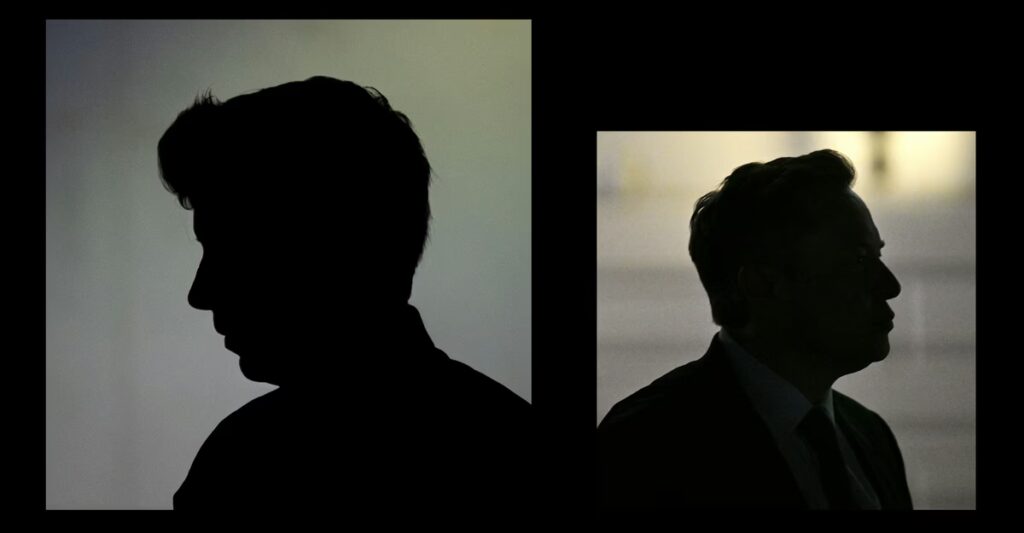
Sam Altman did not seem to be having a good time. During the many days that he spent inside an Oakland courtroom, the normally cheery CEO of OpenAI—a guy who tends to be chipper even when declaring AI’s existential risks to humanity—appeared anxious, even distraught. When he listened to the proceedings in Elon Musk’s lawsuit against him, a weekslong trial that threatened to remove Altman from OpenAI’s board and functionally destroy the company, he frequently concealed his mouth with his palm, fidgeted with a water bottle, and leaned forward and stared at the floor. He kept looking back at the rows of reporters behind him. On the witness stand Tuesday, Altman repeatedly noted how Musk’s actions had “annoyed” him.
Musk, who helped form OpenAI as a non-profit in 2015, alleged that Altman and OpenAI had violated the organization’s founding principles by seeking profits. He was requesting, among other remedies, more than $150 billion in damages, which Musk said he would donate to the OpenAI nonprofit. This morning, a nine-person jury delivered a unanimous verdict after less than two hours of deliberation: Whether or not OpenAI had done something wrong, Musk sued outside the statute of limitations, two to three years depending on the charge. And Musk could have known of any alleged wrongdoing, the jury found, well before. Altman has been granted some respite: OpenAI and the AI industry will continue along, unphased, at least until Musk appeals the decision. (A second portion of the case, related to claims that Musk made under antitrust law, remains unresolved, although the presiding judge has said that his are “not very good claims.” Musk’s lawyers and OpenAI did not immediately respond to a request for comment.)
OpenAI swept the legal argument. But in another sense, basically everybody involved in Musk v. Altman came away looking petty, short-sighted, deceptive, or ignorant. During the dozens of hours I spent in the courtroom, sometimes lining up as early as 5 a.m. to secure a seat, there wasn’t much substance to be found. Frankly, at the end of it all, everyone had good reason to be annoyed.
Musk came off the worst in this trial, by far. The question before the jury was whether OpenAI’s for-profit arm had somehow broken a legal promise the organization made to Musk at the organization’s founding: “It’s not okay to steal a charity,” as Musk told the jury on the first day. This was a farcical notion based on any number of pieces of evidence and testimony presented at trial, not least of which being that in 2017, Musk himself was involved in discussions for OpenAI to raise more money by making a parallel for-profit arm. Coming into the trial, this was already an uphill battle for Musk and his lawyers. But even by those low expectations, the entire affair was a debacle.
As a witness, Musk was impish. When asked simple questions by William Savitt, one of the attorneys representing OpenAI, Musk rambled and avoided the issue at hand. When the lawyers asked for a yes or no, he bristled: “The classic reason why you cannot always answer a yes-or-no question,” Musk said from the witness stand, “is if you ask a question, ‘Have you stopped beating your wife?’” (“We’re not going to go there,” U.S. District Judge Yvonne Gonzalez Rogers interjected.) Later, Musk accused Savitt of asking improper questions, after which Gonzalez Rogers sharply cut in, telling the world’s richest man, “You’re not a lawyer.” Musk conceded but, after a pause, grinned and added, “Well, technically I did take Law 101.”
When Musk answered questions, he argued that OpenAI had sacrificed safe and responsible AI development by prioritizing profits. But when cross-examined about AI safety, Musk was unable to articulate any coherent arguments. Savitt noted that Musk’s xAI, a competitor to OpenAI, is a for-profit company, and asked if xAI presents identical dangers. “Yes,” Musk said, “I think it creates some safety risk.” Savitt then asked about basic AI-safety measures. Musk, who earlier had testified that he wants to avoid an AI “Terminator outcome,” was clueless. Asked about safety cards, for instance, Musk responded, “Safety card? Why would it be a card?” These are years-old, widely used, industry-standard documents that anybody who has worked at an AI company in the past five years should be intimately familiar with.
The following day, in a particularly withering exchange, Savitt went down the list of Musk’s other enterprises. Did he think that Tesla was making the world better? “Yes,” Musk said. And is Tesla a for-profit company? “Yes.” Savitt then asked these two questions about SpaceX, Neuralink, and X. For each of his businesses, Musk responded yes and yes. The same man who has a trillion-dollar compensation package from Tesla and may receive another from SpaceX was suing OpenAI for trying to make a lot of money. I wondered to myself, What are we doing in this courtroom again?
Despite winning in court, Altman didn’t come off all that much better. The first question from Steven Molo, one of Musk’s lawyers, to Altman was “Are you completely trustworthy?” With a puzzled look, the OpenAI CEO responded, “I believe so.” Molo asked if he had misled business partners, and Altman, after a pause, said, “I believe I am an honest and trustworthy business person.”
Altman’s evasive answers were significant because he has a long history of being accused by colleagues and business partners of being deceptive. Ilya Sutskever, a co-founder and former chief scientist of OpenAI, testified that during his time at the company, he had felt that Altman created an “environment where executives don’t have the correct information,” which is not conducive to AI safety. Multiple former OpenAI board members testified to similar effect in explaining why, in late 2023, they briefly fired Altman. (For his part, Altman wrote in a recent blog post that he is “not proud of handling myself badly in a conflict with our previous board that led to a huge mess for the company.”) When the judge excoriated OpenAI’s legal team for making contradictory arguments in separate lawsuits that she is hearing, Musk smiled and nodded. Musk’s legal team essentially hung its case on impugning Altman’s integrity, and Molo told the jury in his closing argument to imagine that they were walking over a bridge: “The bridge is built on Sam Altman’s version of the truth,” he said. “Would you walk across that bridge?”
The many texts, emails, and internal documents released because of the lawsuit, and the sworn testimony of current and former OpenAI executives, were hardly flattering for the firm— depicting a treacherous company culture that has nonetheless made its staff fantastically rich. Sutskever said that his stake in the company is worth some $7 billion, and Greg Brockman, OpenAI’s president and another defendant in the lawsuit, said that his equity is worth some $30 billion. Altman, who previously told the Senate that he has no direct equity in OpenAI, testified that through an investment fund run by the start-up incubator Y Combinator (which Altman used to be president of), he has an indirect financial stake in the firm.
The trial surfaced and produced countless other shenanigans: Musk apparently called an OpenAI employee a “jackass” for wanting to prioritize safety over speed, after which that employee was given a satirical trophy depicting a donkey’s butt. (During his own testimony, Musk denied yelling at someone and said he would have used such a word only in jest.) In a diary entry, Brockman had written that it would be “wrong to steal the nonprofit from” Musk and that doing so would “be pretty morally bankrupt, and he’s really not an idiot.” Sutskever, a Yoda-like figure in the AI world, described AI progress from 2018 to now as “the difference between an ant and a cat.” At the beginning of the trial, the judge had asked Musk to refrain from posting on social media about the trial as it unfolded, and he did show restraint. Immediately after the verdict, though, Musk posted on X: “The ruling by the terrible activist Oakland judge, who simply used the jury as a fig leaf, creates such a terrible precedent.”
To the extent that the trial could have actually been about the best way to develop AI for the benefit of humanity, and about whether OpenAI is honoring its founding pledge to do so—well, it simply wasn’t. For the most part, Musk and Altman—billionaires who are perhaps the two most influential tech CEOs in the world—were in essence asking their attorneys to debate whether making ungodly sums of money was acceptable. In a remarkable exchange during closing arguments, Gonzalez Rogers excoriated one of Musk’s lawyers for misleading the jury: Molo, after attacking the bridge “built on Sam Altman’s version of the truth,” said that Musk is not asking for money from OpenAI. The district judge pointed out that he, in fact, was asking for money. “You need to retract that statement, or you need to drop your claim for billions of dollars,” the judge said. Musk’s lawyers did not drop the demand.
The post The Altman-Musk Trial Was a Waste of Everyone’s Time appeared first on The Atlantic.