In 1971, Richard Nixon announced his plan to visit Beijing—marking a geopolitical turning point, as the trip would be the first for a U.S. president in 25 years. Senate Majority Leader Mike Mansfield offered an observation that has since become a Washington commonplace. “Only a Republican, perhaps only a Nixon,” he told U.S. News & World Report, “could have made this break and gotten away with it.”
This notion entered the political lexicon to denote a particular kind of calculation: that on certain issues, only a hard-liner has the credibility to pursue a softer line and survive politically.
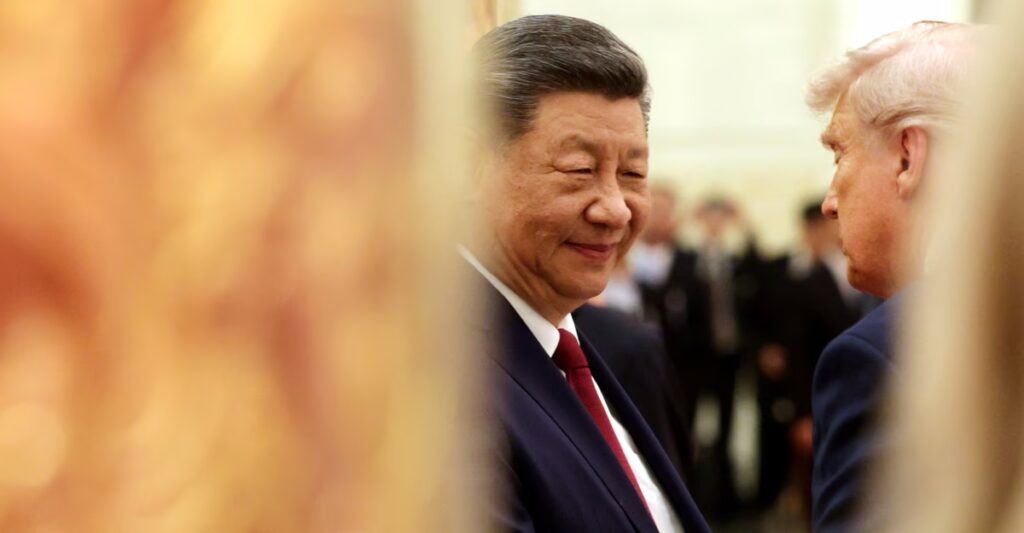
Last week in Beijing, Donald Trump had his Nixon moment. He scrapped a policy that combined hard-headed diplomacy with action to protect U.S. interests and check Chinese power. In its place, he embraced the notion that a personal bond with Chinese leader Xi Jinping can ensure stability.
Trump is getting away with this move politically. Geopolitically, he will not. His new stance imperils Americans and emboldens China, which makes a future crisis likelier than ever.
[Read: A checkers player meets a three-dimensional-chess master]
In recent decades, Republicans and Democrats have largely agreed to treat China as a strategic competitor. The United States has tightened export controls on advanced technology, reduced its economic exposure to China, and thickened its web of alliances across the Indo-Pacific. That shift began during the first Trump administration; the Biden administration intensified it.
Trump has long been a vocal critic of China. He began his second term with a trade war that pushed tariffs on Chinese goods to 145 percent. He reversed course after China retaliated and demonstrated, through its grip on rare-earth processing, that it could inflict real pain in return. Then he began speaking of his great personal relationship with Xi and of the advent of a U.S.-China G-2.
In Beijing last week, he praised Xi in terms he seldom uses for America’s democratic allies: “a great leader,” straight out of “central casting.” Trump took with him an extraordinary delegation of American CEOs, including Apple’s Tim Cook, Tesla’s Elon Musk, and Nvidia’s Jensen Huang, whose company has spent the past year lobbying to keep its most advanced chips flowing to the Chinese market.
China announced that the two countries had agreed to establish a “constructive China-U.S. relationship of strategic stability.” Wang Yi, China’s foreign minister, framed the new concept as one of “respecting each other’s core interests and major concerns.” Beijing is almost certainly suggesting, with this language, that it expects the U.S. to limit its competitive measures. Trump, for his part, announced modest trade deals on aircraft and agriculture.
Were a Democratic president doing any of this, Republican hawks would be unsparing in their criticism. Cowed by Trump, they are largely silent. Trump’s shift raises deceptively simple questions that may define the coming China debate and even reshape American policy: Why are we competing with China at all? What’s wrong with a little peace and quiet?
Some experts see an opportunity to persuade Democrats to soften their position on China. Jessica Chen Weiss, a former Biden State Department official who broke with that administration over what she viewed as excessive hawkishness, used the occasion of the summit to write in the Financial Times that Trump had “created real breathing room in U.S.-China relations,” and to argue for a posture that embraces interdependence and cooperation and abandons strategic competition altogether. Hers will not be the last such argument.
The trouble with this posture is that it fails to account for the Chinese actions that threaten the livelihood and security of the United States and its allies. Consider trade. Beijing uses the full weight of the Chinese state—subsidies, financing, regulatory protection, industrial policy at a scale that no Western country can match—to dominate the high-end industries of the future. It has reduced its imports to make itself less dependent on other states, and increased its exports to gain leverage over them. China’s trade surplus in manufacturing goods is now more than $2 trillion. As Robin Harding of the Financial Times has put it, Beijing is “making trade impossible.” It has effectively given Western countries a choice between deindustrialization and protectionism.
Trump’s tariffs reduced China’s surplus with the United States, but the excess goods simply rerouted to Europe, Southeast Asia, and Latin America, where they are now hollowing out the manufacturing bases of America’s allies. A serious U.S. response would involve coordinating with Europe, Japan, and Korea on common tariffs and pressing Beijing on the underlying imbalance. Trump is doing the opposite. He treats the European Union, which is on the brink of a trade war with China, as a rival rather than a partner, and he has signaled that he sees America’s economic relationship with allies as no more privileged than its relationship with its rivals.
The most striking signal of last week, though, was on cybersecurity. For several years, a Chinese state-affiliated group that U.S. intelligence calls Volt Typhoon has been pre-positioning itself inside the IT networks of American water utilities, transportation systems, electric grids, and the like. Should the U.S. and China come into conflict—say, over Taiwan—Volt Typhoon could unleash destructive attacks on American infrastructure. China has similar capabilities in states allied with the U.S. in the Indo-Pacific.
Asked aboard Air Force One whether he had raised China’s cyber campaign with Xi, Trump offered something close to a shrug. “What they do, we do too,” he said. “We spy like hell on them too. I told him, ‘We do a lot of stuff to you that you don’t know about.’” Pressed on the specific question of pre-positioning for attacks on civilian infrastructure, he allowed: “Well, you don’t know that. I mean, I’d like to see it, but it’s very possible that they do, and we’re doing things to them.”
Espionage—intrusions for the purpose of intelligence collection—is ubiquitous and, within limits, accepted. The pre-positioning of cyber weapons inside the civilian infrastructure of a country with which one is not at war is something else entirely. To conflate the two in public, alongside Xi, is to tell Beijing that one of the most aggressive components of its peacetime posture against the United States carries no political price.
The cyber-penetration also signals a larger problem: China is building the military capability to make a war over Taiwan winnable. John Culver, a former CIA analyst of China’s military, recently told The Washington Post that “it’s hard to point to an area other than submarines and undersea warfare and say the United States still has an advantage,” and that China is leading in “air-to-air missiles, surface-to-air missiles, counter-space capabilities and electronic warfare.”
China’s engagement with U.S. companies has helped it build the industrial and technological base that underwrites these military advances. In his book, Apple in China, the journalist Patrick McGee notes that Apple’s annual investment in China’s technology sector exceeded the Biden administration’s once-in-a-generation investment in domestic chips manufacturing. The high-tech China of today, he writes, would not be what it is without Apple. This “transfer of technology and know-how” was “so consequential as to constitute a geopolitical event, like the fall of the Berlin Wall.” Apple’s CEO was, of course, on the plane to Beijing last week.
China needs advanced U.S. chips to power artificial intelligence. Restricting Beijing’s access to these has been one way for the U.S. to interfere with China’s growing military capability in recent years. But Trump has systematically relaxed those controls over the past year, for example by approving sales of Nvidia’s H200 to several major Chinese tech firms.
With regard to Taiwan, Trump said, rightly, that the United States just seeks to maintain the status quo. But he also needlessly raised doubts about the U.S. commitment to helping Taiwan defend against a Chinese attack, and he seems to have bought into Xi’s narrative that the problem is that Taiwan is seeking independence.
In the past, the U.S. has sought to deter a Chinese assault on Taiwan by strengthening the island’s defenses. Since 1982, the U.S. has made an explicit policy of selling arms to Taiwan without consulting Beijing on the timing or content of the shipments. But last week’s meeting suggested a weakening of this American posture: Trump dismissed America’s long-standing assurances to Taiwan in this regard as something from “a very long time ago” and accused Taiwan of stealing America’s chip industry. He acknowledged that Taiwan had been Xi’s most important issue and said that an American arms package authorized in December and not yet delivered was “a significant bargaining chip” with Beijing.
[Read: The hippocratic summit]
To watch some of the coverage of Trump’s visit to China, or to listen to the administration, one could be forgiven for thinking that he inherited a relationship on the brink of war. He did not. The Biden administration, in which I served, had a strategy of managed competition. That blended close and frank diplomatic contact among senior officials with “competitive actions” to strengthen America’s strategic advantage over China.
Relaxing the competitive policies toward China in favor of warmer leader-to-leader engagement reflects a fundamental misreading of Xi’s intentions. Xi’s preferred strategy toward the United States is exactly the one on offer in Beijing last week: engage Washington to buy a period of stability, then use that time to pursue longer-term objectives in relative comfort. China hopes to emerge with decisive advantages that will allow it to finish its harder business at a moment of its choosing.
Jon Czin, a former CIA analyst of Xi and now my colleague at the Brookings Institution, said in a podcast interview that the key thing to know about the Chinese leader is that “he is not a dealmaker”; nor is he “sentimental about his personal relationships.” He’s “a jack-in-the-box,” Czin said, “who will wind up for years, sometimes for decades, and then pop when he thinks the moment is right, startling everyone around him.”
The Beijing summit was the first of as many as four meetings between the two leaders set to take place this year. Xi is scheduled to visit the United States on September 24, and the leaders may meet again at conferences scheduled for November and December. That frequency gives Trump every incentive to seek to maintain good terms with Xi, even if it means suppressing impulses inside his own administration toward a more competitive approach to China.
Nixon went to China because he understood that relations with Beijing would help the United States in the Cold War against the Soviet Union. Trump went there to abandon the strategy of managed competition and replace it with a leader-to-leader bond. His new posture is one that strengthens America’s top rival, leaves its vulnerabilities unaddressed, and makes a U.S.-China crisis more likely rather than less.
The post Donald Trump’s Nixon Moment That Wasn’t appeared first on The Atlantic.