The only good data center is a canceled data center.
Or so a growing number of Americans seem to feel.
Throughout the United States, citizens are mobilizing against the construction of new data centers in general — and the massive, “hyperscale” ones that fuel artificial intelligence, in particular.
Key takeaways
- Data centers can increase local air pollution, though their emissions vary widely between different contexts. Their impact on local water supplies, meanwhile, has been greatly exaggerated.
- Data centers often drive up an area’s electricity bills.
- But hyperscale campuses can deliver major economic benefits to their host communities, including job growth and tax revenue.
- In some cases, the benefits of data center development almost certainly outweigh the costs.
The past four years have witnessed an unprecedented boom in the construction of such facilities, driven by AI firms’ insatiable thirst for computing power. Between 2022 and 2025, annual spending on the creation of data centers in the United States jumped from $15 billion to over $35 billion, in constant dollars.
And many Americans have had enough.
At the local level, municipalities are nixing data center projects at a historic clip. Over the first three months of this year, plans for at least 20 such facilities have been shelved amid public backlash, according to an analysis by Heatmap Pro. Together, those canceled projects represent $41.7 billion in forgone investment.
In statehouses and Congress, meanwhile, lawmakers are pushing to freeze data center construction outright. Last month, Maine’s state legislature passed a moratorium on new data centers in the state. Gov. Janet Mills ultimately vetoed that legislation, but insisted that she too supported freezing all data center construction in Maine, except for a single, long-planned project in the economically challenged town of Jay.
At least 12 other states are entertaining data center moratoria, while four municipalities have imposed permanent bans. In the Senate, Bernie Sanders has introduced a bill that would pause the construction of AI supercomputing campuses nationwide, until a long list of regulations and social programs are enacted.
This rebellion against data centers is partly motivated by concerns about artificial intelligence. Some progressives, right-wing populists, and tech-wary centrists believe that unfettered AI development poses intolerably high risks — to workers’ economic security, the Earth’s climate, and/or humanity’s survival. From this perspective, the point of blocking new data centers is primarily to throw sand into the gears of AI progress. And if artificial intelligence really is on the cusp of wrecking civilization, then trying to choke off Big Tech’s access to computing power makes some sense.
That said, much of the resistance to data centers is rooted in anxieties about the buildings themselves.
Many Americans have come to think that these industrial complexes offer little to their host communities beyond economic burdens and ecological devastation. Judging by activist rhetoric and viral media accounts, data centers invariably slurp up localities’ water, pollute their air, despoil their landscapes, and poison their residents with “infrasounds” — all while driving up municipalities’ electricity bills and sponging off their tax dollars.
But the truth is more complicated.
If a large data center comes to your town, it could make the local environment slightly worse — and your electric bill somewhat higher. But it could also raise your municipality’s wages, while reducing its property tax rates.
The scale of these costs and benefits vary widely from place to place. Yet in areas with sound environmental regulations, relatively clean and robust electric grids, and progressive tax codes, data centers tend to be a “win-win” for both residents and large tech companies (assuming the latter don’t get the former killed in a robot apocalypse, anyway).
So, how do you decide whether your community should welcome hundreds of acres of computing hardware? Let’s examine the (real and imagined) environmental harms and material upsides point by point — and how the balance between them shifts with local conditions.
Data centers can be dirty
Data centers do come with some environmental costs. But the scale and uniformity of their local impacts are often exaggerated.
The most serious of these harms is air pollution.
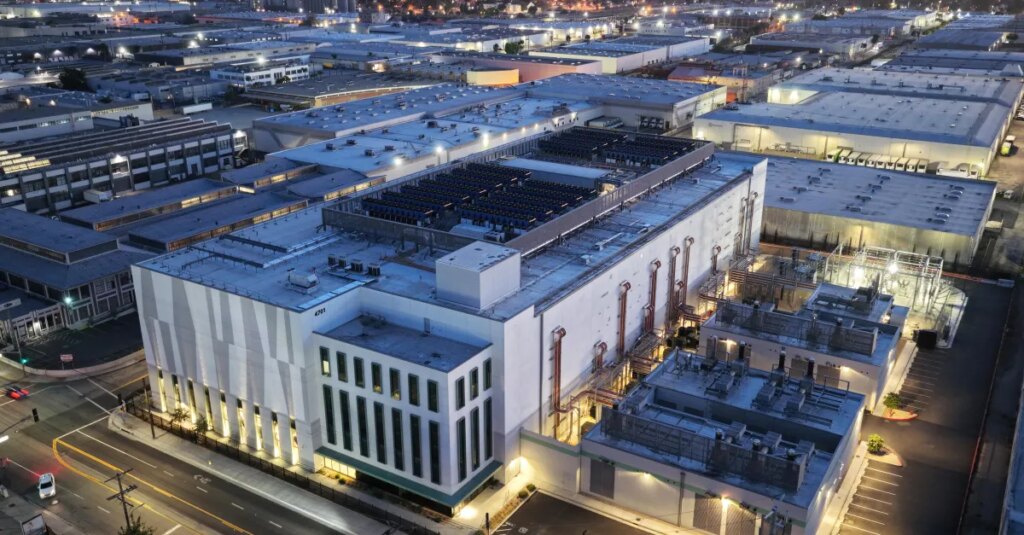
A hyperscale campus can require as much electricity annually as a midsize American city, as such complexes must power tens of thousands of continuously running processors — and then dissipate the consequent heat with industrial-scale cooling systems.
In some places, data centers meet these gargantuan energy demands by spitting a ton of particulates into the sky. For example, xAI’s Colossus campus in Memphis is partly powered by 35 on-site natural gas turbines. All that combustion appears to have dramatically increased the concentration of nitrogen dioxide in nearby air, with peak levels jumping 79 percent since the facility opened in 2024, according to researchers at the University of Tennessee, Knoxville.
Elon Musk’s Tennessee operation is exceptionally dirty. But more typical data centers also tend to increase regional air pollution, at least marginally, by boosting the utilization of an area’s natural gas or coal plants and running backup diesel generators when their energy needs temporarily exceed the grid’s supply.
Nevertheless, in all these cases, the problem arises from the type of energy that a data center uses, not from some inextricable feature of all server farms.
Data centers sited in regions with abundant non-carbon energy sources produce relatively little air pollution, at least by the standards of industrial enterprises. According to Google’s official data, its Oregon cloud computing operations run exclusively on non-carbon energy sources about 87 percent of the time.
Water is less of a problem
On most other fronts, data centers’ environmental costs tend to be overstated.
Server farms do need substantial amounts of water. But this is true of almost all forms of industrial production. And modern data centers are not exceptionally water-intensive operations, in part because they typically use closed-loop cooling systems that recirculate the same pool of H2O repeatedly.
According to the calculations of AI researcher Andy Masley, as of 2023, 0.04 percent of America’s fresh water was being consumed inside data centers. For comparison, the nation’s golf courses churned through 33 times as much H2O that year.
To be sure, data centers don’t need to consume a significant share of the national water supply to burden especially arid regions. Fortunately, parched localities tend to already constrain the amount of local water available for industrial purposes.
Consider Box Elder County, Utah. There, investors are seeking to build a massive hyperscale campus over sagebrush in the state’s hinterlands. This has prompted furious pushback from local residents, driven partly by fears that the facility would deplete the rapidly declining Great Salt Lake. If that body of water continues losing volume, it will release plumes of toxic dust over Utah’s urban core.
In this context, it’s understandable that residents would fear a vast data center soaking up their region’s scarce reserves. And yet, to secure its H2O, the Box Elder project needed to purchase water rights from an existing agricultural user. This transaction did not increase the total amount of industrial water consumption in Utah, but merely transferred a small portion of a fixed pool from one business to another.
Critically, as City Journal’s Shawn Regan notes, that exchange is plausibly net-positive for the Great Salt Lake: When farmers use water to irrigate a field, much of it gets lost to evapotranspiration and never returns back to its source. By contrast, when water courses through a closed-loop data center, it retains far more of its volume, and then gets periodically flushed back into the local watershed. Therefore, shifting water rights from a farm to a data center conceivably reduces long-term depletion.
Finally, when sited too close to residential areas, some data centers generate noise pollution that meaningfully degrades their neighbors’ quality of life. But server farms located in far-flung, industrial zones do not have this problem. And contrary to some viral videos, there is no reason to think that data centers emit subaudible “infrasounds” that damage the health of those in their vicinity.
Data centers create more jobs than you might think
So, data centers come with some real environmental costs, which can be profound in certain circumstances.
It does not follow, however, that server farms are always bad for the localities that host them. An industrial enterprise can benefit a community, even if it imposes some ecological burdens. Or so most people — including most prominent data center skeptics — seem to believe.
After all, when a town loses a car plant or steel mill to offshoring, progressives and right-wing populists don’t typically cheer that municipality’s good fortune — even though such manufacturing facilities can be far worse for local air quality than a data center.
The key question, then, is how a given data center’s ecological harms stack up against its economic benefits. And the latter, like the former, vary widely from one situation to another.
Hyperscale campuses can enrich communities in two primary ways: by generating jobs and tax revenue.
Data center opponents often belittle their benefits to employment. And not without reason. Once built, a server farm is among the least labor-intensive industrial facilities one can find.
Nonetheless, data center projects can meaningfully benefit a region’s workers in both the short run (by creating a large number of temporary construction jobs) and in the longer term (by fostering a favorable ecosystem for tech sector development).
A recent study from the Brookings Institution spotlights the latter point. To gauge data centers’ impacts on employment, researchers examined labor market trends in 93 counties that welcomed their first data center between 2008 and 2024 — and 3,000 counties that never received one. After controlling for a variety of variables, the authors estimate that the arrival of a large data center raised private employment in the former counties by 4 to 5 percent over a five- or six-year period. Meanwhile, the data centers also appeared to lift wages for both existing workers and new hires by about 3 to 4 percent.
These gains are driven partly by temporary spikes in construction employment. But hyperscale data centers — the kind that powers AI — also yielded more durable jobs in the information sector. As the authors note, vast cloud computing campuses generate demand for local fiber installers, IT contractors, managed service providers, and other types of tech firms. And these businesses generally open near such campuses, so as to regularly service them.
This dynamic is most visible in counties that host data center clusters: When places welcomed at least four new data centers in the studied time period, their employment soared by 23 percent. By contrast, counties with a single, non-hyperscale data center saw boosts to construction employment, but little durable growth in IT jobs.
Servers will sometimes pay your taxes
But the biggest local benefit of data centers is typically fiscal.
Hyperscale campuses generate a lot of tax revenue without consuming much in the way of public services. In many jurisdictions, a data center doesn’t just need to pay taxes on its land or buildings, but also on its exceedingly valuable equipment — servers, networking gear, generators, etc. For this reason, such facilities can yield far more revenue per acre than a housing complex or office park.
What’s more, unlike the residents of a new subdivision, servers in a hyperscale facility do not send any children to a municipality’s public schools, drive around on its roads, crowd its parks, or use public transit.
For these reasons, data centers can sometimes deliver immense fiscal value. In Loudoun County, Virginia, they now provide nearly half of the county’s tax revenue — enough to cover all of its government’s functions beyond the school system. In other words, Loudoun County residents effectively get their local police departments, courts, parks, infrastructure maintenance, and many other social services provided free of charge — a fact that has allowed the county to slash its property tax rate by about 30 percent over a decade.
To be sure, northern Virginia’s experience is somewhat exceptional; Loudoun has been a major IT infrastructure hub for decades, and hosts 200 data facilities. Nevertheless, other jurisdictions enjoy similar fiscal benefits at a smaller scale.
Indeed, data center development can be especially valuable for economically declining rural towns. Such municipalities often struggle to attract highly profitable, labor-intensive industries, since they lack large numbers of knowledge workers. But a single data center’s direct labor needs are fairly light, even as its commercial value is high. They can therefore provide rural localities with a modicum of economic development and revenue, when few other enterprises will.
For precisely this reason, however, localities sometimes get caught in a race to the bottom to attract data center investment, showering exorbitantly wealthy tech companies in tax incentives, a phenomenon that has further embittered much of the public against hyperscale projects.
Fortunately, there’s reason to think that most communities could be driving a harder bargain, without chasing away investment. As Brookings notes, many of these tax breaks appear to be subsidizing projects that would happen even in their absence. When making siting decisions, hyperscalers tend to care more about the availability of power, land, and fiber infrastructure than fiscal favors.
When a data center comes to your town, it will probably — though not definitely — push up your electric bill
Of course, data centers also come with one infamous economic downside: Their gargantuan energy demands can push up nearby residents’ electricity bills.
The mechanism here is straightforward: If you abruptly add the equivalent of a midsize city to a region’s electric grid, power demand will probably rise faster than utilities can expand production. In the short term, this may force them to purchase more expensive electricity from wholesale markets. In the longer run, it can require them to finance new power plants and transmission infrastructure. In either case, ratepayers are liable to foot some of the bill.
Market analysts and economists have produced evidence that this is already happening in some markets.
Even on this front, however, context matters. Rising electricity demand does not automatically translate into higher prices. And data center development does not unfailingly correlate with electricity inflation.
Virginia is, again, a case in point. The Old Dominion saw a 14 percent increase in electricity demand between 2019 and 2024, due in part to data centers’ energy consumption, according to a study from the Lawrence Berkeley National Laboratory. And yet, over that same period, electricity rates in the state actually fell by 1 cent per kilowatt hour, in inflation-adjusted terms.
Trends in North Dakota were even more paradoxical. That state saw electricity demand skyrocket by almost 40 percent, amid a data center building boom. Nevertheless, its inflation-adjusted electricity prices fell by 3 cents per kilowatt hour.
These results are counterintuitive. But they are consistent with the (often odd) economics of power markets. Electric grids aren’t built to provide the exact amount of power a region requires. Rather, they generally maintain excess generation and transmission capacity.
For this reason, in systems with a lot of spare capacity, moderate increases in demand can lead to fuller utilization of existing resources, rather than major new capital expenses. In such circumstances, adding a data center to the grid may spread its fixed costs across a larger volume of electricity sales, lowering the amount that each individual household must contribute to sustain the system.
To be clear, more often than not, adding a bunch of hyperscale data centers to a region’s grid is likely to push up its electricity prices. But that result is not automatic. And governments can limit ratepayers’ burdens by forcing hyperscalers to meet the full costs of satisfying their power demands.
New data centers may end the world; but first, they’ll probably lower someone’s property taxes
Although this catalog of data centers’ effects may seem complicated, the upshot is simple: data center projects are neither intrinsically good nor bad for localities. Each offers a distinct mix of costs and benefits, depending on factors including how its operations are fueled, regulated, and taxed.
Put differently, policymakers have the power to make data center development pay off for more communities — by, among other things, decarbonizing electric grids, enforcing noise limits, and paring back tax breaks for Big Tech firms. Regardless, even under today’s flawed policy frameworks, ordinary people often benefit when a data center comes to town.
Hyperscalers might eventually trigger a robot apocalypse. But in the meantime, they’ll almost certainly make some municipalities a bit better off.
The post Data centers could actually be good for your hometown appeared first on Vox.