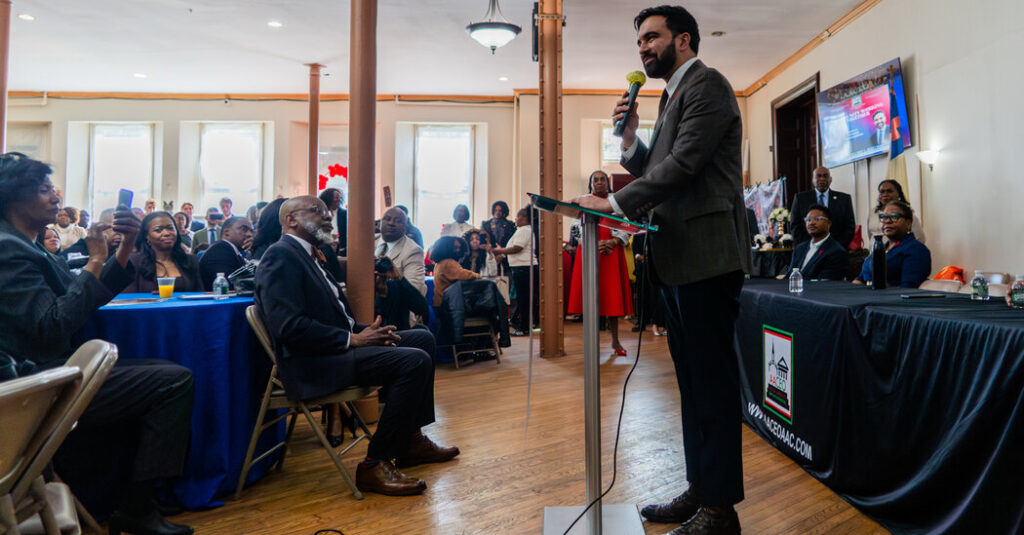
At a breakfast earlier this month for Black clergy and elected officials, Mayor Zohran Mamdani seemed intent on being the crowd pleaser.
He shouted out the reverends in the room, praised the police and compared the many firsts accomplished when he was elected mayor to when David Dinkins was elected as the city’s first Black mayor. He rattled off examples of how his administration has tried to help Black New Yorkers, including the creation of an office to battle deed theft and the suspension of the sale of tax liens.
The outreach was meant to address a string of what many Black leaders considered to be unforced errors by Mr. Mamdani — actions or oversights that they believe slighted many Black New Yorkers.
Still, some of his conciliatory efforts have fallen short.
When the mayor released a long-delayed racial equity plan in April, he called it a first step toward a blueprint to “solve decades of neglect and discrimination.” Yet some of his critics focused on what went missing: Several references to diversity, equity and inclusion had been removed from a draft to avoid potentially antagonizing the Trump administration.
Now the plan is drawing more fire.
The city’s Commission on Racial Equity intends to issue a report this week criticizing the plan for its failure to include crucial elements required by the City Charter, including a vision to increase racial equity in budgeting and policymaking, according to an advance copy of the report reviewed by The New York Times.
“Community members raised very specifically that they don’t see race explicitly addressed” in the mayor’s racial equity report, said Linda Tigani, the chairwoman and executive director of the commission, which is charged with holding the city accountable for advancing racial equity in government. “They don’t see Black and brown communities specifically noted in this report and they don’t feel included in this work.”
The disagreement illustrates the challenges that Mr. Mamdani, a democratic socialist, has faced as he has sought to make amends with Black New Yorkers, a key Democratic Party constituency.
The mayor faced fierce criticism for not initially hiring a Black deputy mayor; he eventually responded by choosing a Black woman as the deputy mayor for community safety.
Mr. Mamdani had infuriated many Black homeowners by suggesting that he might be forced to raise property taxes by 9.5 percent if the state did not go along with his tax-the-rich proposals. He backed away from the proposal after meeting with Black community leaders, and officially dropped it by the time he released his executive budget last week.
In an interview, Mr. Mamdani said he had heard from Black leaders and residents about how “intentional policy decisions” had “targeted” and “excluded” Black New Yorkers from opportunities available to other New Yorkers and that the effects of increasing costs had not “been applied evenly” across the city.
“Many of the neighborhoods where the pressure of ever-increasing rents and skyrocketing child care costs have been felt,” the mayor said, “are also the very neighborhoods where Black New Yorkers have often had to reckon with the absence of city government in addressing their day-to-day struggles.”
He called his focus on the issues facing Black New Yorkers a “continuation” of the policies he ran on.
Yet Mr. Mamdani won the Democratic primary without the city’s traditional base of Black primary voters. His victory put on full display the electoral consequences of decades of displacement that had reduced the Black population in traditionally Black neighborhoods like Fort Greene and Central Harlem.
During the general election, Mr. Mamdani began to build bridges to traditional Black primary voters.
“There is no progressive politics without Black politics,” said Basil Smikle, a professor at Columbia University. “You can’t govern as a progressive in New York City without supporting what happens in the Black community.”
Some of Mr. Mamdani’s supporters argue that his affordability agenda, with its focus on child care, housing and transportation costs, is inherently beneficial for Black New Yorkers, whose median income is well below the median income for white residents.
Grace Mausser, the co-chairwoman of the New York City Democratic Socialists of America, acknowledged the tension between socialists and some residents of gentrifying Black neighborhoods.
The D.S.A.’s goal, she said, is to “embrace policies that are universal” and that are targeted to helping working- and lower-class people who are “intentionally oppressed” by powerful institutions.
“I think a lot of what we’re fighting for,” Ms. Mausser said, “does disproportionately impact Black and brown New Yorkers.”
The mayor’s efforts at courting traditional Black primary voters appear to have made some headway. A recent Marist poll found that roughly two-thirds of Black New Yorkers had a favorable opinion of the mayor.
“I hate this narrative around this mayor not being a mayor for Black people,” Chi Ossé, a Black councilman from Brooklyn and one of the mayor’s strongest allies on the City Council said at the recent event to herald the office to guard against deed theft — a stubborn problem in historically Black neighborhoods that are gentrifying. “The last mayor was Black and he didn’t do crap on deed theft.”
Some Black leaders say Mr. Mamdani still hasn’t done enough to surround himself with enough key Black advisers. They accuse the mayor of failing to understand how anti-Blackness is ingrained into the country’s political system or appreciate the nuances of racial alliances in shaping voting coalitions — criticism that is often lodged toward democratic socialists like the mayor.
“I have found that the left has often had a problem with prioritizing what race means and usually just goes to class,” said Jumaane Williams, the public advocate who is the only Black official elected to citywide office. “That’s just been a spot where there has been struggle, and that struggle continues.”
Tyrik Washington, a strategist for the racial equity commission, agreed with Mr. Williams, saying that the “conversation has moved away from race, and has now, because of Mamdani, been replaced by a class analysis.”
“That,” he added, “has never been beneficial for Black people.”
Other reactions have been mixed.
Donovan Richards, the borough president of Queens, said Mr. Mamdani has been “making a concerted effort to do more outreach and to show up,” but missteps, like the decision to remove D.E.I. from the racial equity plan and the threat to raise property taxes, are indicative that his “tent has to grow” to include more Black advisers whom he trusts.
“I get that the Trump administration has put forth plans to gut D.E.I.,” said Mr. Richards, who is Black. “But I don’t think we should run from that fight.”
The mayor was criticized by his predecessor, Eric Adams, after he did not visit the playground where a 15-year-old Black teenager was fatally shot in Jamaica, Queens. Mr. Mamdani also did not immediately comment about the shooting.
“I would have liked to see him go to the scene to deal with that,” said the Rev. Al Sharpton. Mr. Mamdani did eventually meet with the teenager’s family.
But Mr. Sharpton — along with Mr. Williams; Vanessa Gibson, the Bronx borough president; and L. Joy Williams, president of the New York N.A.A.C.P., — praised the mayor for trying to smooth over the speed bumps he created.
The mayor, Ms. Williams said, seemed willing to “course correct” after hearing from Black leaders.
The mayor spent Palm and Easter Sundays at Black churches talking about the value of homeownership, a noteworthy step after his unpopular property tax proposal.
“His visit was a step in the right direction,” said the Rev. Stephen A. Green, senior pastor of The Greater Allen AME Cathedral of New York where Mr. Mamdani spoke on Palm Sunday.
“It shows a level of commitment that his administration has to engage Black communities and not just to be a one-off for a campaign, but to actually govern with Black citizenship in view.”
Jeremy Edwards, a spokesman for Mr. Mamdani, said the shift to prioritizing racial equity in the city’s budget will take more than the five months the mayor has been in office and could stretch over multiple years. That process, he said, has already begun, with recent investments in public housing, child care programs and neglected parks.
He described the racial equity plan as the foundation of an effort to “deepen the city’s commitment to racial justice,” adding that the administration was reviewing public feedback to the plan.
Yet there is still a sense among some Black civic leaders that Black political power is on the decline with Mr. Mamdani as mayor. The New York State N.A.A.C.P. recently launched Black New York Forward, described as an effort to build “durable” Black political and economic power.
Marlon Rice, a Democrat in Bedford-Stuyvesant in Brooklyn, is running against Jabari Brisport, a Democrat who is the State Senate incumbent and a Mamdani ally. He expressed skepticism that the mayor’s sudden focus on deed theft was genuine.
“If this new department helps elders keep their homes that’s a good thing,” Mr. Rice said. “But they’re playing politics first and it just feels disingenuous and performative.”
Jeffery C. Mays is a Times reporter covering politics with a focus on New York City Hall.
The post After a Rough Start, Mamdani Focuses on Skeptical Black New Yorkers appeared first on New York Times.