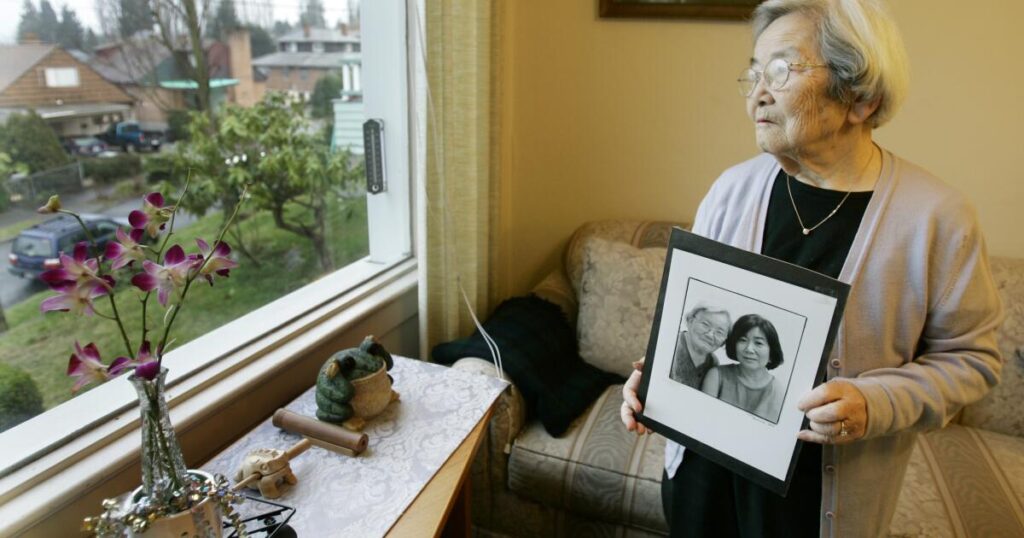
In 1942, a pregnant Fumiko Hayashida boarded a ferry for Seattle clutching her 13-month-old daughter and a stuffed animal. Her family, owners of one of Bainbridge Island’s largest strawberry farms, was among the first of the more than 120,000 people of Japanese descent shipped to hastily built prisons in the months after Japan’s attack on Pearl Harbor.
Fumiko and her husband, Saburo, and their two young children, like the majority of those imprisoned by order of President Franklin Delano Roosevelt, were American citizens. While none of them had been or ever would be convicted of betraying the United States, they shared the same bloodline as the country’s enemy across the Pacific.
History has condemned the military architects behind Roosevelt’s Executive Order 9066, issued on Feb. 19, 1942. But far less attention has been paid to why one of this nation’s most revered leaders agreed to take this action against the advice of his wife and others.
An ugly truth is that Roosevelt believed people of Japanese descent could never become trustworthy Americans because their loyalties would always be influenced by their Japanese ancestry.
Making the link between Roosevelt’s views on race and the wartime incarceration is crucial to understanding this tragic chapter in American history. Doing so is paramount today, when discredited racist “science” hierarchies has found new champions among President Trump and his followers.
The Trump administration’s campaign against the “mongrelization” of America has made it the darling of white supremacists around the world. The president has called immigrants from Somalia and other African countries “garbage,” given white Afrikaners protected refugee status, and launched a redistricting arms race to suppress nonwhite Americans’ voting power.
As did Roosevelt, Trump resurrected an old law — the Alien Enemies Act of 1798 — to wage a campaign against nonwhite immigrants and their descendants, rounding up people based on race and ethnicity, imprisoning them without due process, separating families and pressuring them to self-deport or be deported.
Roosevelt is widely admired as a champion of the underdog and architect of the New Deal. Less remembered are his harsh views on race. Like his distant cousin Teddy Roosevelt, Franklin Roosevelt embraced aspects of eugenics as a way to justify discrimination against people he deemed biologically inferior or different.
These beliefs in racial purity, which were held by many prominent Americans including Planned Parenthood founder Margaret Sanger and aviator Charles Lindbergh, provided the intellectual underpinnings for a web of federal and state laws that cast Asian Americans as lesser beings: unable to become a citizen and, in many parts of the West, unable to own land or marry white people.
When politicians and labor leaders began pushing for greater restrictions on Japanese immigration in the early 1920s, Franklin Roosevelt wrote an article in Asia magazine describing the Japanese as people “of acknowledged dignity and integrity.” But he also argued their exclusion from the United States was justified because “the mingling of white with oriental blood on an extensive scale is harmful to our future citizenship.” That sentiment helped give rise in 1924 to the Johnson Reed Act, which severely restricted immigration from non-Nordic countries and banned Japanese from entering the country.
As president, Roosevelt expressed hope that the U.S. and Japan could avoid a military conflict. But after Pearl Harbor, when military leaders claimed people of Japanese descent in the United States were aiding the enemy — despite evidence to the contrary — he readily accepted their calls for a mass imprisonment. It was, explained historian Greg Robinson, “a carelessness toward innocent people that was born of prejudice.”
Roosevelt’s role in this disgraceful chapter demonstrates the power that one influential individual can have on history. Though a few prominent journalists and religious leaders and a handful of imprisoned Japanese Americans pushed back against the wartime incarceration, even the top leaders of the American Civil Liberties Union were afraid to challenge a popular wartime president.
Had he rejected the idea of race as a basis for incarceration, this lasting stain on his presidency could instead have been a powerful demonstration of justice. Instead of spending the war behind barbed wire, the Hayashidas of Bainbridge Island and other Japanese Americans could have continued contributing to America’s success at home and on the battlefield. And the millions of dollars spent on their incarceration could have been used to fight the war and possibly end it sooner.
Instead, the Hayashidas returned to Bainbridge after the war to find their once prosperous farm in ruins. Saburo eventually found a job with Boeing, and the family moved to Seattle.
Under pressure from the Japanese American community, President Reagan signed a law in 1988 that provided some restitution and a formal apology to the Japanese American survivors of wartime prison camps. But the legal apparatus that was used to execute what the U.S. government called a “grave injustice” — including the Alien Enemies Act and Supreme Court decisions upholding the wartime incarceration — is now being used by the Trump administration to wage war on immigrants and people who oppose its actions.
There is one major difference between 1942 and the present: the emergence of a powerful grassroots movement aimed at stopping Trump and his supporters from weaponizing fear and prejudice to undermine the democratic values on which this country was founded. Among those protesting are Bainbridge Island survivors of the World War II-era incarceration, whose slogan of “Nidoto nai yoni” (“Let it not happen again”) has become a powerful rallying cry for the resistance.
Evelyn Iritani, a former reporter at the Los Angeles Times, is the author of “Safe Passage: The Untold Story of Diplomatic Intrigue, Betrayal, and the Exchange of American and Japanese Civilians by Sea During World War II.”
The post Trump is copying the worst of FDR’s presidency with racial roundups appeared first on Los Angeles Times.