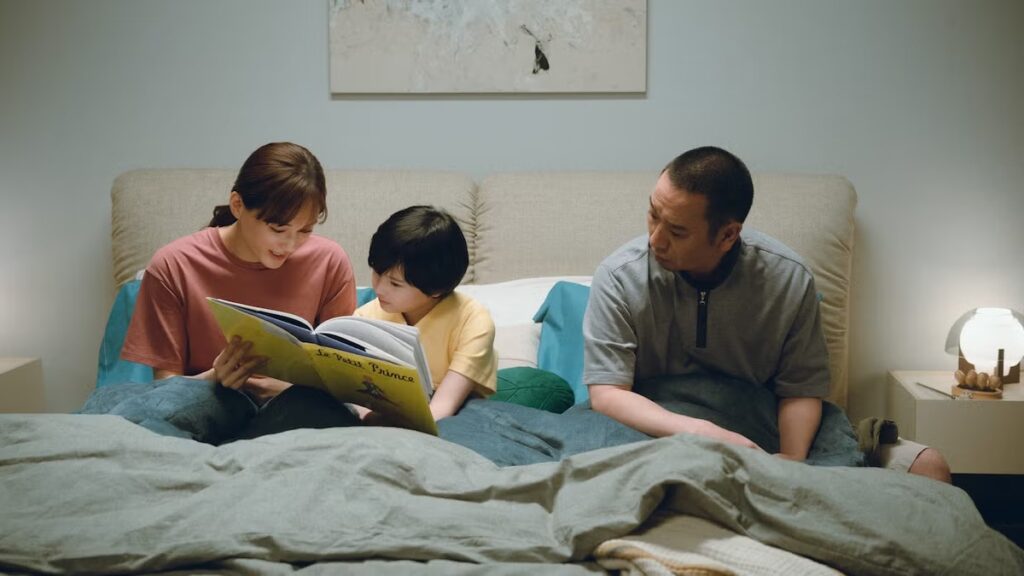
“Sheep in the Box,” Hirokazu Kore-eda’s movie about androids, artificial intelligence and found family, plays out in exactly the ways you might think a Kore-eda film about those subjects would, and is also something uniquely and touchingly unexpected. Kore-eda (“Shoplifters,” “Still Walking”) has always been a humanist filmmaker, one who has no naïvete about our capacity for destruction, even as he celebrates the ways people, despite their own self-interests, can sacrifice and care for each other.
His new film, which premiered on Saturday in the Main Competition at the Cannes Film Festival, notably and intentionally steers away from its genre elements to instead offer musings around the courage of facing death and the way technology can both help and hurt the mourning process.
From the very opening shot, it’s evident Kore-eda is aware of exactly the types of iconography he’s toying with. The camera pans over the city of Yokohama, drawing attention to the architecture nestled into the verdant countryside, with the people occupying those structures being barely noticeable. A title describes this as the “not so distant future” as a drone carrying an unknown package flies into frame, crossing paths with another going the opposite direction.
In just these scenes, technology, nature, and humanity share the same space, albeit unevenly. The dynamics between all three will be a key fixture of the film’s central couple, Otone Komoto (Haruka Ayase) and Kensuke Komoto (Daigo Yamamoto). Otone works as an architect, and “Sheep in a Box” takes time to document the home she and her husband live in. Their house feels in community with the surrounding trees and foliage, rather than in antagonism with it. There’s nary a room not illuminated by natural light, which can make the nights feel all the more lonely.
The couple have recently lost their son, Kakeru (Rimu Kuwaki), and in their grief, Otone receives an advertisement (from one of the aforementioned delivery robots) that creates humanoid robots of deceased loved ones. The couple decides to welcome a robot of Kakeru. (It helps also that the rental is complimentary, which convinces a more skeptical Kensuke to accept: “People’s misfortunes can be profitable,” he grumbles while they’re waiting for Kakeru.)
The robotic Kakeru’s integration back into his caretaker’s lives consists of the majority of the “Sheep in a Box” runtime, and Kore-eda’s meditative pace allows for deeper explorations of the use of such technology in assuaging pain. On the surface, Kakeru is a perfect physical replica of the son Otone and Kensuke lost, but the limitations of the technology underscore the gap between the son they’ve lost and the one they now have.
Upon learning that you can set certain intelligence settings on Kakeru and that he needs to sit in a charging chair when his power is low, Kensuke quips that they’ve ostensibly been gifted a combination of a “Tamagachi and a Roomba.” The humanoid is earnest in its desire to learn, but of course, it hasn’t lived the life of the real Kakeru. Otone attempts to get Kakeru caught up to speed, but even she realizes the absurdity of the task. She points out that her humanoid “son” doesn’t like green peppers or praying mantises, key facets of her human son’s personality that are now simply lines of data that need to be fed into his automaton replacement.
Critically, Kore-eda does not demonize Kakeru, nor does he lambast Kensuke and Otone. “It’s nobody’s fault a child died,” someone says, yet Kore-eda knows that parents cannot accept such an easy absolution. For Kensuke and Otone, making themselves responsible makes what happened to Kakeru something they can control. That’s a far better alternative than imagining his passing as an unexplainable act of violence.
When it comes to their kids, parents will always feel guilty about the ways they failed to protect and properly care for them. Their doting isn’t delusional but courses with redemptive possibility. They see their new son as a vessel into which to pour their love and atone for past failures.
The problem with vessels, though, is that more often than not, they’re stationary. Tensions arise when Kakeru desires to go off script, taking his growth in ways incongruent with the human Kakeru’s life. Kore-Ed’s doesn’t frame this with an apocalyptic undertone à la “the machines are trying to take over our humanity!”, but frames it as a gentle critique of the ways we don’t give the dead their peace when we see their passing through the prism of tragedy.
“Who do the dead belong to?” a character asks. Kore-eda offers no concrete answer, but he does ask whether or not we keep captive those who have gone before us by not accepting that they can blossom into new forms. They don’t have to remain static memories, and they don’t have to become humanoid androids. What he offers is a new way to rethink holding our grief, and the end result is a slight and wistful poem of a movie.
The post ‘Sheep in the Box’ Review: Japanese Film About Grief and Parenting is a Lo-Fi Stunner appeared first on TheWrap.