Thunderstorms will carve a path through the central United States, bringing multiple days of severe weather that kicks off on Saturday, continues into Sunday and peaks with the most widespread and adverse conditions on Monday, forecasters say.
The rounds of storms are expected to deliver a barrage of weather hazards, including damaging winds of more than 75 miles per hour, hail as large as softballs, bursts of heavy rain and strong tornadoes from Texas to the Great Lakes.
“This is certainly looking like one of the bigger severe weather sequences this year so far,” Andrew Lyons, a meteorologist with the Storm Prediction Center, said on Saturday morning.
Some areas will be at a higher risk for the most severe weather than others, and the National Weather Service advised that people living in areas threatened by thunderstorms keep an eye out for watches and warnings, especially those alerting of tornadoes.
A tornado watch is a heads-up that conditions are favorable for tornadoes, while a warning is an order to find shelter immediately because a tornado is about to form or has already been spotted.
Here’s a day-by-day look at what to expect.
Damaging Winds Possible on Saturday
A risk of severe storms was focused over parts of the Central Plains and the Midwest on Saturday, with the highest prospect of unsettled weather forecast for the areas of northeast Colorado, southern Nebraska and northern Kansas.
The thunderstorms could bring damaging winds and large hail Saturday afternoon into the evening, forecasters warned. Mr. Lyons said that the tornado threat on Saturday was low, but that they were still possible and people should prepare for them.
Some of the storms could intensify into long-lived supercells, which would be most capable of producing tornadoes, though that threat was expected to be higher on Sunday and Monday than on Saturday, Mr. Lyons said.
Thunderstorms are fueled by rapidly rising columns of warm, moist air known as updrafts. In a typical thunderstorm, the updraft can last up to about an hour. In a supercell, it rotates and can persist for much longer.
“Supercells are what we call ‘organized,’ which means they are persistent and they can go for several hours,” Mr. Lyons said.
There was also a low risk of heavy rains that could lead to flooding in the region, with a slightly higher threat across northern Missouri and into southern Iowa.
Persistent Storms on Sunday
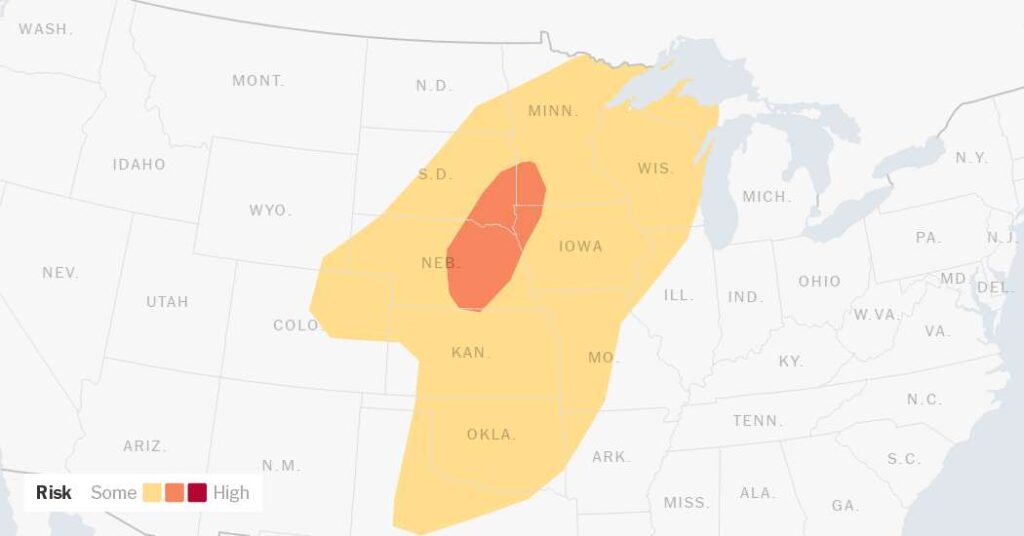
The threat of severe storms was expected from the Central Plains to the Upper Midwest on Sunday afternoon and extending into the evening hours, particularly from eastern Nebraska to southwestern Minnesota, northwestern Iowa and southeastern South Dakota.
Cities falling within the area under the highest risk include Sioux Falls, S.D.; Sioux City, Iowa; and Grand Island, Neb. Supercell storms are more likely in these areas and could bring more damaging winds, large hail and tornadoes than typical thunderstorms.
Mr. Lyons said that the threat of tornadoes was expected to bump up to a medium risk on Sunday.
A low chance of heavy rain that could lead to flooding was spread across portions of the upper Midwest, with flooding possible on the streets of the Twin Cities.
Severe Storm Risk Rises on Monday
Monday was expected to be the most active day of the sequence, with the risk of severe storms heightening and expanding across a broader area of the Central and Southern Plains and the Midwest.
Thunderstorms are forecast to develop in a large stretch of the central United States, from the Great Lakes to northern Texas. The threat of supercell storms was predicted to be highest on Monday, particularly in an area spread between northern Oklahoma and central Iowa, with Kansas City, Mo.; Omaha; and Des Moines among the cities that could see the most severe weather.
These storms could bring hail as large as softballs, as well as tornadoes.
“It’s very likely we will see a few tornadoes with Monday’s storms and some of them could be strong to intense,” Mr. Lyons said.
Amy Graff is a Times reporter covering weather, wildfires and earthquakes.
The post Severe Storms to Bring Strong Winds and Hail to Central U.S., Forecasters Say appeared first on New York Times.