If you’ve ever tried to quit cigarettes, you know that nicotine addiction is ridiculously difficult to beat. A full two-thirds of adult smokers want to kick the habit, but only one in ten succeeds — while untold millions ultimately die from it.
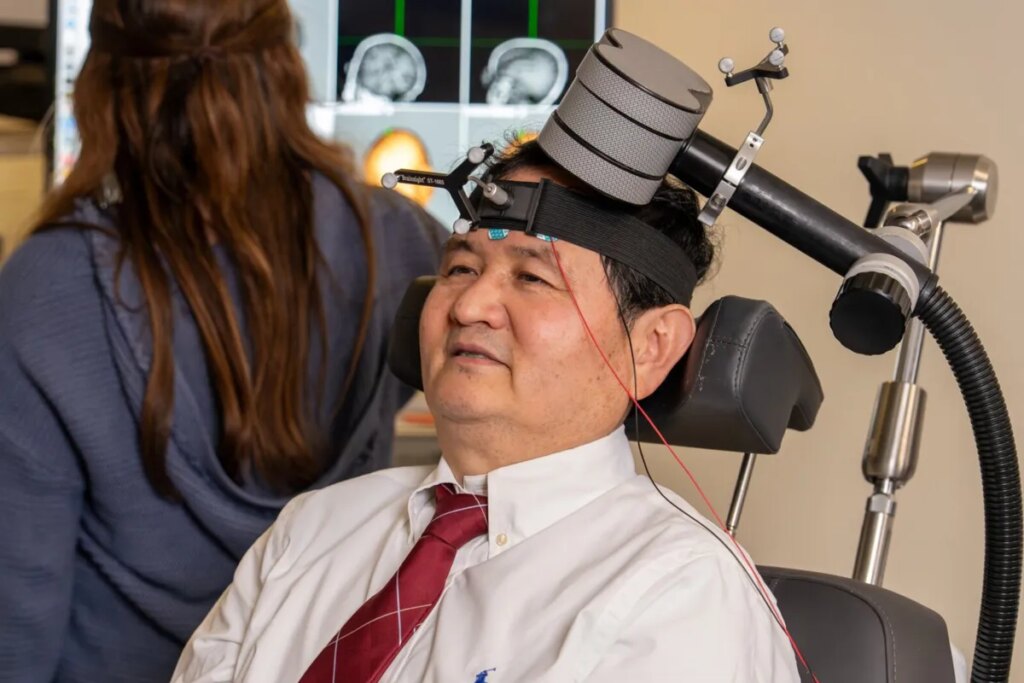
We’ll believe it when we can try it ourselves, but scientists say a noninvasive brain stimulation technique known as repetitive transcranial magnetic stimulation (rTMS) — basically an electromagnetic blunderbuss that shoots powerful bursts directly into targeted areas of your brain to modulate neural activity — could offer new hope for addicts.
Treatment with rTMS has already shown promise for the treatment of depression, chronic pain, obsessive compulsive disorder, and more. Now, as outlined in a a new study in the Journal of Psychiatric Research, researchers are investigating whether the technique could help patients quit smoking as well.
As lead author and professor at the Medical University of South Carolina’s (MUSC) Hollings Cancer Center Xingbao Li explained in a press blurb, the idea is basically that addiction can alter the brain’s balance of cravings, control, and decision-making — and he’s convinced that he can restore that balance via magnetic pulses.
“In addiction, brain systems can get out of balance,” he said in the blurb. “One system, tied to reward and craving, becomes overactive. Another, responsible for control and decision-making, becomes weaker.”
Li’s team ran experiments on 45 smokers trying to quit, each of whom received 15 treatment sessions, and they said the results were undeniable. Participants who received high-frequency stimulation to the dorsolateral prefrontal cortex, a region of the brain associated with decision-making and self-control, reported fewer cravings and reduced their tobacco use by an average of about 11 cigarettes per day. In other participants, Li’s team targeted the medial orbitofrontal cortex, responsible for rewards and cravings, but that group only reduced its cig intake by about five. (Participants in the control group who received a sham treatment reduced their average cigarette use by six.)
“It’s a kind of precision medicine,” said Li, who’s also investigating whether the technique can help ditch meth and alcohol. “We’re tailoring the treatment to each person’s brain.”
More on nicotine: FDA Working to Remove the Stuff in Cigarettes That Feels Good
The post Scientists Say Test Subjects Were Able to Quit Smoking After They Blasted Their Brains With a Huge Magnet appeared first on Futurism.