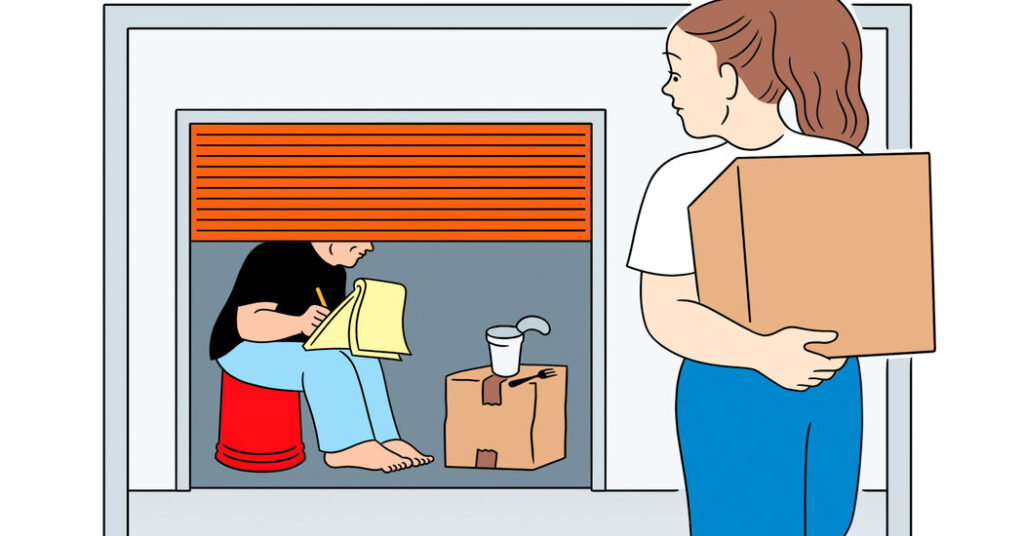
I’m a woman in my 30s, and I rent a small unit from a national storage chain on the outskirts of Los Angeles. The building is a bit run-down and not in the best area, but it doesn’t usually feel unsafe, and the price and access hours are good. The first few times I went to move my things in, everything seemed normal.
On my third trip, there was a man in the unit directly across from mine — bags in the hallway, sitting on a five-gallon bucket, barefoot, writing on a notepad and eating cup noodles. As I approached, he pulled down a makeshift curtain of old plastic sheeting hung on a rope where the door would close. I was too surprised to get a good look inside, but I did see a large jar of yellow liquid and a semi-used roll of toilet paper, along with floor-to-ceiling bags and boxes that looked as if they had been there for many years. Behind the plastic it sounded as if he just continued to write. I had planned on organizing my unit that day but was so uncomfortable I just threw my things inside and left.
On almost every subsequent visit of mine, he has been in there. He always pulls the plastic down, but it doesn’t cover the whole doorway, and it’s deeply uncomfortable shuffling around my own things (or using the hallway) while someone sits there five feet away. We don’t interact; sometimes I think I hear a pen scratch, but once I heard rhythmic squelching and got really grossed out jumping to an obvious conclusion.
Here’s my quandary: Do I listen to my discomfort and approach management, or do I try to let it go? Los Angeles isn’t affordable, and getting his unit revoked could put him in a much worse situation (though I don’t know that he’s homeless). Management might already know from the security cameras. Plus, access isn’t 24/7, so if he’s not living there full-time, is that even a contract violation?
I’ve considered asking to change units to an equivalent one in another hall, but I don’t know how I’d answer when they ask the very obvious “Why?” I also considered quietly leaving and going to another facility entirely, but that feels like kicking the can to the next renter, who may not consider the potential consequences of complaining.
I moved to this storage unit because it was closer to my apartment, so I could use it more. But I’m so hesitant to go now. What’s the ethical thing to do? — Name Withheld
From the Ethicist:
A 2020 study found that Norway had 3,325 homeless people out of a population of about 5.4 million. Most of them were in emergency or other temporary lodgings, staying temporarily with family or friends or in institutions. Only 66 were classified as “living rough,” sleeping without a roof over their heads.
In Los Angeles County, which has a population about 1.8 times that of Norway and an overall homelessness rate almost eight times that of Norway, the number of “unsheltered” people is close to 50,000. Of course, there are many differences to be taken into account: Los Angeles is warmer, Norway is modestly richer and European categories don’t map neatly onto American ones. The point remains that the United States leaves far more people without even temporary accommodation.
Against this background, I can understand why you want to cut your storage-unit neighbor some slack. That doesn’t mean you should feel obliged to ignore your unease, or that a storage unit is a proper form of shelter. Poor ventilation, lack of sanitation, improvised heating or cooking and temperature fluctuations can create hazards for the person living there and for others using the facility. So there’s an argument for alerting the managers. But the least disruptive first step would be to ask for another unit in a different hallway. If you’re pressed for an explanation, you can say that another renter’s regular presence near your unit has made it hard for you to use the space the way you normally would, without offering any speculations about him. Obviously, if you come to feel threatened, it’s another story. Until then, asking to move yourself, rather than trying to get him removed, is probably the most humane course, and the one most likely to preserve your peace of mind.
Readers Respond
The previous question was from a reader who was concerned that her sister’s alcoholism was putting her grandson at risk. She wrote:
One of my sisters is raising her grandson, who is 5 years old. She is in her early 70s and has had him since he was born; the two of them live alone together and he is thriving. My sister, however, is a high-functioning alcoholic, and recently I learned that the child has discovered her unconscious on more than one occasion. Though everyone in the family is aware of her alcohol addiction, I’m unsure of how many know about her passing out. Other family members think that approaching our sister very slowly and carefully is the way to go. Meanwhile, I worry about the child’s safety. The fear is that state intervention will separate them even though he is currently doing very well, and the greater family would be torn apart by dissension with the whistle-blower. What should I do with this information? I do not have a close relationship with this sister. — Name Withheld
In his response, the Ethicist noted:
Young children, let’s agree, should not be left in the care of an adult who may become unconscious when they need help. Being asleep is one thing; being passed out is another. … The family’s responsibility is to prevent foreseeable harm, not simply to respond to it when it happens. That the child is thriving makes it easy to wave away the red flags; that nobody else is specifically on the hook allows for the diffusion of responsibility, and inertia. But when you’re aware of a pattern that could put a child at risk, doing nothing is a decision — and possibly a consequential one. The immediate goal should be a concrete, workable plan: another adult checking in regularly, relatives helping with care, the child staying with trusted family members as appropriate, hiring a home caretaker if that’s possible. Although outside intervention may be necessary as a last resort, the family really should be pressed to come up with that plan. The child’s bond with his grandmother is worth protecting, but the priority should be to make sure that he’s kept from danger.
(Reread the full question and answer here.)
⬥
There are two dominant questions: 1) Is the child safe? Demonstrably, no. And 2) What has to happen to make the child safe? Either the family steps in, immediately and actively, or that role must be turned over to an agency of some kind. It is not OK to approach this slowly and gradually. If the child were 10 or 12 maybe — but not a 5-year-old. — Scott
⬥
I would also add that when a child of that age is living with an alcoholic and has discovered that person unconscious on numerous occasions, it isn’t just their physical safety that needs consideration. The letter writer says the child is thriving, but this situation may take its toll and eventually affect the child, leaving damaging emotional scars. Many adult children of alcoholics hold this very memory as among their most painful. Perhaps the child doesn’t understand what is going on now, but eventually he will, and the damage will be done. Intervention shouldn’t be an “if” in this case, but a “how soon?” — Angie
⬥
The Ethicist’s response is good, as far as it goes. But regarding planning for the future: The letter writer’s sister is 65 or 70 years older than the child she is raising as a single parent. She may live to be 100 and see the child reach adulthood. Or, if she has a more average life span, he will be left without a parent when he is 10 or 15 years old. It would be wise for the family to have in mind a Plan B for the child, an idea of who will raise him if and when the sister is no longer capable of doing so. That time may come when she passes away or if she becomes too ill to care for him — or it may come tomorrow night, if he finds her passed out drunk again. — Jeanne
⬥
I grew up with alcoholic parents, but I also had my grandmother in the house. As a young woman in my early 20s, I moved back in with my mother. I remember as if it was yesterday that my mother had passed out and I could not wake her. Being older, I knew to call 911, and my mother eventually recovered after some time in the hospital. I can only shudder to consider a 5-year-old child being put in that position. I also wonder what else the child observes that the rest of the family is not aware of. The family needs to have a very frank discussion with the grandmother. The emotional and physical safety of the child is the first priority. — Karin
⬥
I agree with all the Ethicist’s points. To them I would add suggestions for strategies to strengthen and educate the child. My daughter was this grandchild’s age when I had to let her go for unsupervised visitations with her father, who was often impaired. I made sure that she could identify reliable adults to access, knew how to call 911 and taught her other tools she could use, if necessary. — Jody
The post I Think Someone Is Living in the Storage Unit Next to Mine. What Should I Do? appeared first on New York Times.