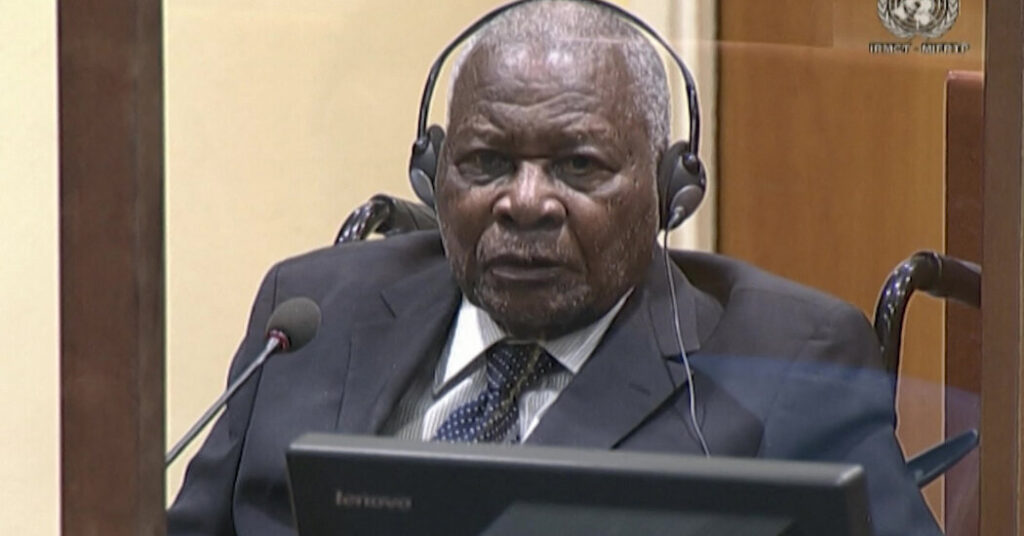
Félicien Kabuga, an accused mastermind of Rwanda’s genocide who spent 26 years on the run protected by his wealth and wiliness, and who escaped prosecution after a United Nations war crimes tribunal ruled him unfit to stand trial because of dementia, died on Saturday in The Hague. He was 91 or 93, based on various accounts.
His death, in a hospital, was announced by the United Nations. He was arrested in France in 2020 and, while he never was held to account for his alleged crimes, he remained in U.N. custody.
A trader and entrepreneur who became one of Rwanda’s richest citizens, Mr. Kabuga was accused by international prosecutors of using his fortune to finance and direct the explosion of bloodletting that claimed upward of 800,000 lives in 100 days of mayhem in 1994.
The killings initiated a chain of conflicts that claimed some two million lives in Africa’s Great Lakes region and persisted well into the 21st century.
Mr. Kabuga was said to have sponsored inflammatory broadcasts on his own radio station, inciting his compatriots to slaughter their adversaries — principally members of the Tutsi minority; and to have financed the supply of weapons, including guns and machetes, used by militias and civilians from the Hutu majority to beat, stab and shoot their victims to death.
With the defeat of those militias by Tutsi insurgents, Mr. Kabuga was said by prosecutors to have embarked on a pimpernel existence. He fled first to Switzerland, where he was refused asylum, and was subsequently sighted — or said to have been sighted — in Oslo and Nairobi.
He was in his 80s when, in May 2020, he was finally detained in a well-heeled suburb of Paris. At the time, Rwanda’s Justice Minister, Johnston Busingye, declared: “You can run, but you cannot hide. It can’t be forever.”
The warrant for his arrest had been issued in 1997.
His capture in Asnières-sur-Seine followed a protracted hunt by French police officers with the cooperation of Belgian and British police forces.
The charge sheet included genocide, incitement to genocide, conspiracy to commit genocide and three counts of crimes against humanity relating to political persecution, extermination and murder. He pleaded not guilty to all the charges.
When he was finally arrested, surrounded by family members at 7 a.m. in a rented home, prosecutors depicted the event as a potential milestone in the effort to bring long-sought, high-profile accused perpetrators to international justice.
His apprehension was the weightiest since the seizure in 2011 of Gen. Ratko Mladic, a Serbian military leader subsequently found guilty of committing genocide in the Bosnian war of the 1990s. The United States had circulated wanted posters depicting Mr. Kabuga in Nairobi and had offered a reward of $5 million for his capture.
For victims and survivors of the genocide, said Serge Brammertz, the chief prosecutor of the United Nations International Criminal Tribunal for Rwanda, “after waiting so many years, his arrest is an important step toward justice.”
When he went on trial in late 2020, Mr. Kabuga initially refused to attend the tribunal’s hearings in The Hague. Initially the tribunal said he was fit to stand trial, although he “suffers from cognitive impairment, is in a vulnerable and fragile state and requires intensive medical care and monitoring.”
Then, in June 2023, the court determined by a 2-to-1 majority of judges that “on the basis of the unanimous opinion of three medical experts, Mr. Kabuga was not fit for trial and was very unlikely to regain fitness,” according to an official summary of the case. The finding was challenged by judge Mustapha El Baaj of Morocco, who argued that Mr. Kabuga was fit to stand trial.
At the same time, the court ruled that some kind of arrangement should be devised to provide for a limited legal process without a verdict.
The case dragged on with Mr. Kabuga’s attorneys urging appeals judges that he should be provisionally released, but a group representing survivors said that would set a “deplorable precedent.”
The only state offering him sanctuary was Rwanda itself, and Mr. Kabuga’s attorneys said he refused to be sent there. According to rights organizations such as Human Rights Watch, his native land has a record of increasingly autocratic rule under President Paul Kagame, who led the victorious insurgent forces that ended the genocide in 1994 and has dominated the country since then.
Equally, the tribunal, by now reduced to a smaller successor court known as a so-called “mechanism,” found in September 2025, that “if Kabuga is ever to be released from detention, it will only be to Rwanda.” The prosecution urged that the tribunal make a ruling on his deportation from The Hague to Kigali, the Rwandan capital, but the judges ruled that he was unfit to travel.
“Kabuga remains in limbo, while complaining that his continuing detention violates his most fundamental rights,” the tribunal said.
Félicien Kabuga, an ethnic Hutu, was born into a farming family in northern Rwanda. Early on, he proved himself adept in the world of business. He traded used clothes and cigarettes before purchasing land on which he built the first of several tea plantations.
He and his wife, Josephine Mukazitoni, who reportedly died in Belgium in 2017, were said to have at least 11 children, some of whom married into the family of Juvénal Habyarimana.
The year of Mr. Kabuga’s birth was disputed. Some sources claim March 1, 1933, but the court listed it as 1935. Coincidentally, 1935 was also the year when Belgian colonial rulers introduced a system of identity cards that cemented ethnic distinctions between Hutus and Tutsis. Rwanda achieved independence in 1962.
Mr. Habyarimana died when his plane was shot down in 1994 — an event that ostensibly triggered the genocide. At the time, Mr. Kabuga was a founder of a widely followed radio station called Radio-Television Mille Collines.
The tribunal said the station “directly and publicly” incited genocide through “denigrating broadcasts” for months before the killing started. Prosecutors said the station even directed murderous gangs to places where ethnic Tutsis were concentrated.
In addition, Mr. Kabuga was accused supporting Hutu militias with “material, logistical, financial and moral support,” including the supply of weapons and ammunition.
Stephen Rapp, a former chief prosecutor at the tribunal, said Mr. Kabuga used assumed names and a variety of passports to elude his pursuers. He also cultivated high-level connections to shield his whereabouts and paid at least one police officer in Kenya who enabled him to escape by alerting him to an imminent arrest. Kenyan authorities denied accusations that they had been lax in the search for Mr. Kabuga.
While Mr. Kabuga was on the run, the tribunal froze a number of his bank accounts in Belgium and France, prompting Mr. Kabuga to argue that he was penniless and could not afford his own legal fees.
It was unclear when he arrived in France, but investigators said he was located through phone calls made by family members who visited with him. Once Mr. Kabuga had been arrested, the French authorities transferred him to the U.N. Rwanda tribunal at The Hague in October 2020, amid the Covid pandemic.
The initial plan had been to send him for trial to a branch of the tribunal’s successor court Arusha, Tanzania. But shortly after his arrest, that plan changed to provide for medical assessments of whether his health would permit him to be transferred safely.
The case was among the last heard by the U.N. tribunal and its legacy successor. Over the years, the tribunal tried almost 80 cases. Thousands more were prosecuted in Rwandan courts.
Some of the U.N. investigations drew controversy, because critics said they ignored excesses committed by Mr. Kagame’s insurgents. The earlier trials also sought to throw light on the question of accountability beyond the actions of physical perpetrators.
“The power of the media to create and destroy human values comes with great responsibility,” the tribunal said in a summary of an earlier judgment of media figures in 2003. “Those who control the media are accountable for its consequences.”
Alan Cowell had a long career as a foreign correspondent for The Times based in Africa, the Middle East and Europe.
The post Félicien Kabuga Dies; an Accused Mastermind of Rwanda’s Genocide appeared first on New York Times.