PORT-AU-PRINCE, Haiti — When the U.S.-backed security force came to Haiti in 2024, Monique Methellus Paul was hopeful.
Kenscoff, the farming town outside Port-au-Prince where Paul lived with her five children, had been spared the heavily armed criminal groups that occupied most of the capital. Now, the 52-year-old vegetable seller believed, the U.N.-approved, Kenyan-led police force “would help push back the gangs” and restore security in this beleaguered Caribbean nation.
But the town, which straddled the last open road out of Port-au-Prince, made an inviting target. In January 2025, armed groups attacked. Over the next two months, Mayor Massillon Jean said, they killed more than 260 people, sent tens of thousands fleeing and took control of 70 percent of the town.
During the assault, bandits set fire to Paul’s six-room home, destroyed her crops and stole her three oxen. “I spent over 12 years building that house,” she said. “I have nothing left. I am devastated.”
Local officials had warned the National Police that the attack was coming, Emmanuel Pierre, the administrator of the Kenscoff municipal office, told The Washington Post. But the Multinational Security Support Mission, or MSS, took hours to arrive.
Now a new international force promises to succeed where predecessors failed. The U.N. Security Council has endowed the Gang Suppression Force with more personnel, more aggressive rules of engagement and the authority to gather intelligence and operate independently of Haitian police.
The GSF will have five times as many troops as the MSS, a State Department spokesperson said. Member states of the United Nations have pledged more than $110 million to fund its operations since it was announced. The first members — 400 Chadian soldiers led by a Mongolian army general — have arrived in Haiti. The force is expected to be fully deployed by September.
“As with any multinational force generation process, operational capability is being built in phases over time,” a GSF spokesman said. “The scale and tempo of operations will expand progressively as additional personnel and capabilities arrive.”
The failure of the MSS to achieve its goals offers lessons.
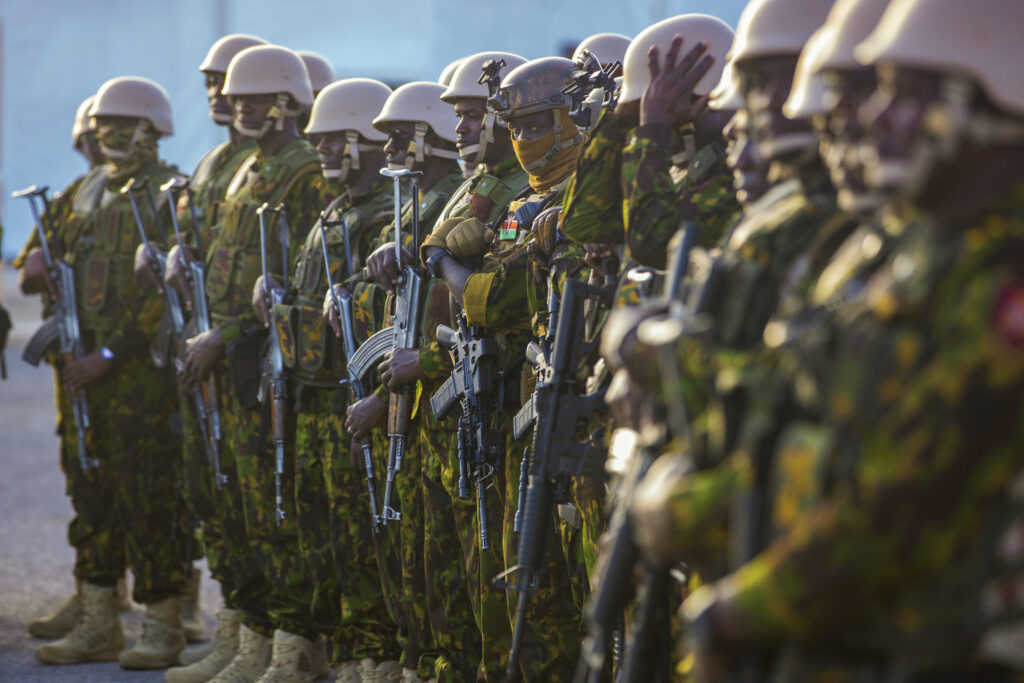
That force, backed by the United States and staffed primarily by Kenyan police officers, arrived in 2024 to stem the violence that had worsened in the political vacuum left in this nation of 12 million by the 2021 assassination of President Jovenel Moïse. Its mission was to help restore security so elections could be held.
The MSS was expected to counter the gangs that control 80 to 90 percent of Port-au-Prince, according to the U.N. Office on Drugs and Crime, strengthen the Haitian National Police and secure hospitals, schools, airports and major roads. Washington provided more than $970 million in funding and other support.
But in 22 months here, the force struggled to deliver on its core objectives. The country’s warlords remain free to rampage. Their gangs continue to control key territory and major roads. At least two of the deadliest massacres in modern Haitian history occurred during the deployment. A record 11 percent of the population has been displaced by the violence.
Police, meanwhile, have struggled to hold fragile gains. Three Kenyans were killed, and the body of one was never recovered.
The Federal Aviation Administration continues to ban U.S.-registered airlines from landing in Haiti. A Belgian aircraft carrying 80 Chadian personnel here last month was struck by two bullets.
The MSS was “bound to fail,” said Evelyne Asaala, a professor of international criminal law and transitional justice at the University of Nairobi. The Kenyans “don’t know the context, they don’t know the history, they don’t know the language, they don’t know the terrain.”
Authorized at 2,500 members from multiple countries, the force never grew much beyond 1,000. Most were Kenyans. The few other countries that contributed, such as El Salvador and Guatemala, focused on providing air cover for medical evacuations and protecting infrastructure, leaving the Kenyans to handle ground operations.
Contributions to the MSS were voluntary. Mission leaders complained about a lack of personnel, insufficient air support and faulty equipment. Officers were wounded inside armored vehicles, according to Fritz Alphonse Jean, a former member of the council that ran Haiti in the absence of an elected government. The main problem, he said, was “an underestimation or under-evaluation of the nature of the violence” in the country. The council’s mandate expired in February.
Haitians accused the MSS of overpromising and underdelivering. On social media, it declared repeatedly that the mission was entering a “decisive” phase, warned warlords that their time was “running out,” and promised to “smoke” them out of “their enclaves and hideouts.” It dismissed reports of a lack of coordination with Haitian police as “propaganda.”
Godfrey Otunge, who served as MSS commander before stepping down last month, said the resources it was given were insufficient to the task.
“We often operated with limited means, under intense pressure, and with immense expectations from the population,” he said in a statement to The Washington Post. Still, he said, the mission secured critical infrastructure and contributed to joint operations that led to the arrests of gang members.
“These achievements did not resolve everything,” he said. “But they created space, saved lives, and laid the foundations that must now be consolidated by the GSF.”
Haitians are skeptical. “I don’t think this new force will change anything,” said a police officer who spoke on the condition of anonymity because he was not authorized to speak publicly.
In his view, Haiti’s challenges cannot be resolved by foreign deployments. “The security problem has to be solved by Haitians.”
The U.N. Security Council has authorized the Gang Suppression Force at 5,500 members. The MSS was staffed by police officers, while the GSF will include a mix of police and soldiers.
Since the MSS was deployed, the challenges have grown.
The gangs have metastasized beyond Port-au-Prince. At least 70 people were killed in an assault in the Artibonite region north of the capital in March, the U.N. office here reported, and 13,500 were forced from their homes. Extrajudicial killings by police and neighborhood vigilante groups have exacerbated the crisis. A record 1.4 million Haitians nationwide have been uprooted by violence. More than half the population is facing severe food insecurity, defined by the U.N. Food and Agriculture Organization as having run out of food, experiencing hunger or going a day or more without eating.
One of Haiti’s most difficult challenges is the growing number of children being drawn or forced into armed groups. The Viv Ansanm coalition of gangs recruited more than 300 children in 2024, U.N. Secretary General António Guterres reported, and child gang involvement surged by 200 percent last year, according to UNICEF. Most children are used in combat roles, Guterres said.
More than 1,200 people were killed in drone strikes between March 2025 and January 2026, according to Human Rights Watch. They included at least 17 children and dozens of adults reportedly unconnected to gangs, the rights group said. The strikes were launched by a task force created by Prime Minister Alix Didier Fils-Aimé with support from private mercenaries.
When the Kenyans arrived, there was only one land route out of Port-au-Prince not under the warlords’ control: the treacherous, unpaved Kenscoff road, carved into the green mountains to the southeast.
The gangs close roads to claim territory, tighten their grip and exert pressure on what is left of Haiti’s government. They also make money: They set up checkpoints or ambushes, extort bribes from those wishing to pass and sometimes kidnap travelers for ransom.
If they could shut this last artery down, they could make the capital an open-air prison.
When the first wave of the assault began in January last year, Clédor Joseph, a truck driver, was home with his family in the mountainside community of Godet.
It was 3 a.m. The invading bandits split themselves into two groups and went to work setting the tin-roofed wooden and concrete houses ablaze and shooting escaping neighbors. Joseph’s house was burned to the ground. His cousin was shot dead with three bullets to the head.
A 41-year-old woman was breastfeeding her baby when she was gang-raped, the U.N. office reported. Another woman was attempting to flee with her baby when she was met by gang members warming themselves by a fire. They took the 1-month-old baby and threw it into the flames, the U.N. office reported.
Joseph fled on foot with his two children, ages 12 and 8. The gangs had set fire to his two trucks. He is currently unemployed and staying with friends. “I was proud to be from Kenscoff,” Joseph said. “I never thought the area would end up like this.”
The gangs still control the Kenscoff road, which has enabled them to attack deeper into the countryside. The Kenyans lost multiple armored vehicles, according to Pierre, the Kenscoff administrator. The gangs set fire to more elsewhere in the capital and Artibonite.
Police complained that the armored vehicles were poorly equipped for Haiti’s urban geography and frequently broke down. The U.N. reported last year that a shortage of parts had idled half the mission’s combat vehicles.
A Haitian police officer who patrolled alongside the MSS fears the new force might amount to little more than a rebranding. Language barriers, he said, crippled operations: Haitians speak mainly Creole and French; the Kenyans relied on English and Swahili. At times the comrades resorted to typing messages back and forth on Google Translate. The few Haitians who knew some English, he said, were kept inside armored vehicles to serve as interpreters.
The officer, who spoke on the condition of anonymity because he was not authorized to speak to the media, recalled a deployment last year near Haiti’s State University in Port-au-Prince. Haitian police entered a courtyard in an armored vehicle and came under gunfire from about a dozen men. They wanted reinforcements, but a Kenyan armored vehicle blocked the only entrance. Officers pleaded over the radio for the Kenyans to move, but the Kenyans did not understand. “They were in the way, lost, not knowing what to do,” he said.
He said the Kenyans rarely left their vehicles to help the Haitians reclaim territory. “We constantly argue with them over the radio,” he said. “It’s hard for them to understand us.”
The Office of the U.N. High Commissioner for Human Rights last year substantiated allegations of sexual exploitation and abuse against four personnel assigned to the MSS. The U.N. finding was first reported last month by the Haitian news outlet AyiboPost.
The MSS was approved by the U.N. Security Council but funded voluntarily by donors — principally, the U.S. and Canada. The GSF is to receive logistical and operational assistance from a new U.N. support office in Haiti, the costs of which will be spread across the U.N.’s membership. But contributions of personnel and the costs of their salaries remain voluntary. That has spurred concerns that the GSF could be hobbled by the same funding challenges that hindered its predecessor.
The U.S. will provide “targeted logistics and life support” to the GSF, the State Department spokesperson said, and will continue to provide assistance directly to the Haitian National Police.
The new force also has a more formal command structure. It is led by a special representative, the South African former U.N. official Jack Christofides, supported by a civilian secretariat. A standing group of partners, including the U.S., Canada, Kenya, Jamaica, the Bahamas, El Salvador and Guatemala, is providing strategic direction and oversight.
The structure is intended to improve coordination with the Haitian government and enforce accountability, including safeguards against sexual exploitation and abuse. Critics have doubts.
“In theory, the difference between the two missions is real — particularly the GSF’s autonomy from the [Haitian National Police],” said Romain Le Cour Grandmaison, director of the independent Haiti and Caribbean Observatory at the Global Initiative in Geneva. “But it is in practice that we must judge, and that is where the uncertainty remains.”
What Haiti needs, the observatory said in a January report, is a force large enough to carry out operations and maintain a near-continuous presence in the capital and the surrounding countryside. The GSF should be backed by air support, the observatory said, and ideally a maritime unit to patrol the coast, disrupt traffickers and reduce the illicit flows of money that finance gangs.
But force alone would only be a temporary fix, the observatory said: Without political, economic and social reforms, criminal groups are likely to reemerge.
Rael Ombuor in Nairobi and Claudia Méndez in Guatemala City contributed to this report.
The post U.S. sank millions in failed mission to stem crisis in Haiti. It’s trying again. appeared first on Washington Post.