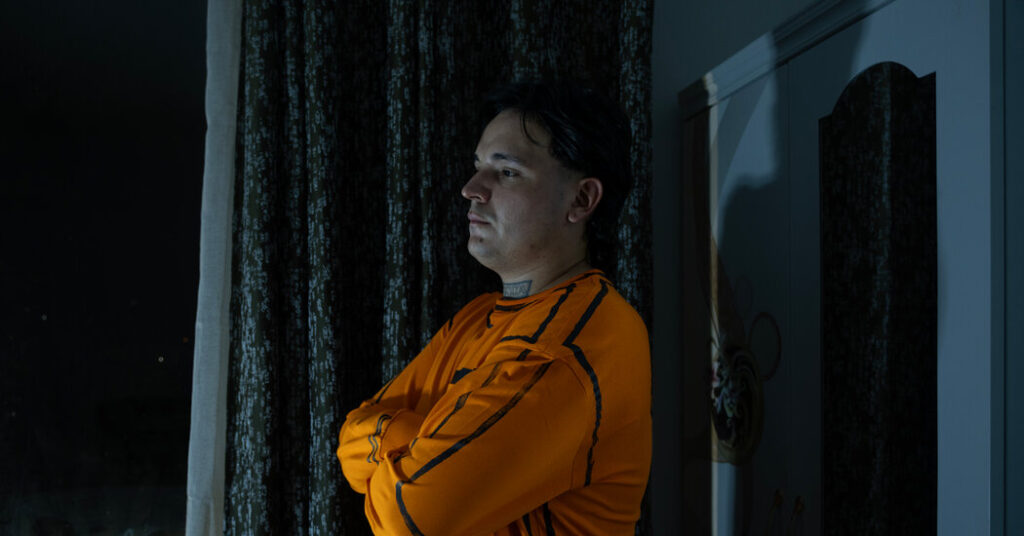
Hugo Palencia said he was delivering meals in Aurora, Colo., for DoorDash and Uber around this time last year. Now, he is in a hotel in the Democratic Republic of Congo, dazed by a journey that he said took him in shackles from the United States to a Central African country that he had barely heard of before last month.
Mr. Palencia was deported to Congo on April 16 along with 14 other migrants from Colombia, Ecuador and Peru, he said. They were all taken to a large hotel outside Kinshasa, the capital city.
“I’m on the other side of the world,” Mr. Palencia said.
The migrants’ odyssey was suddenly thrust in front of the courts this week when a judge ruled that one of them, Adriana Maria Quiroz Zapata of Colombia, was likely deported to Congo illegally. The judge said Ms. Zapata had been sent to the African nation even after it told the Trump administration it could not accept her because of a medical condition. The judge has ordered immigration officials to return Ms. Zapata to the United States.
Mr. Palencia, 25, and other deportees who spoke to The New York Times in interviews at the hotel said they were presented with a choice when they arrived. Officials from the United Nations’ migration agency, or I.O.M., told them they could return to their home countries in Latin America or stay in Congo and hope for the best, he said.
They were given seven days to decide.
The Trump administration’s so-called third-country deportation policy has sent thousands of migrants from the United States to far-flung nations other than their own. In many cases, migrants are stripped of their passports and phones, locked in foreign detention centers and kept in legal limbo.
The administration is counting on the threat of being sent to a country like Congo, South Sudan or Cameroon to act as a deterrent for those planning to come to the United States illegally. In some cases, these nations may be more dangerous than the migrant’s home country, making that threat all the more palpable.
A lawyer for the deportees, Alma David, said several of them had U.S. protection orders making it illegal for the U.S. to repatriate them, for fear of their safety. Though the Trump administration has described U.S. deportees as “barbaric criminals,” none of the migrants at the hotel in Congo has a criminal record in the United States, according to the Congolese government.
The Department of Homeland Security did not comment on the 15 Latin American migrants deported to Congo. In a statement to The Times, the agency said, “Anyone who has been deported received full due process.”
Another woman from Colombia, who requested anonymity for safety reasons, said that she and the other migrants had been told that if they agreed to go home, they would be protected by the I.O.M. and allowed to stay in the hotel for “as long as necessary.”
If they did not accept the offer, she and Mr. Palencia said, agency officials told them they would be on their own and would have to pay for their own accommodations. The deportees are currently on a three-month tourist visa, which does not allow them to work in Congo, the woman said. But they have been allowed to leave the hotel, with supervision.
In a statement to The Times, the I.O.M. said it does not force anyone to return to their home countries. It added that the seven-day deadline is the I.O.M.’s minimum period of support, and that the agency could extend assistance beyond those days.
Sitting on a plastic chair by the pool bar on his first night at the hotel, Mr. Palencia spent some of the little money he had on a Corona to remind himself of home in Colombia.
“We’re all wondering whether we’re more afraid to return to our countries, or to be here in a country like this,” Mr. Palencia said. A U.S. judge had ordered his deportation in 2023 after he entered the country illegally twice, he said, but the judge shielded him from being sent back to Colombia, citing the risk of torture. Instead, the authorities sent him to Congo.
The I.O.M. deadline expired more than two weeks ago and most of the migrants have agreed to go home, Mr. Palencia said.
While they wait inside the hotel’s high, barbed-wired walls, the migrants can swim, play tennis, lounge and walk the tree-lined grounds. The electricity and water are sporadic and the occasional rat scurries past, but there is air conditioning, as well as en suite bathrooms and three meals a day, all paid for by the I.O.M. and the U.S. government, according to Congolese authorities.
But the hotel is not luxurious, and the atmosphere was sometimes tense. The Times saw dozens of Israeli military instructors and Congolese soldiers on site.
Navigating Congo outside the hotel would also be a challenge. Kinshasa is one of the continent’s biggest and most high-energy cities, but with aging, inadequate infrastructure and multiple languages. Its traffic is legendary; the yellow minibuses that bounce over its potholed roads are known as the Spirit of Death.
Congo is also grappling with one of the world’s worst humanitarian crises, and many Congolese have questioned why their government has agreed to accept United States’ deportees when the country’s own urgent problems include millions of displaced people.
“This decision is detrimental to the interests of the Congolese,” wrote Jean-Claude Katende, a prominent human rights lawyer and commentator who has been highly critical of the agreement.
Many accuse the Congolese government of granting President Trump too many favorable deals, including preferential access to Congo’s abundant minerals.
In a rare news conference held last week, Félix Tshisekedi, the Congolese president, said he had imposed certain conditions on the United States before accepting the migrants; the deportees couldn’t be “bad boys.” But he had agreed to take them, he said, “simply because it’s what the Americans wanted.”
“They dreamed of living the American dream, and now they’re living the Congolese dream,” he joked.
It did not take long for Mr. Palencia to agree to go back to Colombia, having judged that the risks in Congo were higher than those he faced at home, he said. “I know nothing of Congo, except the music, which Colombian musicians sometimes cover, translated into Spanish,” he said. “Ideally, I would have been sent straight home.”
“This country is three times as insecure and dangerous as my native country,” he added.
While the migrants are unlikely to feel the effects of the ongoing conflict in eastern Congo, they could face threats largely associated with some of world’s poorest countries: a crumbling health system, dangerous roads, entrenched corruption and tropical diseases like malaria.
The woman from Colombia said she could not go back home. She described being kidnapped and tortured by an armed group, with the complicity of an ex-partner who worked for the government. Seeking asylum in the United States, she crossed the border alone from Mexico in September 2024, and was immediately arrested by U.S. authorities, she said.
She said she had spent a year and a half in Eloy Detention Center in Arizona, trying to navigate the immigration process without a lawyer. She was granted a protection order by a judge last year, she said, but was arrested by I.C.E. officials in March during a routine immigration appointment. (The Times verified the woman’s immigration history and torture protection order with government documents and court records.)
“Where on earth is this place?” she remembered thinking when she found out she was being sent to Congo. “I said, ‘I’m scared to go there. I don’t want to be sent to Africa. You can’t do this to me. What you’re doing isn’t legal.’”
Ms. David, the lawyer, said I.O.M. officials had informed the Colombian woman that she will continue to receive assistance from the agency based on her circumstances, even though she has refused to go back home. The lawyer also said that U.N. migration officials have offered to put her in touch with a separate U.N. agency that processes asylum claims.
The deportees have grown close in the few weeks they have spent together in Congo. They take walks and stay up late waiting to call their families back home. Most spend their days indoors, to escape the tropical heat and the thunderstorms. “We are united,” the Colombian woman said. At night, they danced and sang together to vallenato — accordion-heavy Colombian folk music — or Latin trap.
To pass the time, Mr. Palencia plays Christian Nodal and Yuri Buenaventura songs on YouTube. When he talks to his family members, they sometimes cry over the phone, he said. He finds it difficult to comfort them.
“No human should live in this kind of unspoken prison,” he said. “You don’t know how your child or your spouse woke up, how your family is. It’s very hard when your family depends on you.”
Stranded in Congo, the Colombian woman is terrified of what’s next. Every night, she speaks to her 10-year-old daughter, but has not yet told her that she’s in Congo. She doesn’t want the child to worry, she said. For now, she pretends that she is still living a normal life in the United States.
Hamed Aleaziz contributed reporting from Washington.
Ruth Maclean is the West Africa bureau chief for The Times, covering 25 countries including Nigeria, Congo, the countries in the Sahel region as well as Central Africa.
The post U.S. Migrants Deported to Congo: ‘Where on Earth Is This Place?’ appeared first on New York Times.