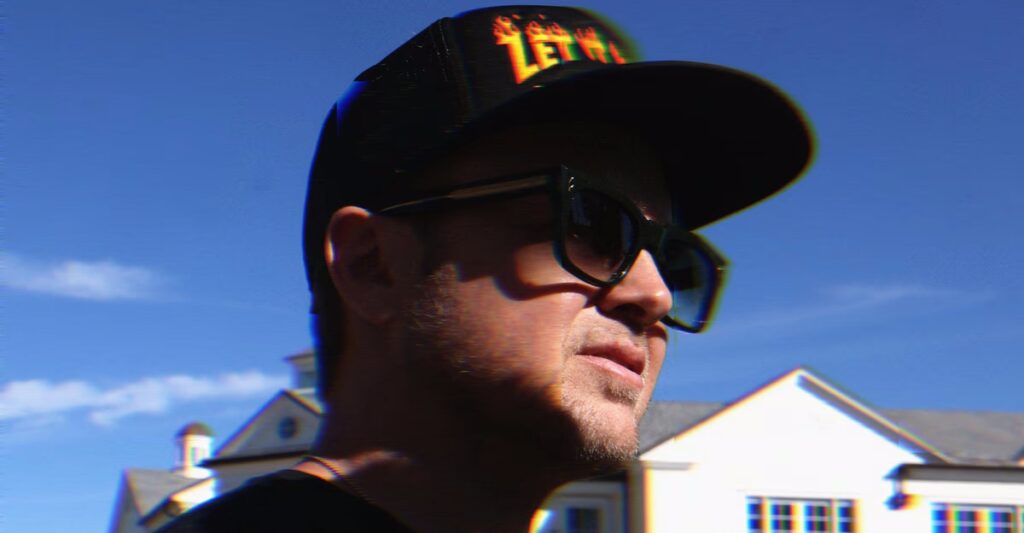
Spencer Pratt, the former reality-TV star and aspiring mayor of Los Angeles, recently spoke with me for a podcast. We met in front of the Airstream trailer that now sits where his house did before it burned down in the Palisades Fire in January of last year. He was excited to share his ideas, if not always able to complete his thoughts, about what he’ll do when he’s in charge. For starters, he’ll clear the drug-ravaged homeless encampments of downtown, bring in developers from all over the world, and use 3-D-printing technology to build “an entire art deco, vibed-out affordable housing.” On the issue of bike lanes, a pet cause of the YIMBY voters who are backing one of his main opponents, Pratt says he’ll do them one better.
“I’m going to have bike tubes through the sky!” he says. “You know, like it’s endless possibilities when you enforce a law and you get rid of the zombies.”
Zombies is Pratt’s term for the tens of thousands of people who live in depraved conditions on L.A.’s streets, many of them addicted to drugs that leave them profoundly incapacitated and sometimes violent. It’s not a nice word to call someone who’s fallen into a bottomless abyss of hallucinations and thrashing self-destruction. But anyone living here knows exactly what he means.
For anyone not living here, it’s nearly impossible to comprehend what has become of the place. It’s not just that, in January of 2025, wildfires destroyed more than 16,000 structures and engulfed nearly 40,000 acres across the county. Apocalyptic as the fires were, they are not the main story and never really were. The main story is one of a city seemingly annihilating itself. Potholes crater the roads. Street lights, stripped of copper wire by organized-theft crews, are out across the city.
[Conor Friedersdorf: Spencer Pratt and the temptations of populism]
Vector-borne diseases such as typhus are breaking out at record levels, the result, at least in part, of 45,000 people (a low estimate, and closer to 75,000 if you include the whole county) living in squalid encampments on sidewalks. Fueled by fentanyl and a new, psychosis-inducing form of methamphetamine, street homelessness is no longer confined to the 50 hellish blocks of Skid Row in downtown Los Angeles. It’s now a city- and countywide humanitarian crisis that lives on freeway ramps, underpasses, parks, the banks of the desiccated L.A. River, the steps of public libraries, and the alleys behind homes and businesses. Undeterred—and unprotected—by laws that are no longer enforced, profoundly sick humans stumble blindly into traffic, defecate in plain sight, wave machetes in the air, threaten violence to passersby, and leave dogs tied to junk-filled shopping carts while they slump on the sidewalk in a fentanyl stupor.
It’s possible to live here and not fully comprehend the scope of it. Not just by dint of wealth, though that helps, but because the region is carved up into separate jurisdictions with seemingly no logic. Pacific Palisades, where almost every structure north of Sunset Boulevard burned to the ground, is part of Los Angeles, but its neighbors up and down the coast, Malibu and Santa Monica, are their own jurisdictions with their own city officials. Inglewood, an independent municipality whose mega sports stadiums have lifted it into affluence, sits adjacent to South Central, where the 1992 riots that follow the Rodney King beating still haunt the streets. Trendy northeast L.A. neighborhoods abut Glendale and Pasadena, cities with their own micro-cultures and tolerance levels for street camping and open drug use. To live in greater Los Angeles is to embrace the arbitrariness of it all. Your neighbor one block over might have an entirely different mayor, police force, and fire department than you do. This is usually immaterial, the kind of thing most people don’t notice until there is a very real reason to notice it, at which point it matters quite a bit.
Such is the setting of 2026 L.A. mayor’s race. On June 2, Los Angeles will hold a nonpartisan primary in which the top two vote-getters, regardless of party, advance to a November runoff. (If someone gets more than 50 percent in the primary, they win right there and then.) Incumbent Mayor Karen Bass, a career politician with deep ties to the city’s progressive-nonprofit world, would probably have skated through a couple of terms if not for the force majeure of January 7, 2025. On that day, she happened to be attending a presidential inauguration in Ghana even though fire-weather warnings had been issued before her plane left L.A. Among her campaign promises in 2021 was never to travel abroad during her time as mayor.
More than a dozen mayoral candidates are on the ballot, including a few unlikely sorts who seemed at first to be running almost as a joke. Until mid-April, Bass’s chief rival was presumed to be Nithya Raman, a city-council member who chairs the city’s Housing and Homelessness Committee and who identifies as a democratic socialist.
Then one of the jokes got serious: Pratt. A lifelong resident of Pacific Palisades, Pratt lost both his own house and his parents’ house in the fires. Shortly thereafter, he found himself in a new kind of reality show. Part community advocate, part self-appointed investigator, he ranted on TikTok about municipal negligence and alleged cover-ups, filed a lawsuit, and testified at a Senate hearing about the failed fire response. On the one-year anniversary of the fire, he took the podium at a rally called They Let Us Burn and announced his candidacy for mayor. “Business as usual is a death sentence for Los Angeles,” he told a crowd of about 1,000, “and I’m done waiting for someone to take real action.”

Pratt is a remnant of the last era of television as something that was actually watched on a television. The designated villain on the MTV series The Hills, which ran from 2006 to 2010, he was of the generation of reality stars for whom mere reality wasn’t enough. Audiences demanded drama—love triangles, career sabotage, family histrionics—and cast members had to supply it while maintaining the premise that it was all true. Therein began a mass erosion of the fourth wall. Tabloids reported on storylines as if they were real-life scandals, a central one being the tumultuous relationship between Pratt and his girlfriend-turned-wife, Heidi Montag, who were famously accused of leaking a sex tape belonging to their castmate Lauren Conrad.
After the show ended, Pratt continued his commitment to notoriety, publicly blowing his fortune on Birkin bags, designer suits, a crystal collection, and, as he wrote in his memoir, The Guy You Loved to Hate, “tens of thousands of rounds of ammo stacked in the closet next to my Armani.” The book, published a few weeks after Pratt announced his candidacy, is a frenzied romp of self-incriminations and about as far from campaign literature as you can get.
The notion of Pratt being the leader of the second-largest city in America is random and absurd. But Los Angeles is itself random and absurd. Built in a waterless basin on top of two major fault lines and fringed with chaparral ready to burn at a moment’s notice, it’s a city that never really should have been here in the first place. And although it flourished magnificently in spite of itself, it is now, in many ways, less here than it has ever been in its entire history. As of January, rebuild permits had been issued for roughly one in five of the homes destroyed across the region. The slowly-then-all-at-once downfall of the film and television industry has gone from something everyone talks about to something actually happening to everyone. Locals all seem to know at least one art director or costume designer leaving the business and going back to school to become a therapist.
As work disappears, the average monthly rent hovers around $3,000 and the average home price is just under $1 million. What that has to do with the number of people sleeping in urine-soaked clothes on the sidewalk is a question that can be debated in good faith. But it is by now a truth almost universally acknowledged that the man waving around a machete on Venice Beach is not doing so because he can’t afford an apartment. He is doing so because his situation requires serious professional treatment, and he should get it whether he wants it or not. Even Mayor Bass recognizes this. “Just putting someone in a house is not enough,” she has said. “There needs to be health care and other social-services support.” Fair enough. But she’s had four years to implement that policy and hasn’t come close.
This sort of fecklessness from politicians, alongside ineptitude, waste, and possibly fraud from the nonprofit sector—a federal audit found the city’s accounting of $2.3 billion in homeless services so opaque that auditors couldn’t track what had actually been spent as intended—is why many Angelenos see no solution other than a factory reset.
After a great deal of initial skepticism, I have landed in that camp. If I thought any other candidate was viable, I would not be entrusting a city I love to a guy from The Hills. But when the moderate Democrat I’d have otherwise chosen couldn’t raise his polling numbers above the low single digits, I crossed the Rubicon into the surreal. It helped that I have never seen an episode of The Hills.
What you will frequently hear about Pratt, including from me, is that even if he accomplished very little of his agenda as mayor—not an unlikely scenario in a city where the mayor shares power with 15 council members and has no authority over the county agencies that run most social services—his mere willingness to acknowledge reality and enforce existing laws would be an improvement over the status quo.
Pratt is a registered Republican (he told me all of his friends are Democrats except one he hadn’t seen since ninth grade), but the mayoral seat is nonpartisan, and he’s running on local issues that cut across party lines. His plan for the homeless is, depending on your point of view, simplistic or seductively simple: get them off the streets and into appropriate treatment, by force if necessary, and do away with the nonprofits that stay in business by perpetuating the cycle. He’s also won over some voters by talking about an issue so disturbing, it all but goes ignored: the horrific abuse of dogs on Skid Row, which rescue groups have said are being bred, sold for drugs, and tortured by addicts and dealers on the streets. Pratt has made the issue central to his platform. “People that are torturing dogs, these are monsters,” he told me. “They are going to jail with Mayor Pratt. Under the jail.”
Pratt told me he believes he can win on dog lovers and safety-concerned moms alone. Whether enough of those moms and dog lovers are registered voters in the actual city of L.A. and not Burbank or Calabasas or any one of countless not-in-L.A. parts of L.A. is anyone’s guess. Less than 15 percent of L.A. voters are Republicans. Rick Caruso, a housing developer who spent $100 million on the 2022 race, switched his registration to Democrat before running but still lost to Bass 55 to 45. Although many Angelenos I’ve talked with now kick themselves for not voting for Caruso, a sizable portion are so unwavering in their hatred of Donald Trump that anyone bearing the slightest resemblance to that other reality star is a hard pass.
[Read: California’s Blue Armageddon]
Fittingly, given his background, it could be argued that Pratt’s message is almost a side note to the medium. The short videos that were instrumental to Zohran Mamdani’s mayoral win in New York already look like vintage films compared with the avalanche of content generated by and for the Pratt campaign. The official campaign ads are notably polished, sincere, and stylish. At the same time, independent creators are using AI to make their own pro-Pratt videos, putting made-up words into real people’s mouths and throwing out all pretense of convention or decorum. Gleefully unwoke and unapologetically crude, they roll out almost day by day, heralded by fans—and maybe sometimes bots—as “the best campaign ad ever made.”
The campaign is rewriting the rules about what is allowed and therefore what is possible. It’s also a bit of a trick mirror, given that selling Pratt as a serious adult requires selling the idea that his previous incarnations weren’t really him but rather an extended piece of performance art. In a cruel electoral irony, some of the people most derisive about Pratt’s mayoral effort are deeply invested Hills viewers who hate the embellished character he created in his own name and can’t comprehend that it’s anything but real.
One of Pratt’s refrains is “I keep being called a reality star, but I’m the only one living in reality.” In a city fed up with leaders who tell constituents that problems happening before their eyes aren’t happening at all, that message lands, as they say in Hollywood. Even if Pratt never becomes mayor, it’s possible that simply saying the truth out loud will make him a bigger force for change than whoever does.
The post Spencer Pratt Is the Factory-Reset Option for Los Angeles appeared first on The Atlantic.