Artificial intelligence has been propelling financial markets around the world this year — but not the stocks that you may have expected.
True, Nvidia, the world’s most valuable publicly traded company, returned more than 21,000 percent over the last decade, according to FactSet. But it isn’t the hottest chip maker in 2026.
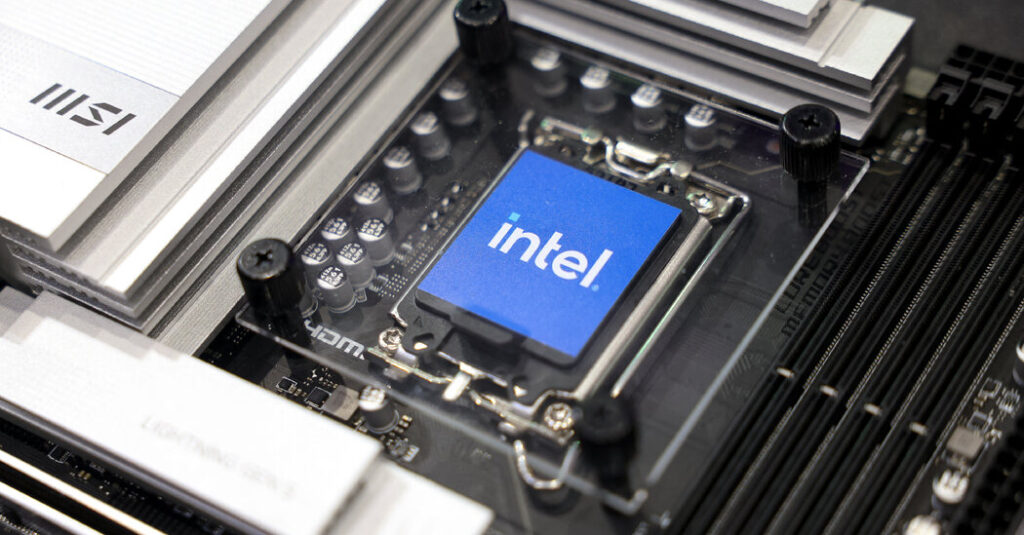
That distinction belongs to an unlikely company: Intel. Only a year ago, Intel needed a bailout by the U.S. government. Yet it has made a remarkable comeback. In April alone, its shares soared 114 percent. For 2026 through Thursday, Intel was up 214.6 percent, more than eight times Nvidia’s return.
Like the fluctuating price of oil and the war in the Persian Gulf, A.I. is moving markets, creating immense levels of stock concentration, not just in the United States but nearly everywhere.
What’s different now is that the A.I. halo is hovering over some different companies. Instead of Nvidia, which makes chips critical for the “training,” or development, of A.I. models, there has been a run-up in share prices for companies whose semiconductors enable “inference” — the answers given by A.I. agents to user queries.
Intel fits that category, and so do other companies in a multitude of places. For example, the stock markets in South Korea and Taiwan have been among the best on the planet this year, thanks to chip makers — led by Samsung Electronics and SK Hynix in South Korea and, perhaps most important, by Taiwan Semiconductor Manufacturing Company, or TSMC. That Taiwan foundry churns out highly advanced chips based on the designs of a host of other companies, including Nvidia.
Chips in Emerging Markets
Thanks to chip companies like these, investors in emerging markets are experiencing a boom year. Consider the MSCI Emerging Markets Index. It is perhaps the most widely followed measure of emerging market stocks, and it was up 22.2 percent in 2026 through Thursday, compared with 8.8 percent for the S&P 500 and 7.6 percent for the Roundhill Magnificent Seven E.T.F. The fund’s holdings comprise Alphabet, Amazon, Apple, Meta, Microsoft, Nvidia and Tesla, all of which have benefited from the A.I. frenzy.
That’s true for emerging markets, too, but partly for an idiosyncratic reason — the way the widely followed emerging market index is constructed. MSCI restricts the weight of Chinese companies to 23 percent — and defines Taiwan and South Korea as emerging markets. Those two technologically advanced economies have a combined weight in the index of 43.7 percent, compared with 23 percent for China and about 12 percent for India.
As a result, TSMC, Samsung Electronics and SK Hynix are the three largest components of the MSCI Emerging Markets Index. A broad bet on emerging markets right now, using that benchmark, is as much a bet on A.I. as an investment in the tech-heavy S&P 500.
That’s heightening a major dilemma. The ascendance of the Magnificent Seven stocks, and other tech companies, has made the U.S. stock market so highly concentrated that even the most comprehensive U.S. stock index funds are no longer well diversified, as I pointed out in January. The rising share prices of the chip companies show that the problem extends way beyond the U.S. stock market.
Take emerging market stocks. They are widely thought to operate in a different dimension from so-called advanced or developed markets, like those in the United States, Western Europe and Japan. That was still broadly true in the 1970s, when I was a student in Taiwan, and, to a lesser extent, in the 1980s and 1990s, when I reported from places like Beijing, Manila, Ho Chi Minh City and New Delhi.
Today, though? True diversification is hard to find.
Some stock markets aren’t dominated by A.I. and chip companies. Along with South Korea’s Kospi Index and Taiwan’s Taiex Index, the GSE Composite Index in Ghana and the NGX All Share Index in Nigeria are among the top four global performers this year, according to Bloomberg.
But both Nigeria and, to a smaller degree, Ghana are oil producers, distributors and refiners. So they are profiting from the rising world oil prices set off by the U.S.-Israeli war with Iran, much as U.S. fossil fuel companies are. Seplat Energy in Nigeria and Ghana Oil have had strong performances — and so have the companies in the S&P 500 energy sector, which leads the overall S&P 500. Valero Energy, a refiner, and Halliburton, an energy services company, are American S&P 500 companies whose investors are reaping profits because of soaring oil prices.
Whether it’s because of A.I. or oil, no stock market is an island.
The View From Philadelphia
In fact, what’s moving world markets to a remarkable degree are semiconductor companies, many of them tracked by a venerable index from Philadelphia, home of the oldest stock exchange in the United States. The Philadelphia Stock Exchange merged with the Nasdaq in 2007 and is a shadow of its former self, but its Philadelphia Semiconductor Index, known as the Sox index, continues.
It’s been transformed into a global index. Top stocks include Intel; Nvidia; ASML, the Dutch company that makes the machines needed to etch circuits for the smallest and most cutting-edge chips; and TSMC. With Intel at the head of the pack, the global chip companies in that index rose 70.5 percent this year through Thursday.
Back in the dot-com era of the late 1990s and early 2000s, the Philadelphia Sox index had a similarly breathtaking ascent, and it made frequent headlines. Its giddy ride this year is reminiscent of that era’s experience, which ended badly, as Bespoke Investment Group pointed out this week. The last time the Sox outperformed the S&P 500 this much was in 2000, Bespoke said in a note to clients.
Michael Burry, the hedge fund manager profiled in the movie “The Big Short,” made a similar observation, but took it much further, warning that A.I. has bewitched the entire stock market. We are, once again, in a tech bubble, he added, and it will surely burst. This time, it’s a closely linked global stock market.
I’m not in the forecasting game, and remain invested in global stocks through index funds, but I’m nervous, too.
The Taiwan Strait
I have another reason for concern. Much as the Strait of Hormuz has become a strategic chokepoint for the world’s oil supply, the Taiwan Strait has an outsize economic importance for silicon chips because Taiwan is home to a vital company, TSMC.
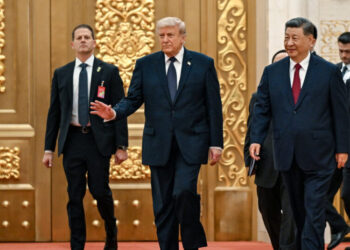
The meetings that accompanied the U.S.-Chinese summit in Beijing included discussions of Taiwan, as such sessions always do. China claims Taiwan as an offshore part of its territory, and says there will be reunification eventually. On the other hand, the official U.S. policy is a posture of “strategic ambiguity.”
There has been an uneasy peace for decades — allowing the semiconductor industry to cluster there and form a “silicon shield.” That has helped to protect Taiwan because the silicon chips produced there have been so crucial for the world economy.
The status quo is what global markets prefer. Political tremors in East Asia could upset the markets as much as the disruptions around the Strait of Hormuz have.
You can invest far and wide in today’s world, but you can’t leave geopolitics behind. Chips, A.I. and oil dominate the world’s stock markets, just about anywhere you go.
Jeff Sommer writes Strategies, a weekly column on markets, finance and the economy.
The post It’s Not Just U.S. Stocks. A.I. and Oil Are Moving Global Markets, Too. appeared first on New York Times.