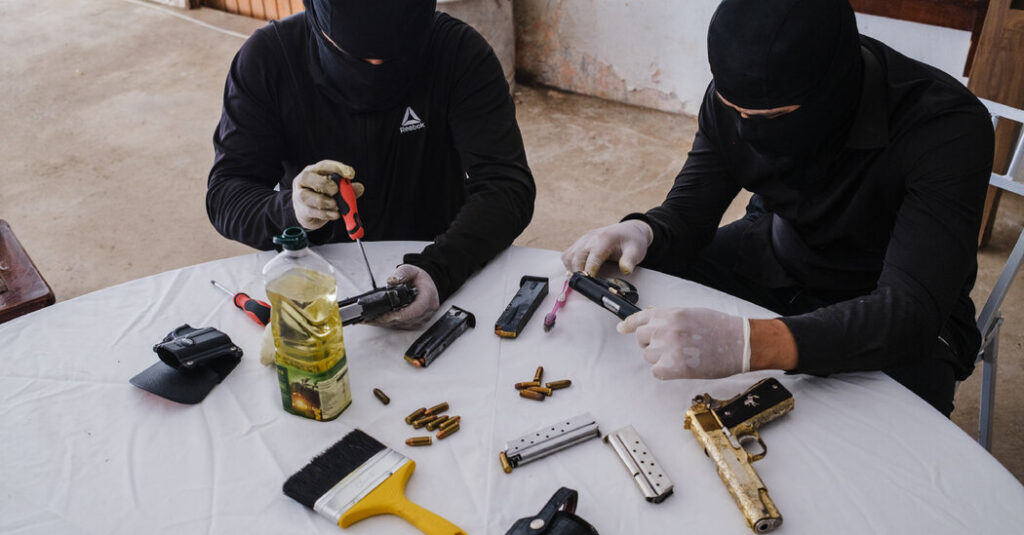
The pact with the authorities worked like this, cartel operatives said: Spoken code words cleared the way for drugs and weapons to pass through security checkpoints unimpeded; names of rivals were given to police officers who detained and delivered them to their enemies; and at times, cartel gunmen joined in on police raids.
For years, an invisible architecture of protection inside various levels of Mexico’s government allowed the Sinaloa Cartel to operate in plain sight, several members of the criminal syndicate told me. That system helped the cartel become one of the world’s most powerful criminal organizations, trafficking billions of dollars worth of fentanyl over the U.S. border, even as key leaders of the group were taken down and an internal war ripped the organization in two.
Days after a U.S. indictment against several Mexican officials was unsealed last month, I spoke with four cartel operatives, who agreed to discuss how the Sinaloa Cartel worked with politicians and law enforcement and military members in recent years. The indictment accuses the governor of Sinaloa state, Rubén Rocha Moya, and nine other former and current state politicians of maintaining a yearslong alliance with the group in exchange for bribes and political support.
Prosecutors in the Southern District of New York describe collusion that reached the highest levels of power in Sinaloa and ran deep through its security apparatus. They allege that the cartel — particularly the Chapitos faction, which is run by the sons of Joaquín Guzmán Loera, known as El Chapo — helped Mr. Rocha win the Sinaloa governorship in 2021 by stealing ballots and kidnapping and intimidating opposition candidates. In return, U.S. prosecutors say, he promised to support their trafficking operations and, once in office, allowed the group to operate freely by installing corrupt officials across state and local governments, who protected the cartel.
Despite more than 200 documented reports of armed intimidation, ballot theft and candidate kidnappings, local and federal electoral authorities dismissed the 2021 turmoil as a group of isolated incidents and formally upheld Mr. Rocha’s victory.
Three of the operatives I spoke with said they were tied to the Sinaloa Cartel’s Chapitos faction. One operative said he was connected to the opposing faction, Los Mayos. They did not provide their full names, and spoke on the condition of anonymity, fearing retaliation from law enforcement and their bosses.
One of them is a senior cartel member who has talked to me several times for my reporting. Another I met in a cartel safe house filled with armed men. I spoke to a third at a location that I have used in the past to meet with cartel contacts, and a fourth after receiving an introduction from that network. My interviews and reporting for this story, including confirming some details of the operatives’ accounts, established that they had a close understanding of the cartel’s inner workings.
Their descriptions of the protection networks involving the cartel and local authorities were corroborated by experts, former officials and evidence from past criminal cases.
Local authorities continue to provide some protection today, the operatives said, though the arrangement has been weakened by an internal war between the Chapitos and Los Mayos factions and a crackdown on criminal groups by the administration of President Claudia Sheinbaum.
“The local police forces in Sinaloa have effectively served as bodyguards for drug leaders,” said Guillermo Valdés, the former head of Mexico’s federal intelligence agency from 2007 to 2011, adding that criminal groups in Mexico have historically bribed entire police forces, exploiting their low pay and the weak protections for those who refuse to cooperate.
Mr. Rocha, who has temporarily stepped aside as governor, has denied the charges in the U.S. indictment, calling them “entirely false and without foundation.” He also said the charges were an attempt by the Trump administration to undermine Mexico’s sovereignty and target the leftist coalition led by Ms. Sheinbaum, of which Mr. Rocha is a member.
Ms. Sheinbaum has declined the United States’ requests to arrest Mr. Rocha, saying that the evidence is insufficient, and has instead directed Mexico’s attorney general to investigate.
Evidence of corruption within Mexico’s government has been well-documented in both Mexican and U.S. courts. In 2024, Genaro García Luna, Mexico’s former security chief and once the face of the country’s war on cartels, was convicted in a U.S. court for taking millions in bribes for over a decade from the Sinaloa Cartel.
In Sinaloa, three of the cartel operatives I spoke with said the most consistent form of protection came through local and state police forces, who acted as reliable collaborators. Officers carried out targeted arrests, tracked rivals and turned them over to their enemies and, in some cases, participated directly in cartel operations, the operatives said.
At times, one operative said, cartel members themselves joined official police raids, dressed in uniform to carry out crimes for the law enforcement officials.
One of the operatives I interviewed, a 22-year-old in Culiacán, the capital of Sinaloa, described how lower-level members were given names of rivals who owed money, were suspected of being snitches or had crossed the organization, and were ordered to pass those names on to police officers and commanders.
Municipal and state officers also provided the cartel with advance warning of major military operations, particularly in rural areas and ranches where cartel leaders gathered or where drug laboratories operated, he said.
“With so much protection,” he said with a faint smile, “you felt like Rambo, or John Wick.”
A couple of months ago, the operative said, he heard over his radio that a senior cartel member had been trapped in a shootout with the military. Another cartel member later told him that state police had intervened, escorting the man out so he could escape.
Another operative, 28, who said he has worked with the cartel since he was 13, told me how that government cooperation extended to some members of the military.
He explained that at checkpoints, soldiers allowed cartel members to pass with drugs or weapons once they provided the rotating code words — “green, R8, delta,” for instance — to verify their affiliation.
The operative had a quiet demeanor and spoke about his line of work with remorse. “I try not to think too much,” he said. “I regret all of it. I wish I had never entered this life.”
He said he grasped the depth of the protection the cartel receives from the authorities about two years ago, when his boss was hunting a man who owed the group money. The notice went out to bus stations, tollbooths, checkpoints and the airport.
A call came in from an airport employee. The target had just bought a ticket to Tijuana.
The operative said he went to the airport, where he was stopped by soldiers. After a brief exchange, he simply offered two words — “La Chapiza” — and he was waved through. He walked up to the target, took him by the arm and showed him the gun under his jacket, he said.
He said that was when he thought, “We’re plugged in everywhere, all the way from the top.”
The operative recounted the story while carrying three cellphones and a radio. One of those phones, he explained, was for both cartel members and police officers to share information on which streets to avoid, where rivals were moving and where military checkpoints were set up.
Officials, employees and ordinary residents understood the terms, he said: Cooperate with the cartel, take some money, and live. Refuse and you die, and the cartel goes after your family.
The cartel operatives also described a sophisticated bribery system that reached across multiple levels of government and into parts of the military. Two of them recalled escorting cartel paymasters as they delivered bags of U.S. cash to police commanders and senior state officials, including a former top security chief.
The extensive collusion between the cartels and the authorities has been documented throughout Mexico.
In Nayarit state, the former attorney general, Edgar Veytia, was sentenced to 20 years in 2019 for aiding a cartel. In Tamaulipas state, former Governor Tomás Yarrington was indicted in the United States and then sentenced in 2023 for laundering millions in bribes from the Gulf and Zetas cartels.
In the state of Guerrero, The Times previously reported that nearly every layer of local government worked with the criminal group behind one of Mexico’s darkest atrocities: the 2014 disappearance of 43 students. Drawing on unpublished text messages, witness testimony and investigative files, The Times found that police commanders whose officers abducted the students also took direct orders from a local cartel. One commander supplied cartel gunmen with weapons; another helped hunt rivals down.
Gina Parlovecchio, a former federal prosecutor in New York who led cases against several cartel leaders, including El Chapo, said that corrupting public officials at all levels of government is central to the cartels’ ability to operate.
Political corruption, she said, “has grown and become such a problem in Mexico because of the power of the cartels and how much money they have and their single-minded dedication to corrupting as many officials as they can.”
In Culiacán, many residents celebrated the U.S. indictment of Mr. Rocha and the other officials as a long overdue reckoning. But three of the cartel operatives said that losing the blanket of state protection could be a fatal blow to their faction of the cartel.
“This could be the end of us,” one said.
Still, one operative described the indictment as just one more example of the relationship between the cartel and the state, which, he claimed, long predates the current administration.
“When you have an entity that exists outside the state, and it’s stronger than the state itself,” he said, his tone almost clinical, “it’s impossible for the state to exist without us.”
Jack Nicas contributed reporting from Mexico City.
Paulina Villegas is a reporter for The Times based in Mexico City, where she covers criminal organizations, the drug trade and other issues affecting the region.
The post How a Drug Cartel Made a Mexican State Its Tool appeared first on New York Times.