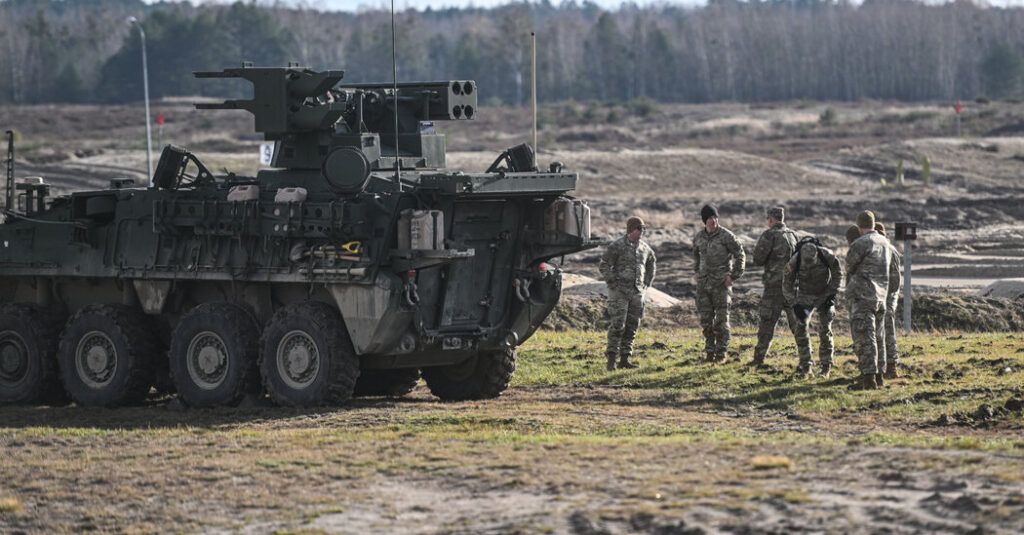
The Defense Department has abruptly canceled the deployment of more than 4,000 troops to Poland, three U.S. Army officials said on Thursday, the second major reduction in American forces in Europe this month that caught many military officials off guard.
Two weeks ago, the Pentagon said it was withdrawing 5,000 troops from Germany and would redeploy them to the United States and other posts overseas. It also canceled a plan developed under the Biden administration to place a missile-equipped artillery unit in Europe.
Those decisions came after President Trump angrily responded to remarks by Germany’s chancellor, Friedrich Merz, that Iran had “humiliated” the United States. Mr. Merz questioned how Mr. Trump planned to end that conflict.
It was unclear why Defense Secretary Pete Hegseth canceled the deployment to Poland, which has close relations with the United States and had been considered a possible location for some of the forces leaving Germany. There are now about 7,400 U.S. troops in Poland, and the Army’s V Corps has its forward headquarters in Poznan, Poland.
A Pentagon spokesman declined to comment on Mr. Hegseth’s decision.
Mr. Trump has told reporters that troop cuts in Europe would go even deeper. He has insisted that “we’re cutting a lot further than 5,000” service members from Germany and threatened to also pull troops out of Italy and Spain, countries that the president says have not supported the administration’s goals in the U.S. war against Iran.
Pentagon officials have said that the administration’s long-term aim is for European allies to shoulder more of the responsibility for defending the continent and lessen the U.S. military role there.
The Pentagon’s pullbacks from Germany were sharply criticized by Democrats as well as some senior Republicans in Congress, who cited the conflicts in Ukraine and the Middle East.
The cancellation of the deployment of the Second Armored Brigade Combat Team of the First Cavalry Division is probably part of a broader realignment of U.S. forces in Europe, said the Army officials and other U.S. military officials, who spoke on the condition of anonymity to discuss operational matters.
But the confusing way in which Mr. Hegseth and his top aides have handled the latest troop cancellation — many of the armored brigade’s troops and much of its equipment have already arrived in Poland — has baffled and angered some Army officials and allies as well. The Army Times previously reported the canceled deployment.
Army Secretary Daniel P. Driscoll and Gen. Christopher C. LaNeve, the acting Army chief of staff, did not mention the move in their testimony before the Senate Armed Services Committee on Tuesday.
A NATO official acknowledged on Thursday that the United States was adjusting its troop presence in Europe but added that the cancellation of the American brigade would not affect the alliance’s deterrence and defense plans. The official, speaking on condition of anonymity to discuss operational matters, said that Canada and Germany had already increased forces on the alliance’s eastern flank.
Poland’s defense minister, Wladyslaw Kosiniak-Kamysz, said in a social media post late Wednesday that the issue “does not concern Poland — it relates to the previously announced change in the presence of some U.S. Armed Forces in Europe.”
The troop reductions in Germany announced earlier this month would return U.S. forces in Europe to the level they were in 2022, before Russia began its war in Ukraine, military officials said. Last year, the Pentagon redeployed a brigade in Romania and did not send replacement forces.
Sean Parnell, a Pentagon spokesman, said in a statement earlier this month that the withdrawal from Germany would be completed over the next six to 12 months.
“This decision follows a thorough review of the department’s force posture in Europe and is in recognition of theater requirements and conditions on the ground,” he said.
Even if the Pentagon pulls 5,000 troops out of Germany, the country would still host the second-largest U.S. troop presence in the world, at more than 30,000, behind only Japan. There are about 80,000 U.S. forces in Europe.
Defense officials say the United States depends on its bases in Germany to stage many of its operations in the Middle East, Europe and Africa.
Steven Erlanger contributed reporting from Berlin.
Eric Schmitt is a national security correspondent for The Times. He has reported on U.S. military affairs and counterterrorism for more than three decades. Contact him securely on Signal: ericschmitt.36.
The post U.S. Abruptly Cancels Deployment of 4,000 Troops to Poland appeared first on New York Times.