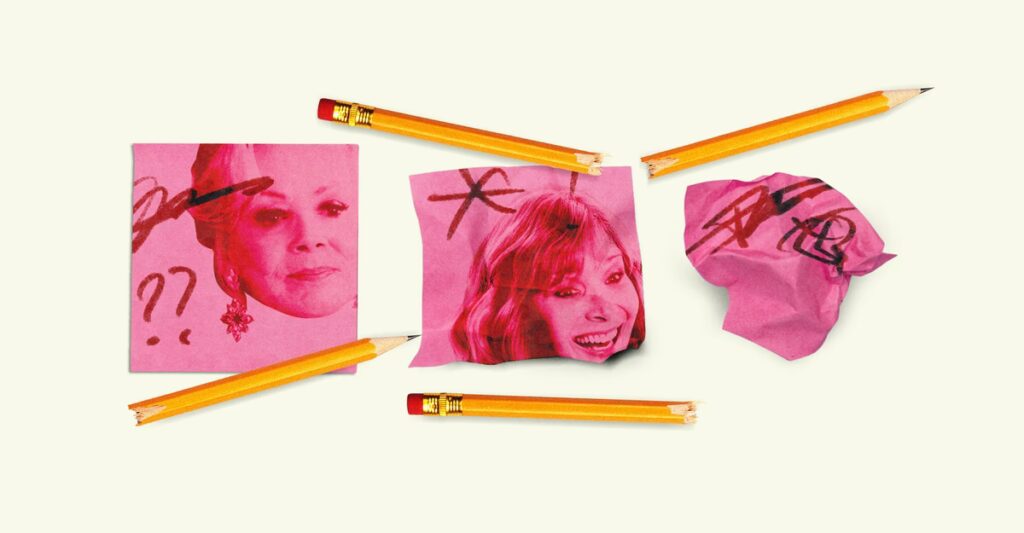
Hollywood, no stranger to existential crises, is finding itself torn on the rise of generative AI. Supporters of the technology argue that it’s the cost-saving future of show business, but opponents say that it could be the end of true creativity. As the debate over AI use rages on in the real world, the fictionalized entertainment industries of Hacks and The Comeback are similarly preoccupied. These self-aware comedies, each following women trying to leave their mark in Hollywood before their cachet expires, have satirized the business with cutting specificity. In their final seasons, the critique extends to AI’s temptations and shortcomings, ultimately making the case for the inefficient art of comedy.
On The Comeback, the flailing sitcom actress Valerie Cherish (played by Lisa Kudrow) is accustomed to sacrificing her dignity for the spotlight. On Hacks, Deborah Vance (Jean Smart), a caustic comedian, will happily sell her stories and likeness in exchange for mountains of cash. So when they’re offered lucrative deals involving generative AI, Valerie and Deborah are receptive. Their instinct to look out for themselves means that neither is particularly moved by pleas from those around her to save writers’ jobs. Instead, they discover a consequence of the technology that surprises them both: AI may offer shortcuts, but it also eliminates the human collaboration that helps them produce their best possible work.
The Comeback’s blunt depiction of Hollywood neuroses has been ahead of the curve since its 2005 debut. Its first season follows Valerie as she films her own reality show, anticipating the boom of Real Housewives–esque series becoming some of TV’s juiciest dramas. Its second, which first aired in 2014, has Valerie confronting the dysfunction of her former workplaces. Twelve years later, The Comeback’s target is AI. Struggling to find work during a sharp post-pandemic contraction on production and amid the ripple effects of the 2023 writers’ strike, Valerie gets an offer from a slinky tech bro named Brandon Wallick (Andrew Scott): She can lead a new comedy show secretly written by a computer program named “Al,” that can spit out jokes faster than any Diet Coke-fueled writers’ room.
[Read: There’s no longer any doubt that Hollywood writing is powering AI]
Valerie generally chooses the quickest path to success; it’s not a shock when she decides to swallow her concerns and embrace Al as her new head writer. With most of the cast and crew kept in the dark to avoid any messy interference from their respective unions, the program generates scripts at a rapid clip. But its limitations quickly become clear. It plagiarizes jokes; it can’t adjust to a live studio audience on the fly. It spins nonsensical stories based on wordplay that it doesn’t understand. When the legendary sitcom director James Burrows (playing himself) attends a taping, he acknowledges Al’s competence but delivers a diagnosis as rueful as it is damning: He saw every joke coming. The funniest and most surprising punch lines, he explains to a chastened Valerie, come from writers “beating themselves up to beat out a better joke.”
But Brandon doesn’t care whether the jokes are any good. All he really wants is a sitcom for his subscribers to fold laundry to, a bar low enough for Al to clear. When Valerie needs to solve a problem beyond basic joke input, though, Al can offer only more of the same. After another live-taped scene falls flat, Valerie brings in an actual writer to help. He, in turn, ropes the rest of the crew into an ensuing brainstorm. Even the kid in charge of maintaining Al, who says he learned to code only because TV writing hadn’t seemed viable as a career, can’t resist turning the scene inside out by hand. Their new joke earns a bigger laugh than Al’s. Much to Valerie’s surprise, she’s more thrilled by the spontaneous collaboration than she is by the audience’s reaction.
Nevertheless, Valerie’s AI stance is fluid. She ultimately leaves the show for one run by humans but also looks the other way as Al keeps writing jokes for the Valerie Cherish AI simulation taking her place. Her loyalty to writers is conditional—unlike her Hacks counterpart, Deborah, whose allegiance to her pen is absolute. She prides herself on reworking her material until it’s sharp enough to kill, and her partnership with her Zillennial co-writer Ava (Hannah Einbinder) challenges her beyond complacency. After more than 50 years in the industry, however, Deborah is a shrewd businesswoman. She’s flattered when a tech investor, Graham Sweeney (Alex Moffat), asks to use her catalog of work for his new app, QuikScribbl, which would embellish users’ eulogies or bridesmaid speeches with her comedic sensibility.
[Read: The human skill that eludes AI]
Ava is horrified by Deborah’s willingness to make the deal. She protests that AI’s “cataclysmic reshaping of society” could wipe out many jobs, including hers. Deborah, ever the die-hard capitalist, shrugs her off. Why should lesser writers failing to read the market be Deborah’s problem to fix? She’s always found a way to break through the industry’s seemingly brick walls. A crushing talk-show cancellation pushed her to succeed in stand-up comedy; a lack of respect from her peers motivated her to write the most critically acclaimed special of her career. If people can’t work around the inevitability of AI, she reasons, they were never good enough to make it in the first place.
But when Graham suggests that she should use the app to write new material herself, Deborah immediately shuts him down. Nothing could offend her more than the suggestion that her love for turning a spark of an idea into an electric joke is a waste of time. She genuinely likes doing the work—a fact that deeply confuses a man whose entire ethos is “But what if you didn’t have to?” AI’s proponents often tout its ability to bypass the hardest aspects of the creative process. But for writers like Deborah, landing a stellar punch line through trial and error upon error is what yields the greatest reward. As with Valerie watching her colleagues enthusiastically reclaim the sitcom script, Deborah realizes the effort is just as important as the end result.
The Comeback and Hacks both make striking arguments about what AI can’t replace and what it means to embrace a technology intended to minimize struggle. Even as Valerie and Deborah prioritize their career goals above all else, they can’t deny the fulfillment of finding answers through collaboration with others, or simply within themselves. Taking the easy route to instant gratification feels good; the satisfaction of doing the work yourself lasts much longer.
The post The Jokes That AI Will Never Get appeared first on The Atlantic.