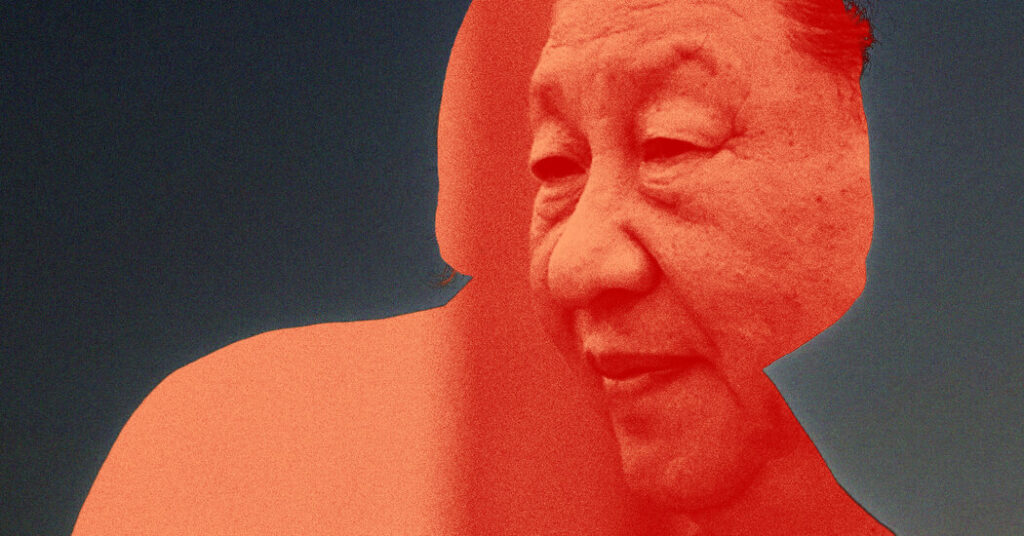
When President Trump imposed 145 percent tariffs on China a year ago, Chinese state media urged the public to revisit a nearly 90-year-old essay by Mao Zedong. The Beijing Daily declared that the text was essential to understanding China’s responses to the “chaotic” attacks of the United States and why China will ultimately achieve a “final victory” against its geopolitical rival.
This required reading was Mao’s “On Protracted War,” a 1938 tract laying out his strategy for defeating the Japanese forces that had invaded China. At its core, it is a meditation on how China can come from behind in a life-or-death contest against a stronger adversary.
President Xi Jinping has praised the strategic foresight, discipline and patience espoused by Mao in the essay, which has emerged as a guiding framework for how China aims to face the United States. He has pointed specifically to Mao’s description of a dynamic, long-term struggle unfolding in three phases: A weaker China initially plays dogged defense, followed by a period of stalemate between equally matched forces, eventually culminating in a powerful, victorious Chinese counteroffensive.
China’s leaders are through with playing defense and have shifted into Phase 2 of Mao’s theory.
The country is far stronger than it once was, in manufacturing, technology, military power and diplomatic influence. Despite a slowing economy and persistent tensions with the United States and its allies, it has become more resilient in the face of pressure from Washington. Mr. Xi easily outplayed Mr. Trump in last year’s trade confrontation, hitting back against U.S. tariffs with Chinese export controls on the critical minerals required for modern technologies, which forced Mr. Trump to step back.
Mr. Xi will provide a lavish welcome for Mr. Trump in Beijing on Thursday, but the Chinese leader almost certainly views the visit — and the broader current state of the relationship — not as a time for accommodation and lasting reconciliation, but as a temporary lull in a longer test of wills.
Mr. Xi’s main goal in this new period of strategic stalemate is buying time to increase China’s strength relative to that of the United States, while seeking to extract concessions from Mr. Trump when he can, including limiting U.S. tariffs and export controls, and halting Washington’s arms sales to Taiwan. Major concessions during Mr. Trump’s visit seem unlikely. Nonetheless, the U.S. president arrives with a weakened hand. The costly war with Iran, which forced Mr. Trump to delay his Beijing trip for several weeks and has battered his approval ratings at home, will no doubt make him eager to spin the visit as a win, giving Mr. Xi leverage.
In these ways, Mr. Xi has the American president right where he wants him.
The enduring resonance of “On Protracted War” in China today reflects Mao’s dictum of “making the past serve the present.” Decades-old historical and ideological references remain central to how the Communist Party legitimates its political, economic and strategic goals and mobilizes the country to achieve them.
Mr. Xi appears to see the competition with the United States through the same prism of long-term struggle that Mao developed to guide Chinese strategy almost a century ago. He and other top officials have invoked the essay as a guide for responding to economic and strategic challenges. Prominent Chinese academics who channel party views repeatedly refer to the tract in framing the rivalry with America, and spectacular commemorations in Beijing last September to mark the 80th anniversary of the end of World War II included copious references to Mao’s text.
Mr. Trump, by contrast, is focused on optics and quick wins. He wants China to commit to purchasing more American products and to strike new commercial deals with U.S. companies, and has gushed about the grand pageantry prepared for him by China during his last visit, in 2017. Yet he seems, at best, uninterested in the topics that matter most to the security of the United States and its allies, such as China’s pressure on Taiwan, its aggressive territorial claims in the South China Sea and cyberattacks on American targets that the United States attributes to China-based actors. The United States has powerful leverage it can use against China, from access to advanced semiconductors to the dollar’s global dominance, but Mr. Trump today appears less inclined to wield it.
Mr. Trump’s shortsightedness plays directly into Mr. Xi’s larger aims. The Chinese leader believes the U.S.-led international order is coming to an end and that what follows is up for grabs. For the first time, he may now see a path toward achieving key goals such as disrupting U.S. alliances in Asia, and weakening American support for Taiwan as well as Washington’s ability to impede China’s rise through technology export restrictions and economic sanctions.
Having moved past playing defense and into a stalemate, Mr. Xi is now steadily working toward the day when China is strong enough to mount a counteroffensive to attain those goals. In March, the government approved a new five-year plan to ramp up China’s already considerable industrial, technological and military capabilities.
China is strengthening ties with Russia and across Southeast Asia, Latin America and the global south, relationships that can help Beijing counterbalance the United States, while taking advantage of Mr. Trump’s alienation of U.S. allies. In recent months, Mr. Xi has hosted the leaders of Canada, the United Kingdom and Germany in Beijing, timing their visits ahead of Mr. Trump’s to underscore U.S. isolation. And countries around the world are turning to China, with its dominant position in green technology, to increase their energy security amid the Iran war’s disruptions.
By contrast, Mr. Trump’s war of choice with Iran is wasting money and matériel that would be better marshaled for long-term competition with China, and his administration is undermining other sources of American strength with actions such as gutting U.S. funding for science and technology.
China faces significant domestic challenges — an aging population, high household debt levels and weak consumer spending. Yet its leaders seem to believe that it is the United States — not China — that is weaker than it appears. As Chen Yixin, China’s minister of state security, wrote in December: America’s “democracy is mutating, its economy decaying and its society fracturing at an accelerated pace.” Globally, he added, U.S. “credibility is rapidly going bankrupt, its hegemony is crumbling, and its myth is collapsing.”
Americans may dismiss such rhetoric as propaganda. But we must reckon with the prospect that many countries agree that China is winning. Mr. Xi is bringing Mr. Trump to Beijing for a visit intended to confirm that to the world.
Julian Gewirtz is a senior research scholar at Columbia University’s School of International and Public Affairs. During the Biden administration, he served as senior director for China and Taiwan affairs at the National Security Council and deputy China coordinator at the State Department. He is the author of several books on China, most recently “Never Turn Back: China and the Forbidden History of the 1980s.”
Source photographs by KENT NISHIMURA and Pool, via Getty Images.
The Times is committed to publishing a diversity of letters to the editor. We’d like to hear what you think about this or any of our articles. Here are some tips. And here’s our email: [email protected].
Follow the New York Times Opinion section on Facebook, Instagram, TikTok, Bluesky, WhatsApp and Threads.
The post Xi Has Trump Right Where He Wants Him appeared first on New York Times.