Something troubling is happening in U.S. education.
Almost everywhere in America, students are performing worse than their peers were 10 years ago, according to new, district-level test score data released Wednesday by the Educational Opportunity Project at Stanford.
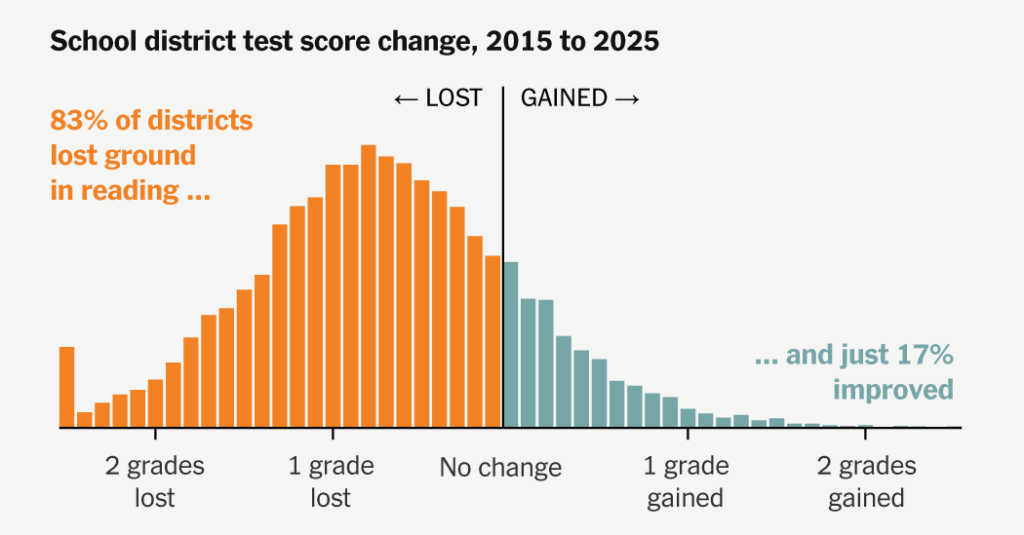
Compared with a decade earlier, reading scores were down last year in 83 percent of school districts where data was available. Math scores were down in 70 percent. The declines have affected both rich and poor districts, and crossed racial and geographic divides.
The new data provides the first national comparison of school districts through 2025, and offers a detailed picture of how individual school districts have performed over time. It underscores that many districts have experienced a long-term slump in student achievement, not just a blip during the pandemic.
From 2017 to 2019, students lost as much ground in reading as they did during the pandemic, and reading scores continued to fall at a similar rate through 2024.
Immediately after the pandemic, there was hope that students would recover quickly. The new data shows that scores inched upward in reading last year, and have climbed more steadily in math since 2022. But it has been nowhere near enough to make up for lost ground, researchers said.
The biggest losses have been among the lowest-achieving students.
“I cannot be more emphatic: This is an enormous problem that’s not getting enough attention,” said Nat Malkus, a senior fellow studying education policy at the American Enterprise Institute.
A report on the new data describes a decade-long “learning recession.” It was released Wednesday by the Education Scorecard, a joint project by Sean Reardon at the Stanford group; Thomas Kane at the Center for Education Policy Research at Harvard; and Douglas Staiger at Dartmouth.
The data includes third- through eighth-grade test scores for districts in 40 states and the District of Columbia, as of the end of last school year. It accounts for about 68 percent of U.S. school districts nationwide. (Ten states were excluded, among them New York and Illinois, because of high opt-out rates or noncomparable data.)
Education experts say there is no single reason for the declines. But the timing provides some clues.
Students’ test scores had been increasing since 1990 — then abruptly stopped in the mid-2010s. That coincided with two events: an easing of federal school accountability under No Child Left Behind, which was replaced in 2015, and the rise of smartphones, social media and personalized school laptops.
The pandemic then accelerated learning declines, especially for the poorest students. Some pandemic effects have lingered. Student absenteeism, for example, remains higher than prepandemic.
Nationwide declines
In one in three school districts in the United States, students are reading a full grade level lower than they were in 2015.
Only a few states, like Mississippi, have avoided the plunge.
Math scores declined more steeply during pandemic school closures but also started rebounding more quickly. Researchers say that’s probably because math is more affected by what happens in school, while reading skills can be developed at home.
Test scores in low-income districts fell furthest, but affluent districts — the types of places families move to for the schools — also lost ground. The changes might not be as evident, because many children are still far above grade level. Yet among the richest districts, more than half have lower test scores compared with a decade ago.
“There are a lot of people in affluent districts who think things are just fine, who have seen big losses over time,” said Professor Kane, the lead author of the report.
The districts with the least improvement since the pandemic, however, were middle-income districts, according to the analysis.
Poor districts received the most pandemic aid from the federal government, which the report concluded helped their recovery. In the richest districts, families have more money to supplement academics outside of school.
The end of federal accountability
Some experts believe that the end of No Child Left Behind, the contentious school accountability law signed by President George W. Bush in 2002, explains some of the recent test score declines.
The law set a goal that all students would be proficient in reading and math, and schools that did not show progress could face penalties. It coincided with a period of rising test scores, especially in math, though reading scores improved more modestly. Low-performing students saw the biggest gains.
The law, though, was deeply unpopular with many educators and parents. Critics said it put an outsize focus on testing, pushing schools to teach to the test and spend less time on other important subjects, like the arts or social studies. In 2015, Congress replaced it, and many states dialed back on requirements.
Like many who have studied the law, Brian A. Jacob, professor of education policy at the University of Michigan, showed that it increased test scores but had problematic elements.
“It was not a cure-all, but I think it really did improve student achievement,” he said. “There’s evidence that school accountability does change behaviors of teachers and administrators and probably parents and students.”
Beyond the policy specifics, its passage reflected a nationwide, bipartisan push to improve education, some experts said, that the country seems to have lost in its absence.
Yet some other countries have seen similar declines in scores, suggesting additional factors may be at play.
Screens, screens everywhere
Something happened globally around the same time: the proliferation of devices, at home and in school.
Nearly half of American teenagers now say they are online “almost constantly,” compared with just under a quarter who said that a decade ago, according to Pew Research Center. Virtually all schools give children laptops or tablets in class, as early as kindergarten.
Few rigorous studies have teased out the role of devices in academic outcomes. Yet educators say there’s no question that swiping has decreased students’ focus and persistence, and time on devices has displaced time spent reading or studying. Far more teenagers — nearly one in three — now say they “never or hardly ever” read for fun.
In turn, schools expect less from students, assigning fewer whole books and simplifying the curriculum, said Carol Jago, associate director of the California Reading and Literature Project at the University of California, Los Angeles.
“There’s no other way, except volume, in order to become a really proficient, fluent, avid reader,” she said.
Radnor Township, an affluent district outside Philadelphia, is one of the highest scoring in Pennsylvania. Teachers still expect students to read full books, including novels like “To Kill a Mockingbird.” The vast majority of students are proficient readers. Still, fewer score at an advanced level on state tests — under 40 percent last year, down from 51 percent in 2015.
It’s harder to keep students’ attention, even after the district banned personal phones and smartwatches during the school day, said Sharon Schaefer, assistant to the superintendent: “We know screens are so stimulating to our students.”
Researchers said a rise in mental health issues and learning disabilities may also play a role in declining achievement, as could changing expectations toward education. The share of Americans who say college is very important has fallen to a record low, 35 percent, according to Gallup, nearly half what it was a decade ago.
Still, some districts are making uncommon gains.
What could help
In 2015, Compton Unified, a poor district south of Los Angeles, was scoring 2.5 grade levels below the national average in math and reading. Today, its students are about at the national average, according to the new data.
The superintendent, Darin Brawley, said one reason was a focus on getting children to come to school every day. It’s a topic at his regular meetings with small groups of principals. In Compton, just 5 percent of students are chronically absent, compared with an estimated 23 percent nationally.
Superintendent Brawley credited a number of other strategies, including giving short, weekly quizzes to assess student learning and using the results to identify students who need tutoring. The tutoring happens during the school day — not after school — an approach he says is crucial for reaching the neediest students.
Washington, D.C., another district with test score gains, has also invested in tutoring, and was an early adopter of the science of reading, which emphasizes direct, sequential teaching of phonics, vocabulary and other skills.
The new report found that science of reading reforms were necessary, but not sufficient, to improve scores. Only states that had embraced science of reading reforms showed improvement from 2022 to 2025 — yet not all of those that did saw gains.
Washington, D.C., has also taken more unusual measures trying to find “the right recipe,” said Lewis D. Ferebee, the chancellor. Teachers who are deemed highly effective, a rating that includes raising test scores, are eligible for bonuses up to $25,000. Teachers receive a bigger bonus for working in the highest-need schools.
But in many places, addressing the “academic, generation-long decline” doesn’t seem to be a priority, said Mr. Malkus of the American Enterprise Institute.
“I think the thing that’s going to haunt us, whenever Congress and some states wake up to what’s going on,” he said, “is that it wasn’t the pandemic.”
Claire Cain Miller is a Times reporter covering gender, families and education.
The post Why U.S. Test Scores Are in a ‘Generation-Long Decline’ appeared first on New York Times.