The American job market is behaving in a way that economists are struggling to explain. The economy is growing. Unemployment is low. And yet, for millions of workers, finding a job has become harder than at almost any other point in decades.
Amanda Munro, 32, followed every rule she had been taught. She earned a graduate degree, cultivated expertise in data science and environmental policy, and began establishing a track record as a policymaker, negotiating line by line with foreign governments over rules designed to protect sharks and rays on the high seas. When she was laid off last year as part of the federal cuts imposed by the U.S. DOGE Service, she expected to find another job quickly. Instead, she ended the year sorting packages in a warehouse in Portland, Oregon, earning $19 an hour. “It feels like the rules changed,” she said.
The struggle is felt across the U.S. workforce, but for the millions of students graduating this spring, it arrives at the worst possible moment.
A ‘low-hire and some-fire’ economy
The first clue that something unusual is happening: Companies are not bringing on new workers the way they normally would in an economy this strong.
“It is weird for us to have GDP growing at the rate it is and the hires rate be this low,” said Laura Ullrich, chief economist at the job search platform Indeed.
The hiring rate — the share of the workforce that starts a new job in a given month — has hovered well below pre-pandemic levels for more than a year, running at 3.5 percent in the most recent month, a level more typical of the sluggish years following the 2008 financial crisis than a growing economy.
The headline unemployment rate, at 4.2 percent, looks healthy. But that figure has been buoyed by a shrinking labor force: Fewer people are actively looking for work, which keeps the rate down even as hiring slows.
Layoffs remain low by historical standards, but they vary widely across sectors. “In some narrow sectors, certainly tech and media included, it is low hire and some fire,” Ullrich said.
The pattern is most visible in tech, where some of the largest employers have shed staff. Amazon (founded by Washington Post owner Jeff Bezos) laid off 16,000 corporate workers in January. Oracle followed in March with cuts affecting as many as 30,000 jobs. Meta said in April it would eliminate 10 percent of its workforce, roughly 8,000 jobs. PayPal announced another 4,800 in early May.
To an extent, these companies are trying to recalibrate after their hiring sprees of 2021 and 2022, when many had raised pay, offered flexible schedules and signed people quickly. Ullrich says she’s hearing from companies: “We hired too many people, so we don’t need to hire a lot of entry-level people. We still have people here.”
Higher interest rates have also made expansion more expensive, pushing many firms to invest in technology rather than headcount.
The AI hiring trap
Another reason hiring has slowed is uncertainty about artificial intelligence. Even though the technology has not yet replaced large numbers of workers, it is already shaping how companies think about hiring. “I don’t think this is AI displacement,” said Ben Zweig, chief executive of Revelio Labs, a workforce data company. “What we’re seeing is anticipatory.” Instead of rushing to bring on new workers, some firms are waiting to see how the technology evolves and which tasks it will eventually take over.
AI is also reshaping the hiring process itself. Recruiters say they are being overwhelmed with applications, many generated by AI, making it harder to identify strong candidates. “Everyone knows it’s a problem,” Zweig said. “We’re getting flooded.”
For job seekers, the hiring process can appear to offer little feedback and even less recourse. Paula Sales Corpuz, an 18-year-old business and accounting major at Montgomery College, a community college in Maryland, has never met an employer in person in a year and a half of job searching, she said. Instead, she was screened through automated video interviews.
“The platform gives you a question, and then you just have to record yourself answering it,” she said. So far the approach has led mainly to silence. “I feel like they haven’t taken the time out of their day to look over the résumé or the application. They just say, ‘We’ve picked another applicant.’ That’s about it.”
On the other side of the screen, automated systems scan incoming applications for keywords before a human reviewer ever sees them, turning the résumé into a puzzle to be solved rather than a record of experience. Job seekers say tailoring each application to match those terms has become almost mandatory, with little guarantee it will work.
Entry-level jobs are vanishing
Samantha Gilstrap, 28, graduated from journalism school in 2019 and has barely caught her breath since. She entered the job market as the pandemic began, later lost a digital reporting job at WUSA9 during industry consolidation, and has since applied for hundreds of jobs. Most applications have led nowhere. “The only times I’ve been able to interact with humans is if it’s a who-you-know basis,” she said. She is now couch surfing to save money. “At some point, if things don’t work out, I will be walking into the nearest McDonald’s.”
Her experience reflects a broader pattern among recent graduates. The unemployment rate for people ages 22 to 27 who recently completed college hit 5.6 percent in the final months of 2025 — well above the 4.2 percent rate for all workers, according to national data from the Federal Reserve Bank of New York. Nearly half of that age group was underemployed, meaning people were working in jobs that did not require a degree, the highest share since 2020.
The squeeze is hardest on those just starting out. At one point last summer, new workforce entrants made up a larger share of the unemployed than at any point since the late 1980s — higher even than during the Great Recession.
When hiring slows, the door closes first on those without an existing foothold. For the class of 2026, the timing could hardly be worse.
“It is getting increasingly clear that young people are being more affected by AI than older workers,” Zweig said. Companies are not eliminating jobs at scale, but many are slow to hire junior workers. At the same time, older workers are staying in the labor force longer, leaving fewer openings for new arrivals.
Shifting goalposts
Even when jobs are available, the bar has shifted.
Positions once considered entry level now often require several years of experience, technical expertise and familiarity with artificial intelligence tools. With fewer openings and more applicants, companies are holding out for candidates who can do the job immediately and need little training. “Because they can,” Ullrich said.
Employers are also looking for a different mix of skills. An analysis of millions of job postings by Indeed found that communication skills now appear in nearly 42 percent of all listings, while leadership skills feature in nearly a third — capabilities that are harder to prove on a résumé and harder still to demonstrate without an existing professional network.
Christine Beck, a career coach who works with early-career job seekers, said employers are asking more of the people they do hire. “Companies are trying to do more with less,” she said, pointing to a growing emphasis on candidates who can lead projects and expand an organization’s capacity without adding headcount.
Meanwhile, the technical skills required for many jobs keep shifting, making career planning difficult. A certification or course can take months to complete, only for demand to move elsewhere by the time it is finished.
Where the jobs actually are
Lance Hebert, 39, of Seattle, has applied for jobs in two very different markets. Between 2015 and 2020, when he worked as a physical therapist, it took him fewer than five applications to land every role he held. But his most recent job search, as a web developer, involved 453 applications to get a handful of interviews and two offers. He eventually accepted a role helping health care companies set up new software systems. “When I pivoted out of physical therapy into tech, that’s when the job search became much harder.”
The care economy appears to be the only engine still running smoothly. Of the net 369,000 positions added across the entire economy since the start of 2025, health care alone accounted for nearly 800,000 — meaning every other sector, taken together, shed jobs.
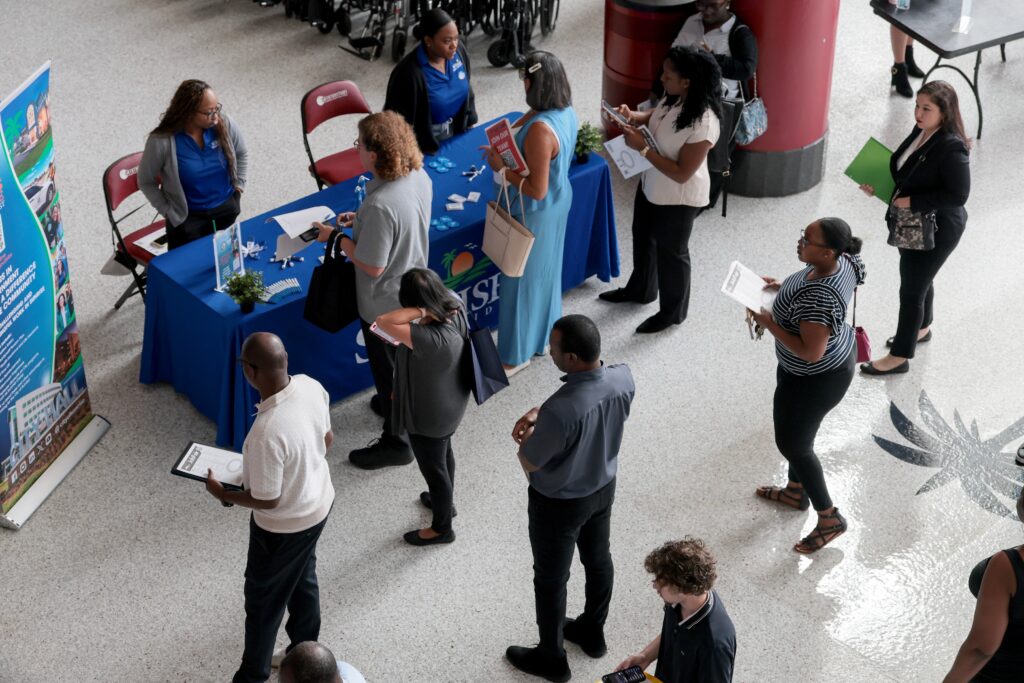
At the Goodwill Excel Center in Baltimore, where adults come to earn their diplomas and retrain for new careers, coordinator Joe Binder knows exactly where to point his graduates. “We’re seeing tons of spaces still being opened in health care,” he said.
Interest in the retraining program has surged: Jonathan Balog, who handles marketing for the school, said roughly 400 people are on the waiting list. “The demand is tremendous,” he said.
Adding to workers’ sense of disorientation is the fact that different corners of the workforce are weakening at different times: federal workers facing mass layoffs, logistics and manufacturing contracting after their pandemic surge, white-collar hiring quietly freezing up.
Kevin Gordon, head of macro research at the Schwab Center for Financial Research, has a name for it: “rolling labor recessions.” Instead of a broad downturn that triggers a national crisis, the pain hits one group after another.
Even organizations that have spent more than a century helping people find work say the path forward has become harder to predict. “Everyone is unclear what the labor market will be,” said Katy Gaul-Stigge, president and chief executive of Goodwill Industries of Greater New York and Northern New Jersey.
Munro, the ocean policy expert, spent her months working in the warehouse alongside a former graphic designer and an ex-IT contractor whose job with the Forest Service had ended when his contract ran out, each with their own version of the same story.
In January, she was rehired by the federal government. The return brought relief, but did not erase her fear that the ground was still shifting.
The post Why the U.S. job market is so hard, especially for recent college graduates appeared first on Washington Post.