There are images and shots crafted in Jane Schoenbrun’s “Teenage Sex and Death at Camp Miasma” that we still don’t have words for. Some films come to you not as media you watch but visions that possess you, and that approximates the haunting and spellbinding world that Schoenrun and their collaborators have so lovingly crafted. It’s a world where slasher killers slam dead campers against tetherball poles till they explode, where bodies line the walls of a video store like fiberglass insulation, where a scene of Gillian Anderson seductively holding a cornucopia of KFC dissolves an ignited fireplace.
Skewering everything from transphobia in slasher films to Hollywood’s hypocrisy of supporting “woke” stories only when it’s convenient, Schoenbrun has established themselves as a master portal maker. They’ve always been adept at making digital worlds – whether they be television shows in “I Saw the TV Glow” or the recesses of the internet in “We’re All Going to the World’s Fair” – as “private alternate universes” (as one character says in the film). These virtual worlds offer safety and the ability to be seen that the outside world fails to provide.
With “Teenage Sex and Death at Camp Miasma,” Schoenbrun further interrogates their relationship to these spaces and the tension between the tragedy of their necessity and the beauty of their reality. What happens to these spaces when we feel comfortable in our bodies again? Does resurrection always have to require a type of death first? Is there ever a point in our lives where it’s too late to transform? That the film manages to make room for these ideas while lacing it all with enough tacky genre thrills to make it all palatable and thought-provoking is a miraculous feat in its own right.
The film’s opening sequence wastes no time in making this world feel lived in. An up-and-coming filmmaker, Kris (Hannah Einbinder), is hired to direct a remake of the long-running slasher film “Camp Miasma” series. As Kris cleverly notes, her hiring kills two birds with one spear: Hollywood is ever hungry for old IP to exploit, and by hiring an LGBTQ+ filmmaker, the studio can wave away criticism over revising a notoriously anti-trans franchise.
As Okay Kaya’s “Nightswimming” plays over the opening credits, we see the story of “Camp Miasma” through merchandise and newspaper clippings, tracing the way the film went from a surprise cult hit to an oversaturated franchise over the span of a few installments. Board games and a magazine cartoon mocking the series shows how quickly stories can be ground into mediocrity under the Hollywood machine.
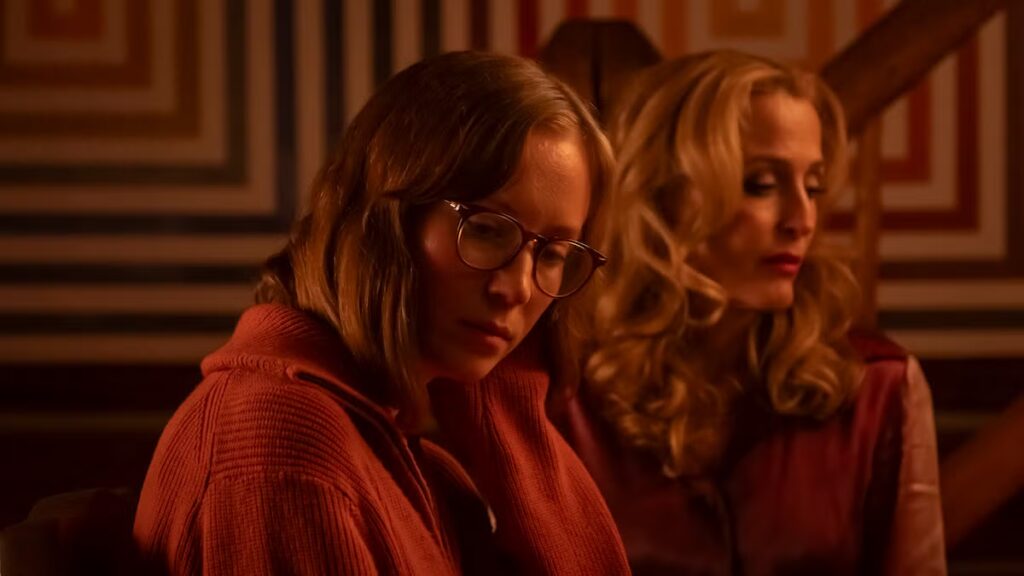
Kris wants to give a role in the remake to Billy Presley (Gillian Anderson), who as a teenager had played the final survivor in the first “Camp Miasma” movie. She takes a meeting with the retired actor, who has set up her home in the abandoned camp where the original films were shot. Their conversations start awkardly enough, but it’s evident that there’s a connection between them that goes deeper than just curiosity. It’s not just desire, but a hunger between the two women that brews beneath their eyes, as emotional guardrails go down and the two discuss their creative and personal lives. It’s easy to get caught in the spell of their bewitching attraction.
The real treat is that this is really multiple films in one. We’re treated to extended sequences from past “Camp Miasma” that are fully realized works of art in their own right, including an uproarious extended massacre sequence choreographed to Counting Crows’ “A Long December.” These re-creations are a testament to the respect Schoenbrun has for thresholds, those strange, colorful, and often violent portals that were our safe spaces when we had nowhere to go.
As if to further underscore this theme, Kris confesses, “Sometimes, I kind of am my work” to Billy. For rest of the film, Kris works to untangle herself from her vocation, to get to the core of who she is rather than hiding it through overwork. She’s long felt insecure about herself, and she soon realizes her time with Billy is a portal in and of itself, a way for her to come to terms with how she’s become estranged from her own body and ashamed of her desires.
You feel the joyful sense of collaboration between production designers Matt Hyland and Brandon Tonner-Connolly, art director Courtney Stockstad and set decorator Hana Cook in the blood-soaked world of the “Camp Miasma” films or in Billy’s camp home, which feels like a Lynchian version of Narnia. While the film is primarily a two-hander between Anderson and Einbinder, the “Camp Miasma” sequences are a way for new and old collaborators of Schoenbrun’s to appear and leave a memorable impression even if they’re quickly dispatched. Of particular note is Eva Victor as DJ Ella Giastic, who plays into the gregariousness of their character’s spiky hair and punk rock attitude, while still allowing for shades of tenderness and humor to bleed through.
In her poem “Effigy,” Gabrielle Bates writes, “What the self forms around / cannot be undone,” and later, “How am I to live if this is who I am?” These words seem sown in the very DNA Schoenbrun’s work, which has explored this delicate, painful nature of uncoupling one’s self and soul.
There are certainly sequences and motifs (including a cornucopia of food brands) that may feel a bit too much to fully process, but that’s a feature of “Teenage Sex and Death,” not a bug. In many ways, the inability to form cohesive or coherent thoughts after viewing the film is a sign of its odd potency and staying power.
It’s hard to totally accept, let alone fully digest, a new gospel when you first encounter it, but the gift of work like Schoenbrun’s is that, above all else, it is characterized by a charitable spirit of invitation. Settle into their assured and madcap wavelength and watch the scales fall from your eyes. Be sure to bring plenty of gummy candy; as Kris points out, it’s the golden age for it, after all.
The post ‘Teenage Sex and Death at Camp Miasma’ Review: Watch Flesh, Fluid, and Gummy Candy Collide appeared first on TheWrap.