This is the second article in a series about travel and the 250th anniversary of the Declaration of Independence.
There’s something about Benjamin Franklin. He is the least dead of America’s founders, and the most relatable, the founder you want to have a beer with. Thomas Jefferson and James Madison have scholars; Franklin has fans — including me.
As the nation prepares to celebrate 250 years of independence, I am particularly enthralled by the diplomatic magic Franklin performed in France as a U.S. representative. Against steep odds, he managed to persuade a wary French government to back the American rebels with guns and money, thus enabling George Washington and his Continental Army to triumph over the British.
What really intrigues me is that Franklin pulled off this diplomatic feat in his 70s, while suffering from a number of ailments. It was in his closing act, a time when he could have been doing the colonial equivalent of golfing in Florida, that he accomplished the most and changed the most.
Traveled the most, too, for Franklin was the most peripatetic of the founders, logging some 42,000 miles and crossing the Atlantic eight times.
With all this in mind, I, too, crossed the Atlantic, a journey that took seven hours, not seven weeks, as it did in Franklin’s time. Before long, I found myself in the Brittany village of Auray. This is where Franklin came ashore on a cold December day in 1776. Normally, he loved sea voyages, but not this time. The ship that carried him and his two grandchildren from Philadelphia was “a miserable vessel,” he wrote in a letter to his daughter and son-in-law. The autumn seas were rough, the quarters cramped, the food too hard. The journey, he recalled, “almost demolish’d me.”
Franklin didn’t stay long in Auray (though that hasn’t stopped the town from naming a quay, a bar and an ice cream flavor after him). From my vantage on the terrace of Bar Crêperie Le Franklin I could survey all of Auray: the wooden sailboats bobbing in the harbor, the black-roofed buildings contrasting with cottony clouds, the sidewalk booksellers who arrange their offerings in neat, adoring rows.
The next day, Franklin began the arduous carriage journey to Paris, dodging armed bandits and fawning fans alike. Thanks to his electrical experiments, he was famous in France. Cheering crowds lined Paris’s Rue de l’Université to greet him. He soon settled in the village of Passy — today part of Paris’s posh 16th Arrondissement.
‘Mon Cher Papa’
Passy is a neighborhood where no one walks. They stroll, so I did, too. I strolled past the impromptu book stalls where each volume was, again, displayed with great care and — there is no other word for it — love. Franklin, the printer, no doubt would have appreciated this passion for books. I strolled past utility workers, leather-apron men, as Franklin called the working class, wrestling with a tangle of cables. I strolled to the Marché de Passy, a covered market featuring sides of beef, cuts of veal and wheels of cheese the size of my head. No wonder Franklin had trouble resisting.
I couldn’t help noticing a profusion of opticians in Passy. Very Franklin, given his invention of bifocals.
I had strolled down Rue Benjamin Franklin and then a narrow street, Rue Raynouard, when I spotted it: a plaque marking the spot where the Hôtel de Valentinois once stood. This had been Franklin’s home and the makeshift U.S. mission, the nation’s first. The mansion was ideally situated — close to Paris but far enough away to offer breathing space and, best of all, on the road to Versailles, the seat of government. It overlooked vineyards sloping toward the Seine. It had a wine cellar and, once Franklin moved in, a lightning rod (another Franklin invention) on the roof and a printing press in the basement.
Franklin adored Passy. He delighted in the spring water, far healthier than anything in London, where he had spent 17 years. As he relayed to his sister Jane in Boston: “I live in a fine airy house upon a hill, which has a large garden with fine walks in it, about ½ an hours drive from the city of Paris. I walk a little every day in the garden, have a good appetite and sleep well. I have got into a good neighborhood, of very agreeable people who appear very fond of me.”
That was an understatement. The French adored Franklin and couldn’t get enough of him. “Mon cher papa,” they called him. He was constantly buttonholed by “projectors, speculators, and adventurers of all descriptions,” recalled his grandson Temple, years later, in a compilation of his grandfather’s writing. Franklin was a regular at salons, especially those hosted by Madame Helvétius, the widow of a renowned philosopher, Claude Adrien Helvétius, and an intellectual force in her own right. Her cat-filled house in Auteuil, a short carriage ride from Passy, was nicknamed the Nine Sisters, after the Nine Muses; the “philosophes” who gathered there were known as L’Académie d’Auteuil. Franklin often played chess there late into the night, as long as the candles held out.
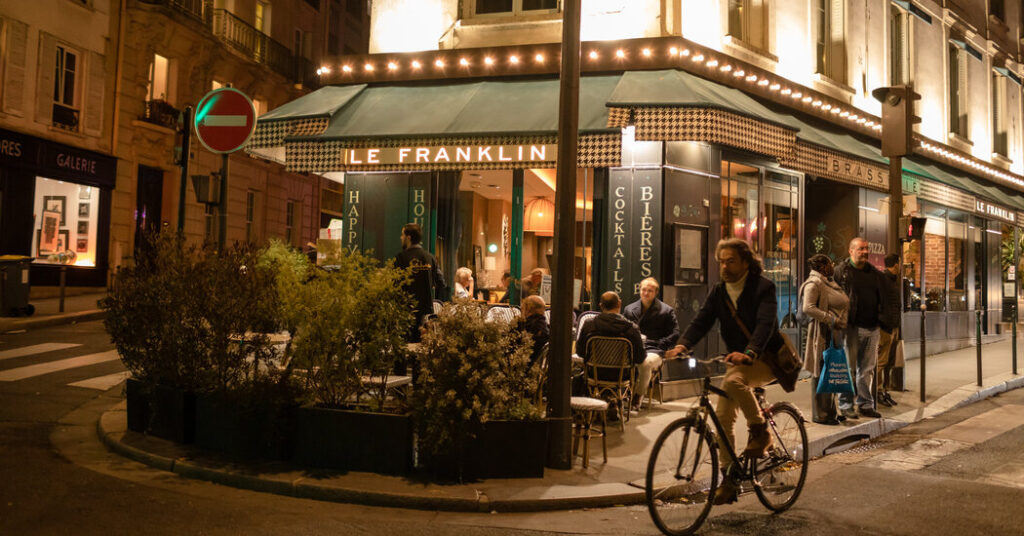
The academy is long gone, but a short distance away I stumbled upon Le Franklin cafe, with its jarringly contemporary vibe, and attempted in bumbling French to order la salade Franklin, a mix of smoked salmon, cherry tomatoes, apples and shrimp. I’m not sure what is Franklinesque about that, though he was fond of apples, Newtown Pippins, in particular.
On to Versailles
After a few wrong turns, I found the right station and boarded the train for Versailles. It took 35 minutes. Franklin’s journey by carriage took several hours, and the rough, bumpy ride aggravated his kidney stones. Still, he didn’t complain.
When the train arrived, it deposited me into a cornucopia of Americana: KFC, McDonald’s and Starbucks. What would Franklin make of this unholy trinity? He’d smile, I’m sure, pleased that his prediction proved correct. American culture was indeed ascendant.
I walked along a gravel, tree-lined path. Some 250 years ago, a trio of American emissaries, led by Franklin, walked here, too, hats in hand. Today Americans come by the thousands, looking not for arms and money but for trinkets and Instagram pics and, perhaps most of all, a whiff of the royal scent that, inexplicably, we children of rebels can’t seem to get enough of.
I skirted the crowds, heading to one room in particular. Markedly smaller than the others and furnished more simply, the Council Room is among the palace’s least popular draws. I saw why. The ceiling is bare, the few mirrors small and dirty. The floors are simple parquet, like something you’d see in a basement rec room, not a French palace. On one side of the room is a fireplace and, in the center, a wooden desk. King Louis XVI conducted business here.
I can’t picture Franklin in over-the-top spaces in Versailles, but I can picture him here, where sleeves were rolled up and important decisions made. It was here where, in 1778, he had an audience with the king. They were commemorating the two treaties France and the infant United States had just signed. No more half measures. The French were now all in with les insurgés, as they called the Americans.
This was a major breakthrough, one that Franklin accomplished not by coercion or bribery, but owing to his gentle charm and deep empathy. This approach often put him at odds with his more caustic colleagues, John Adams and Arthur Lee.
To this day, Franklin is revered in France. As for the others, well, let’s just say there is no Rue Adams or Rue Lee.
Franklin went on to help negotiate the treaty ending the Revolutionary War, and finally, in 1785, the Continental Congress relieved him of his duties, dispatching Jefferson to succeed him. “Having finish’d my day’s task, I am going home to go to bed,” he told David Hartley, his British counterpart at the peace negotiations. But his health had deteriorated further, and at age 79, he had no guarantee he would survive the long journey to Philadelphia.
“Stay,” his French friends pleaded. “Spend the rest of your days here, in the company of those who love you.” What to do? Franklin explained his predicament in a letter to a friend, the sea captain Nathaniel Falconer. “The French are an amiable people to live with: They love me, and I love them. Yet I do not feel my self at home, and I wish to die in my own country.”
Maybe that is the true definition of home — not where you want to live but where you want to die. For Franklin, it wasn’t even close. In July 1785, he began the long journey from Passy to Philadelphia, once again accompanied by his two grandchildren. Too ill to endure the rough carriage ride to the port city of Le Havre, Franklin benefited from one last French kindness: Queen Marie Antoinette lent him her personal litter.
On my last day in Paris, I returned to Rue Benjamin Franklin. At one end of the street is a bronze statue of Franklin. He is seated, upright and alert, as if he might spring into action at any moment. His expression is bright and attentive, his lips revealing a trace of a smile, as if he is reprising one of the bawdy jokes he liked to tell. He does not look young, nor does he look old.
Franklin aged without angst. He never let his ailments disturb his equilibrium. He never succumbed to the stubborn crabbiness that many older people do. If anything, he grew more sanguine, and serene, with age.
He owed this tranquillity, I think, to the fact that, in France, he had found not only a people who loved him but also his true calling: charming revolutionary. And at age 70! Maybe, just maybe, I thought, as I rejoined Rue Benjamin Franklin, there is hope for the rest of us, too.
Follow New York Times Travel on Instagram and sign up for our Travel Dispatch newsletter to get expert tips on traveling smarter and inspiration for your next vacation. Dreaming up a future getaway or just armchair traveling? Check out our 52 Places to Go in 2026.
The post Searching Paris for Ben Franklin, America’s ‘Least-Dead’ Founder appeared first on New York Times.