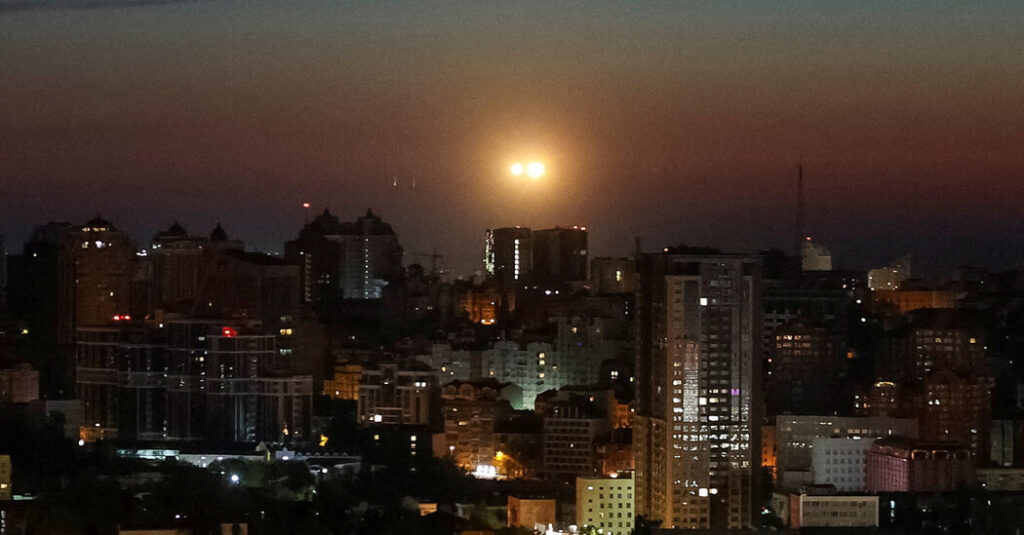
As the clock ran out on a three-day truce announced by President Trump, hundreds of Russian drones, guided bombs and missiles swarmed the skies over Ukraine. Four Ukrainian civilians were killed on Tuesday, and eight more died in strikes early Wednesday, officials said. The fighting on the front carried on, without having paused at all during the ostensible cease-fire.
The latest truce during the Russia-Ukraine war illustrated how the concept has been stripped of its traditional meaning in the Trump era. Through history, cease-fires have generally been reached after lengthy processes that help warring sides achieve a lasting settlement. But in the war in Ukraine, analysts said, they have become a tool of performative diplomacy, stand-alone commodities used to manage media cycles while the machinery of war grinds along.
A decoupling of cease-fires from peace processes has occurred not just in Ukraine but also in the Middle East. In the U.S.-Israeli war against Iran, the two sides quickly agreed to pause the fighting after Mr. Trump threatened Tehran with civilizational annihilation. Weeks later, the tensions remain unresolved, scattered attacks continue and the cease-fire is on “massive life support,” Mr. Trump said on Monday.
“What is going on here is the focus on subset viral moments that land media attention for political leaders,” said Madhav Joshi, a professor at the Kroc Institute for International Peace Studies at the University of Notre Dame.
Mr. Joshi has published research on 42 comprehensive peace agreements reached between 1989 and 2018. He found that a successful peace process takes an average of 1,570 days — over four years — of technical labor.
By contrast, he said, the latest Russia-Ukraine truce lacked the essential “hooks” of success: independent oversight and a substantive political foundation.
U.S.-brokered peace talks between Moscow and Kyiv — led by two men, Steve Witkoff and Jared Kushner, with personal connections to Mr. Trump and little diplomatic experience — have been halted for months. Word of the three-day cease-fire that started on Saturday came suddenly in a Truth Social post by Mr. Trump.
“All recent cease-fires — U.S.-Iran, Israel-Lebanon, Israel-Gaza and Russia-Ukraine — are different from the usual peace process practices,” Mr. Joshi said.
Daniel Byman, a Georgetown University professor and senior fellow at the Center for Strategic and International Studies, said this was driven by a lack of patience in the Trump White House for the “grinding, up-and-down nature” of diplomacy.
“For the president, a cease-fire equals ‘peace,’” Mr. Byman said, observing that this approach sidelined experienced midlevel officials in favor of a “positive headline today.”
When Mr. Trump announced the latest Russia-Ukraine truce, he sounded an optimistic note. “Hopefully, it is the beginning of the end of a very long, deadly, and hard fought War,” he wrote.
He has struck similar notes repeatedly for months, even as his diplomatic efforts have produced few results. A prisoner exchange that was supposed to accompany the latest truce has yet to materialize.
The cease-fire’s crumbling was part of a familiar pattern for Kyiv.
Ukraine’s skepticism toward negotiated pauses on the battlefield began with the flawed 2014 and 2015 Minsk protocols, which failed to stop Russian offensives in eastern Ukraine.
Since Russia’s full-scale invasion more than four years ago, the pattern has continued, from the failed “humanitarian corridors” of 2022, when tens of thousands of desperate civilians were prevented from fleeing the fighting, to the 2023 Orthodox Christmas truce, which Kyiv dismissed as a nothing more than a chance for Russia to replenish its forces.
Washington has brokered five temporary truces since Mr. Trump returned to the White House, all of which were marred by accusations of violations.
Volodymyr Yermolenko, a Ukrainian writer and philosopher who is editor of the news site Ukraine World, described the cycle as a calculated “masquerade.”
In this framing, the announcement of a pause is not about ending the war. It is about signaling a false readiness for peace while preparing for renewed offensives.
Any hope that the Trump administration would use its leverage to pressure Moscow into a deal acceptable to Ukrainians faded as Washington largely abandoned a principle once championed by Western mediators: that a cease-fire must create the physical and political space for grueling negotiations.
Instead, as the administration largely acceded to Moscow’s view of the conflict, Kyiv found itself compelled to go along with hollow truces to avoid being branded an impediment to peace.
This compliance comes at a cost, analysts said, validating a model in which the announcement of peace is the final product rather than the first step.
Yet even as a grand deal fails to materialize — Ukraine continued its long-range strikes on Wednesday, hitting a Russian natural gas site near the border with Kazakhstan — Ukrainians see some possible benefit from even a partial respite.
The Ukrainian foreign minister, Andrii Sybiha, called this week for European nations to take the lead in brokering a mutual halt to strikes targeting airports.
“We probably need a new role for Europe in our peace efforts,” he told Politico while visiting Brussels. He stressed that he was not calling for Europe to replace Washington, saying it would be a “complementary track.”
Marc Santora has been reporting from Ukraine since the beginning of the war with Russia. He was previously based in London as an international news editor focused on breaking news events and earlier the bureau chief for East and Central Europe, based in Warsaw. He has also reported extensively from Iraq and Africa.
The post Russia-Ukraine War Shows Cease-Fires Have Lost Meaning Under Trump appeared first on New York Times.