A feud between the federal government and a Catholic diocese in New Mexico escalated over the past week when the Department of Homeland Security moved to seize church land along the U.S.-Mexico border to build a little over a mile of “border barrier.”
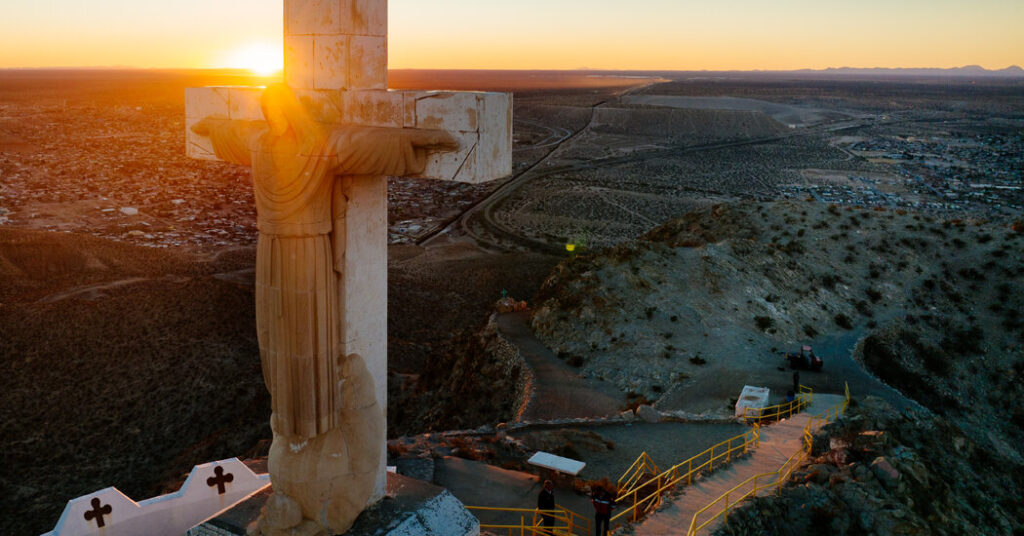
The land is on the lower slopes of Mount Cristo Rey, a rugged mountain on the border just west of El Paso, Texas. It has a 29-foot-tall limestone statue of Jesus Christ at its summit, some 720 feet up. Each fall, the site attracts thousands of pilgrims who celebrate the feast day of Christ the King.
The dispute is the latest episode in which environmental groups, private landowners, immigrant advocacy organizations and local governments, among others, have tried to block the federal government from using eminent domain to build border fencing.
The public opponents to building more barriers along the border, particularly in areas with natural or religious significance, have claimed a small number of successes in recent months, including the removal of plans for a physical barrier in Big Bend National Park.
In a court filing last Friday, the diocese said the Justice Department’s seizure of its land, though taken with compensation to the church, would impinge on the constitutionally protected right to religious freedom of members of the diocese and religious pilgrims.
In the late 1930s, the Catholic Diocese of Las Cruces, acting on the wishes of a local parish priest, commissioned a Spanish-born sculptor, Urbici Soler, to design the statue of Jesus atop the mountain, which is in Sunland Park, N.M., just a few miles from El Paso.
The 14-acre strip of land along the border on the mountain’s southern slope is the only stretch in the El Paso area without a barrier. Border Patrol officials have said the gap provides human smugglers a corridor to bring undocumented migrants into the United States.
The region around El Paso and Ciudad Juárez in Mexico has long been a major hub for smugglers and undocumented immigrants trying to cross the border, though the number of migrants encountered by Border Patrol has fallen dramatically under the Trump administration.
In a lawsuit filed last Thursday to take possession of the land, the federal government said it had “made best efforts to negotiate acquisition of the property interests sought prior to this condemnation action.”
The government added in its court papers that it needed the property “to construct, install, operate, and maintain roads, fencing, vehicle barriers, security lighting, cameras, sensors, and related structures designed to help secure the United States/Mexico border.”
Representative Veronica Escobar, Democrat of Texas, who represents El Paso and surrounding communities that abut Mount Cristo Rey, opposes the new wall. She said in a statement that the federal government’s plans were “consistent with the Trump administration’s blatant disregard for what communities like ours value.”
“There are a number of other ways to provide border security,” she said. “Instead, the Trump administration prefers to destroy this sacred site.”
A U.S. District Court judge will decide whether to allow the federal government’s move to condemn and seize the property. If the judge rules against the government, the matter is likely to be appealed to a higher court.
Max Bearak is a correspondent for The Times focusing on breaking and international news.
The post New Mexico Diocese Tries to Block Government From Seizing Land for Border Wall appeared first on New York Times.