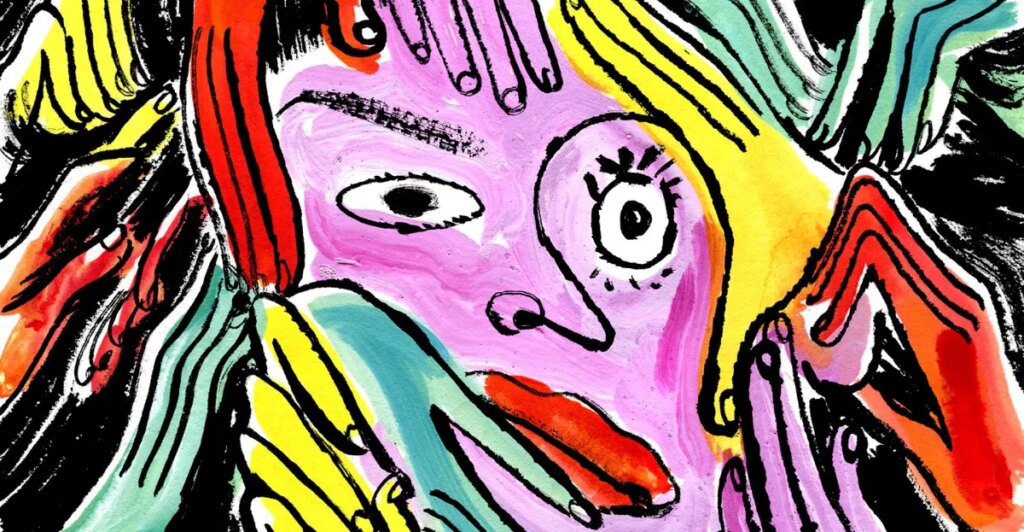
A few months ago, while engaging in one of my more recent pastimes (or compulsions), I verbalized a fear I’d long kept buried, perhaps out of shame or denial or some combination of both. First, the compulsory ritual: Before bed, with the precision of a brain surgeon, I arrange a layer of stickers on my face. The brand is Frownies, and they have been marketed to me as a cheaper, less invasive alternative to Botox. Place these beige patches — offered in unique shapes meant to hug your eyes, caress your forehead, or cradle your mouth — over your wrinkles, and by daybreak, perceptible signs of aging will have vanished. Allegedly.
Which brings me to the admission. No one with any confidence in their face willingly adheres appliques that calcify into what can only be described as a layer of concrete. I perform this routine for a simple reason: I’m visibly aging, and I’m not happy about it. As a woman in her 30s, with years of continued living to look forward to, I don’t want to socially vanish, which is what usually happens to many women of a certain age. I don’t want to become invisible once my face droops a little or when the wrinkles won’t abate with stickers. I want to look not like a puerile being, but some mysterious, age-ambiguous alien. (I do recognize this is a concern for the fortunate, but don’t fret: I also worry about whether I will be able to pay my bills each month. I contain multitudes.)
Why I reported this
I’m a product of the early 2000s when magazines and entertainment glorified beauty, youth, and thinness to the highest degree. The trend cycle has worked its way back around and these ideals are in fashion again, only now with the added pressures of social media and the accessibility of cosmetic procedures. At a moment of transition in my life, I wondered whether I should ignore the constant pressure to look perfect — and what it meant for my identity if I did.
The desire to not age is laughable, I’m well aware. We’re all hurtling toward the same inevitable fate. But some people’s journeys to the pearly gates are more poreless than others. Cosmetic procedures like Botox, fillers, and facelifts aren’t new, but their startling ubiquity is. Between 2019 and 2022, the prevalence of Botox and similar neuromodulators increased by 73 percent, according to the American Society of Plastic Surgeons. Fillers were second to Botox in terms of the most popular “minimally invasive” procedures in 2024. Since 2017, surgeons have reported a 60 percent increase in facelifts and younger patients are increasingly seeking them out. And although more men are seeking cosmetic procedures, the population who most frequently undergoes these treatments is overwhelmingly female. All told, between 2020 and 2023, aesthetic procedures increased 40 percent globally, according to one study.
People aren’t just modifying their faces, but shrinking their bodies, too. Nearly one in eight American adults said they were taking a GLP-1, according to a 2025 KFF Health Tracking Poll. The term “Ozempic” has become shorthand for the class of drugs that celebrities and everyday people alike utilize for weight loss, helping to reinvigorate the briefly dormant ideal that to be beautiful and desired, you must be small.
In other words, we now, as a society, have more control over our bodies and appearances than at any point in history. We’re both sculptor and marble, chiseling our images into a version that most aligns with who we are — or who we think we are. But our lives, and our bodies, are constantly changing. We age, we get pregnant, we break bones, we get sick, we grieve, throwing off the balance between how we see ourselves and how the world perceives us. There exists a fear of not recognizing ourselves as we move through these transitions. When bodies and appearances are malleable, what does that mean for the person underneath?
Let’s get one thing out of the way: I am completely average-looking. Never one to have been praised for my beauty or to have profited from pretty privilege, I hardly see my face as central to my status in the world. But it is directly related to how I see myself and how I’d like to telegraph that version of me to others, and I’m not alone in this.
When the book she co-authored, Face It: What Women Really Feel as Their Looks Change, was released in 2010, psychologist Vivian Diller’s audience was primarily in their 40s and 50s. The term “anti-aging” was en vogue at the time and Botox hadn’t quite hit the mainstream, so options for transforming your face were fairly limited, Diller says. Some women felt the pressure to take drastic measures, like full facelifts, to look younger. “If I were to write that book now,” Diller tells me, “it almost feels a little old-fashioned because the age that one thinks about aging or looking old is no longer in your 40s, 50s.” Instead, it’s late 20s. And it’s not just that people want to look younger, Diller says; they want to look ageless, to prevent the passing of time from occurring in the first place.
That an idealized image is so often conflated with a past self signifies there was a version (or will be a version) that was most aligned with our “true” identity. In Intact: In Defence of the Unmodified Body, University of Cambridge political philosophy professor Clare Chambers argues that people tend to believe there was a point in time, often in the past, where their bodies were most authentically their own: the post-college glow-up, the pre-baby body, the pre-menopause face.
Inevitably, we fail to embrace this edition of our appearance in the moment, only appreciating it much later as something we’ve lost. If you identify as young and beautiful or a parent or an athlete or a career-oriented professional, and the outer shell of that identity changes, you can fall into an existential crisis.
The result, Chambers tells me, is a feeling that our bodies as they are right now are never enough. “In this narrative, the body must be constantly modified to remain true to itself,” Chambers writes in her book. “But why on earth should that particular body, the one that has done so much less than you have, be the ‘real’ you?”
“The body we have right now is our authentic body,” Chambers tells me. “That’s simply the body we have.”
The idea that you will miss the current version of your body when it’s gone is also stressful, particularly when you are surrounded by “anti-aging” marketing making it clear that this is the phase of life everyone else is chasing, one which you’ll eventually look back upon with envy. Although she is only 24 years old, Medha Arora, an actor who lives in Toronto, is terrified of losing her fleeting youth and the benefits that being young and beautiful confers. The more she hears of women her age getting Botox, the more pressure she feels to preserve what she currently has and follow suit. “I feel so confident and I love how I look, and then as a result, there’s this anxiety that’s like, you have to do something to keep it,” she tells me.
The core tension at the center of today’s obsession with idealized bodies, American Society of Plastic Surgeons president Bob Basu tells me, is the mismatch between how people feel and how they look. No matter what you do to feel your best — therapy, sleep, a nutritious diet, a great sex life, strength training, fulfilling relationships — time, gravity, and…life will eventually leave their mark. “As we get older, we want to look as good as we feel,” Basu says. Now, we’re told, fillers, Botox, facelifts, and the like can help close that gap.
A better way of thinking about whether our bodies and identities are aligned is to be mindful of how it feels to be in them, Chambers says. “Do they feel like our own bodies? Do they feel healthy, comfortable, easy to live in, familiar to us?” she says.
Because pregnancy, menopause, illness, and disability can drastically alter the corporeal form, sometimes quite rapidly, the body and soul can feel diametrically opposed. The outer shell is foreign. But there are other ways to reconcile this that don’t involve neurotoxins.
In many ways, I feel especially youthful. Thanks to my longtime devotion to cardio and strength training, my body is sturdy. I try to eat as balanced as possible, and I remember to wear sunscreen most days. Sleep used to come easily and in great quantities, but a recent breakup derailed such rejuvenation. (I’m working on it.)
However, my face betrays these healthful habits. There are bags under my eyes, dark and heavy, and the tone of my skin is sallow and wan. I look in the mirror and see crow’s feet and forehead lines — memorials of happy, more expressive times — and emerging dark spots are coming to claim vengeance for the one summer in high school I decided to be really tan. While I may feel 23, I no longer appear to be.
Running on the hamster wheel of nostalgia often gets us nowhere; we’re chasing a face and body that’s lost to history. But that doesn’t mean that person didn’t exist. There is a difference, however, in grieving who we once were and grasping for who we once were.
“Grief is I miss who I was and I’m letting myself feel that fully. Grasping is I miss who I was, so I’m going to chase that through procedures, restriction, trying to reverse time,” licensed psychotherapist Annie Wright tells me. “Grief is a passage. Grasping is like a prison. And the cruel irony is that grasping is what most of the cosmetic and wellness industries are selling.”
When Wright’s clients find themselves hyperfocused on a past version of themselves, she invites them to consider what their younger self had access to that they lack now. “Honestly, it’s almost never just about the body,” she says. “It’s usually something like possibility, attention, lightness, being at the beginning of things.”
My 23-year-old self felt hungry for the opportunities that lay ahead; the 33-year-old is open to big shifts while still being grounded by the predictability and stability of routine. “We can’t compare across stages,” Wright says. “That’s really rigged. Instead, we ask, what’s uniquely available to me now that wasn’t available before?”
And what is available to you now may be access to filters on videoconferencing platforms, beauty products, and cosmetic procedures with the potential to change your appearance. “The mirror becomes a threat detection device,” Wright says. Clocking every life transition that manifests on our faces becomes a way of asking whether we’re still acceptable, still valuable, still safe.
If she could afford it, Patricia Catallo would get a facelift. The 62-year-old retired bartender from Philadelphia considered herself a “bombshell” earlier in life, but after a recent illness caused her to lose 60 pounds, Catallo says she wasn’t comfortable with the reflection staring back at her. “I felt like I just didn’t look good anymore and I felt invisible,” she tells me. Catallo was used to being approached by fellow shoppers in the store to get her opinion on what shampoo to buy, to chatting with the patrons at the bar where she worked. Now, she feels like someone who isn’t worth engaging with at all.
Talking to Catallo was like staring into the future, or maybe the sun — necessary and painful and impossible to ignore. Ageism is felt by both men and women, but people are generally more positive toward young women than older ones, research shows. Older women report feeling invisible and inconsequential, uncertain about their role in a world that coupled their utility with youth and attractiveness. This waning irrelevance has become somewhat of a stereotype, a seeming inevitability — “and that I think is not changing,” Diller, the psychologist and author, tells me. Is it wrong to want to avoid this fate myself?
If freezing and tightening away every little wrinkle to remain visible is the goal, it might be masking a deeper identity crisis. “Botox, fillers, lasers can soften the visual signs of aging, but they don’t resolve deeper questions about identity or self-worth,” Sonia Badreshia-Bansal, a dermatologist with offices in the Bay Area and Beverly Hills, tells me in an email. “When patients expect a procedure to fix something emotional, the results are almost always temporary in how they feel.”
Perhaps it’s for the best that I lack the funds for cosmetic procedures, as I should not be left unattended with an injector right now. Because, if I’m being totally honest, I’m unsure of my worth, of who I am, and therefore, how I should look, and I would most definitely be using procedures to fix something emotional.
While I was already meandering down the path of insecurity over the past few years, the end of my seven-year relationship a few months ago sent me spiraling toward full existential catastrophe. The life and future I’d envisioned were wiped away overnight, and in its place, a new face, haggard from crying and sleepless nights and poor nutrition. Noticeably more grey hair than a year prior. I questioned whether I, let alone anyone else, would find me desirable again. Still wading through the muck of self-doubt, wondering who I was supposed to be at this stage in my life, fixating on my appearance became a distraction from the lingering question of “What do I do now?” It’s easier to fix your face than to fix your life.
“What do I do now?” is a question best served for a therapist and not an injector, which doesn’t mean Sun Nguyen still doesn’t field it. A dermatology nurse practitioner in central Pennsylvania, Nguyen sometimes deals with patients who struggle to articulate why, exactly, they’re in her office; who, like me, are unsure of how they’re supposed to look at the present stage of their life. Instead of pushing procedures, Nguyen tries to help clients get introspective, especially when she sees them more often and has a relationship with them. “It’s deeper than a 15-minute exam can do,” she says.
Nguyen and other dermatologists I spoke to reiterated something so simple I’m embarrassed I’d never considered it: it’s important to know why you’re seeking cosmetic procedures, to understand your specific motivations for changing your face. And Nguyen is right that this soul searching should go beyond the brief questions your doctor asks in an exam room.
Someone who is driven by the fear of losing attention, relevance, and love, who is letting external voices into their head, is likely being driven not by their true self, says Wright, the psychotherapist. Instead, they are outsourcing their sense of self to the mirror.
When there’s a disconnect between what you see in the mirror and who you believe yourself to be, Chambers, the philosopher and author, suggests acceptance instead of rebellion. That means really settling into the fact that aging is a never-ending process, and will be an uphill battle if you choose to fight it. It starts from the moment we enter this mortal plane, and it never stops. She encourages us to push back against the idea that the pre-baby, pre-breakup, pre-accident, pre-sickness body was the “real” version of each of us, and to be okay in our bodies as they currently are.
That’s not to say we can’t delight in utilizing makeup, hair dye, tattoos, piercings, and even some cosmetic procedures as a form of self- or gender-expression, but it’s important to seriously consider how these modifications connect to an identity that goes beyond just “hot person” or “person in her 20s” or “me, but before this bad thing happened.” It requires getting comfortable with the uncomfortable notion that things change, that our lives and statuses change, often in ways that we don’t like. “In trying to pursue a sense of an aesthetic ideal, we risk not really keeping that connection between who we actually are and what we look like,” Chambers says.
My breakup, Chambers reminds me, has made me acutely aware of how I present to others and whether my appearance will be enticing enough for people to want to get to know what’s beyond the surface. I’m in my 30s and I’m not getting any younger. Still, I tell myself that my value as a friend, a daughter, a potential partner, a human does not depreciate even if society is hinting that it does. I’m reminded of this fact when speaking with Jen Janke, a 53-year-old elementary school teacher in Portland.
Her entire life, Janke was constantly reminded how attractive her parents were, and came to see the value in looking good. At her mother’s funeral, she remembers many guests mentioning how beautiful her mother was. “People also talked about how funny my mom was and thoughtful,” Janke tells me. “But I would want the first thing for someone to say is how thoughtful and funny she was.”
I agree. When my time expires and people are called to remember me, I hope they won’t talk about my face or my wrinkles or gray hair, or really anything about my appearance. What’s more lasting is how I make people feel.
“The most radical thing a woman can do in a culture that profits from her self-doubt, is to know herself well enough that she stops looking to her face for the answer,” Wright says. “Your face will keep changing, and your true self, that’s the one you should spend the time getting to know.”
The post How old am I supposed to look? appeared first on Vox.