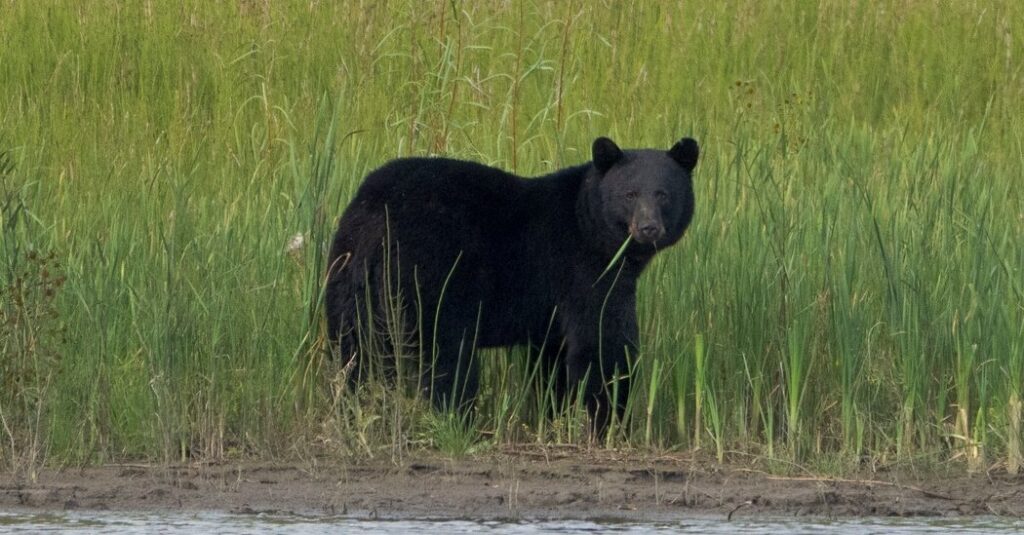
A 27-year-old man was killed last week when he was attacked by a black bear at a remote uranium mining site in northern Saskatchewan, in what officials said was only the fourth fatal black bear attack in the Canadian province’s recorded history.
Provincial officials said the man, whose name has not been released, was attacked on Friday about 50 miles northeast of Points North Landing, one of the northernmost points for trucking and airfreight services for northern Saskatchewan, the Northwest Territories and Nunavut.
The man was working as a contractor for the UraniumX Discovery Corporation, an exploration company working in the Athabasca Basin. The area, which straddles the border with Alberta and reaches toward the Northwest Territories, is home to some of the world’s largest known uranium deposits.
Canada is one of the world’s largest producers and exporters of uranium, a naturally occurring radioactive element that is used to fuel commercial nuclear reactors. In northern Saskatchewan, more than 40 percent of mine site workers are local residents, officials said.
“Uranium mining is pretty widespread in Saskatchewan, and it has been for a very long time,” said Doug Clark, a professor at the University of Saskatchewan’s School of Environment and Sustainability.
Dr. Clark, a former national park warden who specializes in human-bear conflict, said the fatal attack on Friday was an aberration.
But, he added, the presence of attractants, like food, raises the risk of human-bear interactions and conflicts. “So, for that reason, industrial camps typically are held to a fairly high standard in terms of food and garbage management and minimization of attractants.”
UraniumX, based in Vancouver, said it was cooperating with the local authorities, wildlife officials and government agencies in their investigation of the attack. It added that it had temporarily suspended all work at its Athabasca Basin property, which is about 525 miles northeast of Saskatoon, the largest city in Saskatchewan.
“The safety and well-being of our employees, contractors and all personnel working on our projects is, and will always remain, our highest priority,” the company’s chief executive, Esen Boldkhuu, said in a statement.
Provincial officials said the investigation was “in the early stages,” but they noted that a civilian shot and killed the bear near the site of the attack before officers arrived.
A necropsy was completed at the Western College of Veterinary Medicine in Saskatoon, they said, and investigators are examining the bear and other physical evidence to try to determine what happened.
“Attacks are very rare, but companies can make their own luck, good luck or bad, by doing certain things,” said Andy McMullen, a prominent Canadian wildlife safety consultant and founder of Bearwise, an organization specializing in bear safety training.
“Here in Canada, unless you’re in downtown Toronto, you’re in bear country,” said Mr. McMullen, a former regional wildlife officer in the Northwest Territories and Nunavut.
“Black bears, grizzly bears and polar bears. You have to go out, aware that those things are there, and take the time to learn about them, what you can do to prevent encounters, and what to do if you do get into an encounter,” he said. “So a little bit of responsibility by people going into their country goes a long way.”
He said mining companies in the Northwest Territories and in Nunavut, where he worked, erected electric bear fences around housing camps for workers in areas where bears were active.
Saskatchewan is one of the few places in the world where there are overlapping ranges of black, grizzly and polar bears in the far north.
“In bear country, you’ve got to pay a little more attention to your surroundings,” Mr. McMullen said. “That allows you to detect bears from much greater distances so you don’t surprise each other, making noises at the appropriate times.”
The idea is not to surprise the bear, he said.
“This time of year, bears are hungry, period,” as they emerge from hibernation, he said. “Right now they’re eating a lot of sedges, which are a plant with high moisture content in it, because they’re trying to get their stomachs working again. It’s not like they’re ferociously hungry and are looking to eat the first person that comes by.”
Adeel Hassan, a New York-based reporter for The Times, covers breaking news and other topics.
The post Black Bear Fatally Mauls Uranium Contractor in Northern Canada appeared first on New York Times.