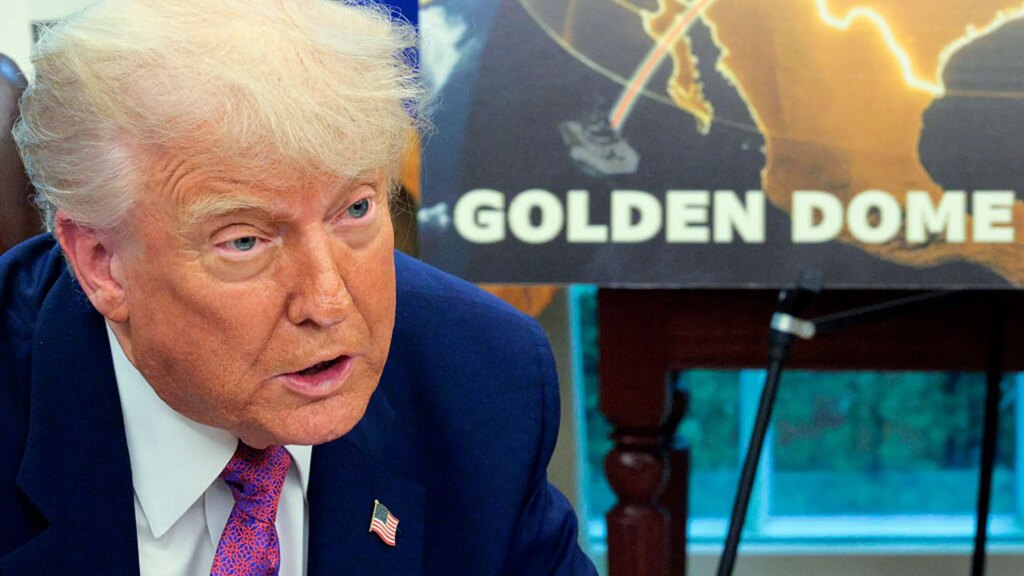
President Donald Trump’s proposed “Golden Dome” missile defense system could cost as much as $1.2 trillion over two decades, according to a new estimate from the Congressional Budget Office, far exceeding the $175 billion price tag he originally offered.
The nonpartisan budget office cautioned that its analysis was not based on a finalized blueprint because the Defense Department has not publicly detailed the full architecture of a complex system that Trump has touted as “forever ending the missile threat to the American homeland.” Instead, the office said its estimate reflected “one illustrative approach rather than an estimate of a specific Administration proposal.”
The report offered the clearest indication yet of how expensive the ambitious project could become, as well as the enormous technical and financial challenges of building a space-age shield against missile attacks. The “Golden Dome for America” initiative was established through an executive order signed by Trump during the first week of his second term. The order called for a sweeping missile-defense network capable of detecting, tracking, and intercepting missiles at multiple stages of flight, including from space.
The Pentagon official overseeing the project, Gen. Michael Guetlein, said in March that the program would cost $185 billion through 2035—roughly a decade—for what he described as the system’s “objective architecture.”
But the CBO used a much longer time horizon in its analysis and estimated that acquisition costs alone would exceed $1 trillion over 20 years. The bulk of the expense is tied to space-based interceptors—orbiting weapons intended to destroy missiles shortly after launch. According to the report, roughly 70% of acquisition spending would go toward that space-based portion, including a proposed constellation of about 7,800 satellites. Purchasing enough orbiting interceptors to destroy roughly 10 incoming ballistic missiles would cost about $720 billion, the CBO estimates.
The “golden dome” concept is partly inspired by Israel’s multilayered air-defense systems, often referred to as the Iron Dome, which have intercepted rockets and missiles fired from Iran and allied militant groups. But Israel’s system is designed to protect a comparatively small geographic area and only shorter-range threats. The American version is intended to defend the entire continental United States, as well as Alaska and Hawaii, against long-range ballistic and hypersonic missiles.
“Over the past 40 years, rather than lessening, the threat from next-generation strategic weapons has become more intense and complex,” Trump said in the order, citing advances by Russia, China, and other adversaries in hypersonic and ballistic missile systems.
The President said at the time that he wanted the system operational before the end of his term in January 2029, an aggressive timeline for a project that would require massive technological advances and a vast expansion of American missile-defense infrastructure.
The CBO said the system envisioned in its estimate could fully counter a limited attack from a regional adversary like North Korea, but warned that it could still be overwhelmed by a large-scale missile assault from Russia or China.
Space-based interceptors have emerged as one of the most controversial and costly elements of the proposal. General Guetlein himself has acknowledged the financial risks associated with the space-based interceptor portion of the program. Testifying before lawmakers last month, he said if the Pentagon can’t produce such interceptors affordably, “we will not go into production.”
Congress has already begun steering significant funding toward the initiative. Last year’s Republican reconciliation package, the One Big, Beautiful Bill Act, allocated roughly $25 billion for enhancements to the Defense Department’s integrated air and missile-defense systems connected to the Golden Dome. In its latest budget request, the Pentagon asked Congress to pass another reconciliation bill later this year that would provide an additional $17 billion for the program.
The Trump Administration has defended the initiative as necessary to counter rapidly evolving missile threats and to modernize American homeland defense capabilities. But the new estimate is likely to intensify scrutiny in Congress over whether the project is technologically feasible, strategically necessary and financially sustainable.
Sen. Jeff Merkley, the Oregon Democrat who requested the CBO analysis, sharply criticized the proposal after the report’s release, calling it “nothing more than a massive giveaway to defense contractors paid for entirely by working Americans.”
The post Trump’s Golden Dome Projected to Cost $1.2 Trillion and May Not Work as Advertised appeared first on TIME.