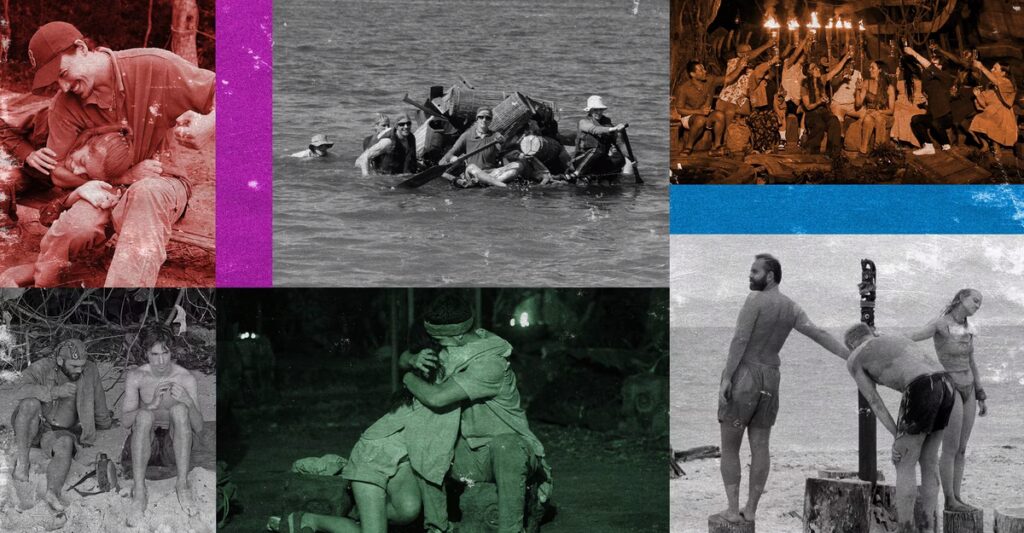
There’s a clue to the secret of Survivor less than 10 minutes into the very first episode. It’s not any of the obvious things: the marooning on remote shores, the obstacle-course challenges, the pathetic attempts at lighting fires or building bamboo shanties. It’s something both subtler and more fundamental, and it is why the show has stayed fascinating for 50 seasons and more than 25 years.
It was May 2000, and two of the competitors—Richard Hatch and Sue Hawk—were having a frustrating conversation. The members of their tribe were running around the beach at cross-purposes, trying to set up camp—to set up a society. Richard, a consultant, was consulting. He was trying to marshal them toward a common goal, but it wasn’t working. “Why are we here? And what’s the point?” he vented to Sue.
“Oh, I figured that out before I come here,” Sue replied. “And you haven’t?”
“I have, for me,” Richard said. “But we haven’t, for us.”
That first season had an uncertainty to it. Was Survivor primarily about watching strangers build a new community together, or was the individual game of voting opponents off the island the whole point? Every episode, contestants go to tribal council and send home one of their own. They do this until only one winner remains, and is awarded $1 million.
At first, contestants didn’t coordinate with one another, and mostly voted for whomever they didn’t like, or people who were underperforming in challenges. One guy simply voted for his fellow castaways in alphabetical order. But slowly over that first season—and then dozens more, as the show became the most influential reality show in the history of TV—the game took center stage. That game illuminates the tension between self and community that has fueled the show’s longevity, and reflects the preoccupations of a country that has always been torn between the two.
The show is currently airing its splashy 50th season, complete with celebrity cameos and a cast of all-star former players. It has evolved many times over the years: complicating the gameplay, diversifying its casting, first traveling the world and then settling indefinitely on the beaches of Fiji. The quality has varied, but as fans put it, Survivor is like pizza: Even when it’s bad, it’s good. How to pursue personal ambition while cultivating interpersonal relationships is a conundrum with infinite answers. Each group of competitors offers a fresh—and inevitably juicy—variation.
All along, Survivor has revolved around the truth that Richard Hatch intuited almost immediately: To win this game of one, a me will need an us.
To wit: Richard, Sue, Kelly Wiglesworth, and Rudy Boesch formed Survivor’s very first alliance, voting together to eliminate everyone else until they were the final four. Forming alliances is now Survivor 101, but at the time, colluding to control the vote was a surprising—and controversial—tactic.
[Read: A Survivor contestant’s empathetic reality-TV novel]
The final tribal council, where Richard faced Kelly, ended up being a referendum on the meaning of the game. Facing a jury of contestants who’d been voted out, Kelly was apologetic, saying she hoped she’d be judged not for the betrayals she’d committed but for the person she was and the connections she’d formed. Richard took the opposite tack: “For me, it’s not about you deciding who the best person is,” he said. “It is about who played the game better.”
When the jury awarded Richard the prize, it set the stakes for the 49 seasons to come. Survivor is about the pursuit of individualism within the constraints of community, and the limits of community in the face of rampant individualism. It’s a defining tension of American culture, gamified and with a $1 million on the line.
When Alexis de Tocqueville came to the United States in the early 19th century to study the political system of a nascent nation, he was struck by the depth of Americans’ individualism. Americans “are in the habit of always considering themselves in isolation, and they willingly fancy that their whole destiny is in their hands,” he wrote in the second volume of Democracy in America, published in 1840.
To this day, the United States ranks highly on many measures of individualism, such as valuing self-expression, believing that success is determined more by individual effort than by outside factors, and even giving children unique names to make them stand out in a crowd. The importance of the self in American culture seems to have become even more pronounced since about the mid-20th century, when the communal—and sometimes conformist—spirit of the 1950s gave way to movements for individual rights and a cultural focus on self-reflection and self-help. One of Americans’ most prized values is being true to themselves.
Television has long mirrored the fixation on the individual; the sociologist Todd Gitlin wrote in 1983, reflecting on network shows of the late ’70s and early ’80s, that “with few exceptions, prime time gives us people preoccupied with personal ambition.” On competition shows, that drive is amplified.
Most contestants and fans understand that everyone on Survivor is—and mostly should be—out for themselves. The show has a bootstrappy vibe in which individual grit and self-belief are portrayed as the keys to success. “You gotta dig!” the host, Jeff Probst, is fond of shouting at contestants who have fallen behind in a challenge. If they escape their proverbial hole, they will be rewarded with another of his favorite catchphrases: “That’s why you never give up on Survivor!” Contestants marvel at their self-actualization via game-show challenge: If you push yourself on Survivor, they say, you will do more than you could have imagined.
Although Survivor was an individual game from the start, loyalty played a prominent role in early seasons, when betraying a close ally was considered somewhat taboo. “Boston Rob” Mariano faced a bitter jury during the 2004 finale of Season 8, Survivor: All-Stars. Rob had begged another contestant, Lex van den Berghe, not to vote out Amber Brkich, with whom he’d become romantically involved. He promised to protect Lex in return, then (treachery!) voted him out. At the final tribal council, Lex laid into Rob: “As good as your game was, you sold out your values, you sold out your character, and you sold out your friends for a stack of greenbacks,” he said. This betrayal cost Rob the $1 million, which he lost by one vote to his fellow finalist, Amber. (The two got engaged during the reunion show.)
But over time, this sort of manipulation became something to aspire to—you do the necessary work of building relationships while never losing sight of your own endgame. In the current season, Cirie Fields, who is playing Survivor for the fifth time, explained the evolution from “old era” to “new era” strategy: “The new-era mindset is ‘I can vote with my archenemy for one vote, for two votes, and then I can get them out. I just want to advance in this game.’ The old-era style is ‘I stick with the people I said I was gonna stick with, and that’s it.’” This shift happened gradually, but new-era thinking was entrenched by Season 41, the show’s first post-COVID season.
The game, as Cirie pointed out, has gotten more individualistic over time. Now voting out a strong ally is a defining move many people seek to put on their “Survivor résumé”—the list of accomplishments that contestants fantasize about reciting to the jury should they make it to the end. And what once was a simple majority-rules vote each week has been complicated by the addition of individual immunity idols and advantages that can shift the balance of power from the collective toward maverick individuals.
These individualistic stories reach their conclusion at the final tribal council, where finalists attempt to cement the story of their personal game as the best one. After weeks of forming relationships to get ahead, they rewrite strategic moves that were communal as personal achievements. Frequently, jury members ask questions to the effect of What moves did you make on your own? How did you take control of the game?
Even those who lose still tend to talk about their journey in terms of a different kind of individual achievement: self-discovery. They’ve learned so much; they’re so grateful; they’ve evolved into a better version of themselves.
Yet neither the trajectory of American culture nor that of Survivor is a simple story of individualism run amok. Tocqueville was struck not only by Americans’ individualism, but also by their seemingly limitless capacity for forming associations—political, civic, religious, and social. He believed this tendency helped keep individualism in check. The push and pull between individuals and groups has persisted across American history. “There is no period,” the historian Jennifer Ratner-Rosenhagen wrote in her 2019 book, The Ideas That Made America, “when thinkers have not wrestled with the appropriate balance of power between self-interest and social obligation.” She traces movements such as mid-19th-century transcendentalism, with its love of self-reliance, and the Progressive movement a few decades later, which prized collective solutions to social problems. (And even as individualism seems to be on the rise in the U.S. and around the world today, the importance of community care can still be seen in, for instance, the growth of mutual-aid networks.)
On Survivor, even as the show leaned into the individual elements of the game, it also doubled down on the importance of relationships. The ethos that everyone will (and should) do what’s best for their own game somehow seems to have led to gentler, cuddlier tribal councils, where people take betrayal less personally—because you’ve got to respect people for doing what’s best for themselves. Rarely does anyone bitterly storm off anymore when it’s time for Probst to snuff their torch. They’re far likelier to give everyone who just voted for them a hug and a “Good game” on the way out. Back at camp, players who feel betrayed after a vote now often insist that they understand, and that they’re not mad (even if they are mad), for the sake of preserving a relationship that could still be useful to them.
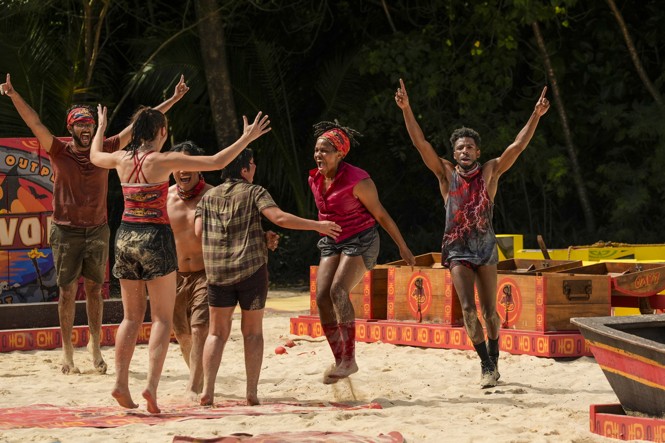
In recent seasons, Probst has begun talking frequently about “community.” “The reason community has always been the foundation of this social experiment we’ve been doing for 24 years is because humans have always craved community,” he said at the start of Season 47. An odd introduction to a game of manipulation and backstabbing, perhaps, but that is the duality of Survivor.
A successful game of Survivor neglects neither the individual nor their complex web of connections. Players talk about the importance of building “authentic relationships”—to further their own ends. Blindsiding a threatening ally builds your résumé, but those with no “social game” are likely to be punished. Players who swing too far to one side of the individualism-community spectrum rarely win. For instance, one of the show’s most notorious villains, Russell Hantz, boasted in Season 19, Survivor: Samoa, of using people like “puppets.” “When I’m finished with them, I just throw them in the trash,” he said. Though he made it to the final tribal council, jurors excoriated him for this attitude and denied him the prize. Likewise, several contestants who played very loyal games have made it to the end, only to be defeated by someone with a more impressive individual strategy.
The question of how to balance me and us is still unsettled as of Season 50. At tribal council in a recent episode, players vented about the difficulty of getting to a group decision when everyone has their own agenda. “We don’t work for anybody but ourselves,” Cirie said, chafing at the notion that she should take directions from anyone. But, Rizo Velovic added, “if it’s about ‘I, I, I, I,’ then it’s not gonna be about ‘We, we, we’ when you want me to vote with you.” The best Survivor players make it about I and we—right up until one person, and only one, goes home with the big prize.
When you buy a book using a link on this page, we receive a commission. Thank you for supporting The Atlantic.
The post The Secret of Survivor appeared first on The Atlantic.