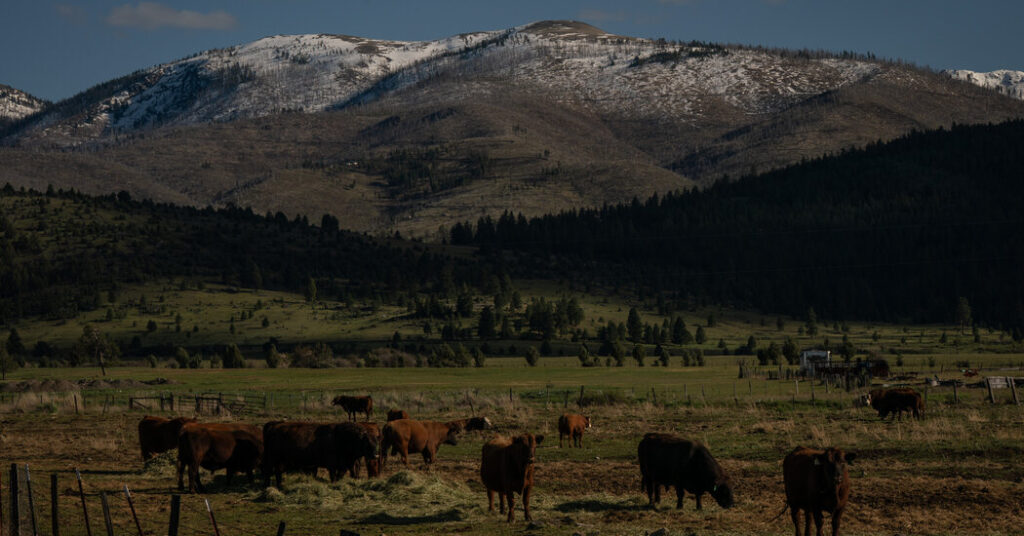
This time of year, Don Gabbard, a fire chief in eastern Oregon, wants to look up at the Strawberry Mountains and see a blanket of snow.
That snow can help delay the start of the region’s wildfire season. Fire crews count on winter weather to moisten the landscape, decreasing the chances that a random lightning storm or forgotten campfire will set off a large, expensive and potentially deadly fire during the drier months of summer.
“In a year like this, fire season starts earlier and goes longer because there’s nothing up at the higher elevation to slow it down,” said Mr. Gabbard, who is based in John Day, Ore., where the nearby mountains showed just a dusting of snow. “It’s pretty dry and brown right now.”
Most of the American West saw significantly less snow than usual this winter, and record warmth wiped out what little did fall. Many states are bracing for a summer of water shortages and heightened fire risk, especially those that rely on the Colorado River basin, which feeds the water supplies of Colorado and other nearby states.
The situation is also dire along the Pacific Coast, where accumulated snow in the mountains of California, Washington and Oregon typically supplies much of the states’ water for the rest of the year. While California and Washington were hit by some storms last winter, including devastating flooding near Seattle in December, a quirk of geography and weather meant that Oregon missed out on a lot of that precipitation.
And with warmer-than-normal temperatures, the storms that did materialize brought mostly rain, which doesn’t linger as long as snow does. The average temperature in Oregon this winter for December through February was 38.6 degrees Fahrenheit, nearly 5 degrees above normal, equaling 2014-15 as the second-warmest winter in records that date back to 1896.
“We just weren’t getting that cold air from the north to help get enough snow,” said Hannah Chandler-Cooley, a meteorologist with the National Weather Service office in Portland.
A dry spell hit in January, and March was warm. The snowpack started to disappear at the time of year when it is typically still building. The governor, Tina Kotek, has declared drought emergencies in nine of the state’s 36 counties.
By early April, when officials traditionally look at all their accumulated data to determine how much melt-off will feed into reservoirs across the state, the numbers were grim. Picturing the snowpack as a reservoir, it held only 12 percent of the amount of water that it should.
“It was essentially empty,” said Larry O’Neill, Oregon’s state climatologist.
By last week, data from the state showed the snow had completely melted away in some of the state’s mountain ranges. That’s a month or more earlier than usual.
Farmers are worried about the water supply.
The lack of snow worries farmers who rely on snow melt for irrigation throughout the summer. The amount of water allotted to them has already been cut in several parts of the state, including the Klamath basin and across central Oregon.
More water is available in the vast Columbia River basin. As the state’s largest basin, it captures rain and snow from four mountain ranges and fairs better than other parts of the state in dry years. But farmers are even worried there.
Devon Wells counts on the water from this area to grow cherries, pears and apples in the Hood River Valley, about an hour east of Portland.
He thinks his cherries, which ripen earlier in the summer, will be OK. But he worries the lack of snow could mean smaller pears, driving down prices and consumer interest when they’re ready for stores and farmers’ markets in late summer and early fall.
“I’m not freaking out about it yet, but at the same time, it’s in the back of your head,” he said. “You start to worry about what you’re going to do when we get to August or September and need water to finish the pears off. That water may not be there.”
Water from the state’s dozens of reservoirs will help make up for the deficit. Most are relatively full because they entered this year with carry-over storage from last year, when a robust snowpack helped replenish them.
But Mr. O’Neill said the reservoirs were on track to be low as early as the middle of summer.
“We’re anticipating big water shortages for irrigation,” he said.
The warm, dry winter also has Oregon residents bracing for an early start to wildfire season this year. Forecasters predicted the wildfire threat across the eastern two-thirds of the state could be high as early as June. In a typical year, the season runs from July to September.
Jon Bonk, a meteorologist for the Northwest Interagency Coordination Center, said that it was too soon to know exactly what will happen.
“It is very challenging to forecast fire weather and fire activity more than a month to two months out,” he said.
Many variables beyond the snowpack can have an impact on a fire season, including spring rain, summer heat and wind patterns. Lightning storms in the summer can often make things worse.
Mr. Bonk said that a low amount of water in the snowpack has not always correlated with an intense wildfire season in past years. The 2020 season was the most destructive on record for the state, burning more than 1 million acres, killing at least 11 people and destroying thousands of homes. The snowpack was healthy that year and the season started slow, but it picked up later in the summer amid outbreaks of lightning and powerful winds.
Mr. Gabbard, the fire chief, said he was taking steps to prepare for an active season. He applied for a state grant to hire three seasonal workers to remove downed limbs, dry brush and other potential wildfire accelerants.
Residents are also concerned, and Mr. O’Neill said that in the public’s perception, the worry is focused more on wildfires than on the water supply issues.
“The snowpack is only one factor and it’s not clear whether it will lead to increased wildfire risk,” he said. “The conditions in the spring will determine how active the wildfire season will be.”
Amy Graff is a Times reporter covering weather, wildfires and earthquakes.
The post Oregon Prepares for a Challenging Summer of Water Shortages and High Fire Risk appeared first on New York Times.