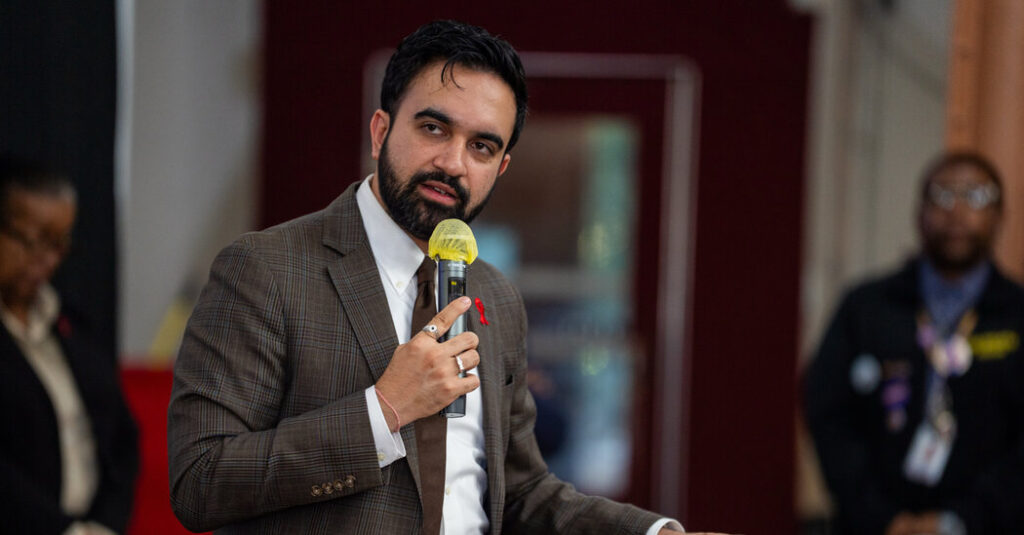
Three months after Zohran Mamdani claimed New York City was facing a budgetary crisis of generational proportions, the mayor announced on Tuesday that he had closed the gap, thanks to an infusion of state resources from Gov. Kathy Hochul and some routine belt tightening.
The announcement came as the mayor released his first executive budget, which totals about $125 billion for the coming fiscal year. The spending plan, which is still subject to change before the City Council ratifies it by a June 30 deadline, comes amid a lackluster job market and an uncertain economic forecast made hazier by the war with Iran.
Like any budget, and particularly any mayor’s first, this budget has also come with its share of drama, political missteps and unfulfilled campaign promises.
As she runs for re-election, Hochul comes to the rescue
Past mayors and governors allowed poisonous interpersonal dynamics to hamper their ability to deliver for city residents. By endorsing Ms. Hochul early for re-election this year, and working with her to expand child care funding, Mr. Mamdani is now enjoying the fruits of a relatively positive relationship with the governor.
Earlier this year, Ms. Hochul committed $1.5 billion in state aid for a host of municipal services. The state budget, which has not yet been finalized, is also expected to include a host of policy changes and revenue increases that will funnel another $4 billion to the city over the next two years.
The largest share — about $2.3 billion over two years — is expected to come from the city’s delaying certain pension payments, a change that requires state approval and buy-in from municipal unions.
The mayor and governor also expect another half-billion dollars to flow from the new tax surcharge on second homes worth more than $5 million that Ms. Hochul recently announced. But the city comptroller recently argued that number might be overly optimistic, and New York City’s byzantine property valuation system means that the new tax would come with substantial implementation challenges.
The city is expected to save another $1 billion over two years from several changes, including the state’s expected agreement to delay a class-size mandate in public schools (despite Mr. Mamdani’s support for the mandate as a candidate); more school aid from the state; and the assumption by the state of a larger share of death benefits for families of police officers, firefighters and emergency medical workers.
State officials said the city will gain another $361 million from “other actions” that they have yet to explain.
The developments appeared to show that Ms. Hochul and Mr. Mamdani had gotten through a somewhat bumpy period and were eager to highlight their constructive and mutually beneficial partnership. The city, as a creature of the state, needs Ms. Hochul’s support on many matters. Ms. Hochul, who is facing re-election this year, needs Mr. Mamdani’s help in turning out Democratic voters in New York City.
“For years, the relationship between City Hall and Albany has been defined by dysfunction and infighting,” Mr. Mamdani said in a statement. “Governor Hochul and I, however, share a belief that government works best when we work together on behalf of the people we serve.”
Mamdani fixes a political misstep, but backtracks on two campaign promises
Mr. Mamdani ended his threat to raise property taxes on New York City homeowners by nearly 10 percent if the state failed to raise taxes on wealthy individuals and big corporations.
The tax increase would have brought in almost $15 billion over four years, but ran into pushback from the moment Mr. Mamdani raised the idea. It sparked outrage among politicians representing Black homeowners, including some City Council members who would have had to approve the measure. From the beginning, the Council speaker, Julie Menin, said it was a nonstarter, and Mr. Mamdani began backing away from the threat nearly as soon as he made it.
This budget also highlights the extent to which Mr. Mamdani has had to backtrack on several campaign promises, as he has transitioned from an insurgent democratic socialist candidate to mayor of New York City.
Though he promised on the campaign trail to drop City Hall’s opposition to the expansion of a rental voucher for poor New Yorkers, the cost of the program prompted him to reverse that stance.
As a candidate, he also expressed support for the state’s requirement that New York City reduce the number of students in classrooms. As mayor, he now backs the state’s intention to delay implementation of that mandate.
Mamdani’s budget relies on a politically risky pension-funding gambit
To balance this year’s budget, Mr. Mamdani is proposing to delay payments into New York City’s pension funds.
The city has five pension funds representing teachers, police officers, firefighters and other unionized municipal workers. The returns, which are invested, total about $300 billion.
The mayor’s plan, which would save $2.3 billion through the end of the upcoming fiscal year, would involve restructuring the city’s contributions to the funds following an overhaul instituted in 2013 by Bill de Blasio, then the mayor of New York City, and Andrew M. Cuomo, then the governor. At that time, the mayor changed the city’s pension payment obligations following a drop in the assumed rate of return, to 7 percent from 8 percent.
City and state leaders agreed to stretch out payments for future bills through 2032.
Police officers’ pensions would be unaffected by the proposed change, as their union, the Police Benevolent Association, is opposed to the plan.
John Nuthall, a spokesman for the P.B.A., said that neither the P.B.A. nor the fund that administers police pensions have agreed to the amortization. Representatives for the Uniformed Firefighters Association and District Council 37 had no immediate comment.
Michael Mulgrew, president of the United Federation of Teachers, said pension board trustees would review the proposal.
The city comptroller, Mark Levine, a Democrat, said there was a logic to the mayor’s proposal on pensions. “Otherwise we’d hit a big cliff in 2032,” he said.
“This really is once-in-a-generation windfall,” Mr. Levine added. “I’d want to use it to bolster our reserves, ideally, or prepare some way for the long term — not just cover expenses for today.”
Sally Goldenberg is a Times reporter covering New York City politics and government.
The post How New York City Is Solving Its Budget Crisis appeared first on New York Times.