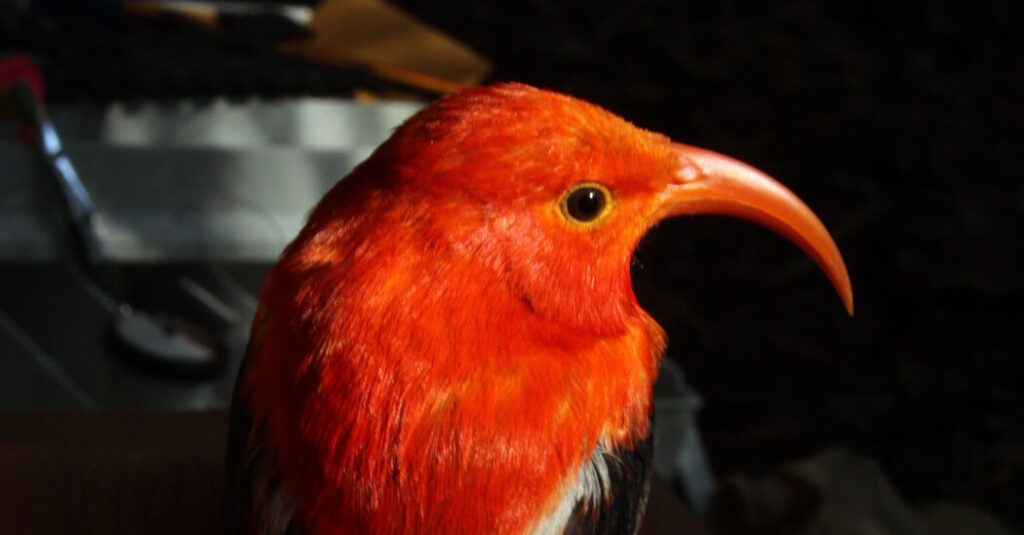
When Mauna Loa erupted in 1885, it enveloped native forests on the island of Hawaii in a layer of basaltic lava flow. The magma eventually cooled, sparing a mosaic of scattered forests known as kīpukas that today are home to a unique set of forest songbirds. Hawaiian honeycreepers are adapted to the most unforgiving of ecosystems, surviving at high elevations where mosquitoes can’t go and equipped with curved bills perfectly suited to forage on the native flowers.
Now, researchers have pinpointed yet another of their evolutionary tricks: opportunistic thievery.
In a study released last month in the journal American Naturalist, researchers found that three species of scarlet and golden honeycreepers on Hawaii are adept at “nest material kleptoparasitism,” the practice of stealing material from the nests of others instead of finding their own. After using GPS tracking devices to monitor 216 honeycreeper nests, researchers found 39 instances of theft.
“It’s an underappreciated behavior that was way more common than we thought,” said the lead study author, Erin E. Wilson Rankin, an entomologist at the University of California, Riverside.
Most pilfered nests were inactive at the time of theft, but five were still active — and two of those thefts may have contributed to nest failures, in which parents abandon the nest and the offspring fail to survive. The three species stole from one another regardless of species identity. Dr. Rankin said over 40 species of songbirds have been reported anecdotally to steal nest materials from one another, but this is the first quantitative analysis of nest material theft.
In the bandit birds’ defense, nest building is no easy feat. It involves breaking down small twigs to build the foundation, shaping them into a cup and then lining that cup with finer and softer materials to facilitate more effective egg incubation. This carefully orchestrated event takes time, energy and knowledge.
Younger birds at first struggle to build the ideal nest. Selecting the right materials takes time and skill, said Jeff Brawn, a conservation biologist at the University of Illinois Urbana-Champaign, who was not involved in the study.
According to the study author Jessie Knowlton, an avian ecologist and conservation biologist at Wheaton College in Massachusetts, the honeycreepers seem to be pilfering from their neighbors at an opportune time: when they’re foraging for food at the same heights as the target nests.
“They’re minimizing the energy that they need to spend, and the risks associated with building nests, which makes sense in terms of natural selection,” Dr. Knowlton said.
But nest theft also comes with its share of risks. While birds might save time, energy and reduce their exposure to predators, they also risk attack if the nest is occupied. Additionally, there are hazards associated with stealing from abandoned nests, particularly from parasites, said James C. Bednarz, a conservation biologist and avian ecologist at the University of North Texas, who was not involved in the study. Nest mites or feather lice from the previous nesting attempts might be passed on to the new brood. “It’s all a cost-benefit analysis,” Dr. Bednarz said.
That’s one reason he was impressed by the number of nest thefts that researchers were able to document. He said that nest theft may be more prevalent in this habitat because it’s harder to track down materials; in such an environment, the risk of theft might outweigh the risk of getting caught or stealing from an infested nest.
Beyond theft, the nests are already victims of a host of failures because of warm weather, storms and rat predation. Hawaiian honeycreepers survive despite facing threats in every direction from climate change, disease and invasive species. Today, they exist at only the highest elevations, where native forests still persist through a moonscape of lava flow. But in terms of their long-term survival, the deck continues to be stacked against them.
“The fact that they’re stealing from each other is just another challenge that they have to face,” Dr. Knowlton said.
The post Building Nests Is Hard. That’s Why Some Birds Steal. appeared first on New York Times.