Introducing a characteristically tight set of dark jokes about Charlie Kirk, A.I. pornography and other hot-button subjects at the Netflix Is a Joke festival, Anthony Jeselnik said the motto of this biennial showcase was: What if everyone was a comedian?
“How about … Jelly Roll?” he asked slyly.
It’s understandable that comics might get a little annoyed when the biggest comedy festival in the country, with more than 475 shows over the course of a week in Los Angeles, gave headlining spots to non-comedians (like Jelly Roll). The announcement that the podcaster Bobbi Althoff would do her first standup show at the festival earned much mockery online. To be fair, the motto this year could also be: What if comedians tried anything besides standup?
Demetri Martin presented a gallery show of cleverly absurd illustrations. Jon Stewart, Conan O’Brien and Jimmy Kimmel rocked out in a late-night-themed band. Iliza Shlesinger D.J.ed a party. Larry David and Jerry Seinfeld played TV critics, picking their favorite episodes of “Seinfeld.” (The only one they agreed on was “The Contest.”)
This stunt casting is symptomatic of the scene in 2026 when every comic multitasks and anyone with the internet can be a comedian. Only Netflix has the clout to bring so many stars to town at the same time. And after seeing about a dozen shows, in sites built for 100 people or 17,500, I noticed a shift in emphasis from multiple polished hours (though there were several of those) toward whatever gets attention. Like this:
Roasts
Insult comedy was everywhere. Martin Short peppered David Letterman with affectionate gibes in an onstage interview. And in a show they are touring, Ronny Chieng and Hasan Minhaj circled each other onstage adopting wrestling-style heel personas, furiously attacking each other in personal terms in a way that only good friends could. An A.I. bot operated as a referee, a gimmick that helped structure the bile. Chieng accused Minhaj of using the oppression of Muslims in his comedy to appeal to white people. “Just admit,” he said with an amusingly titanic amount of scorn, “9/11 was good for your career.”
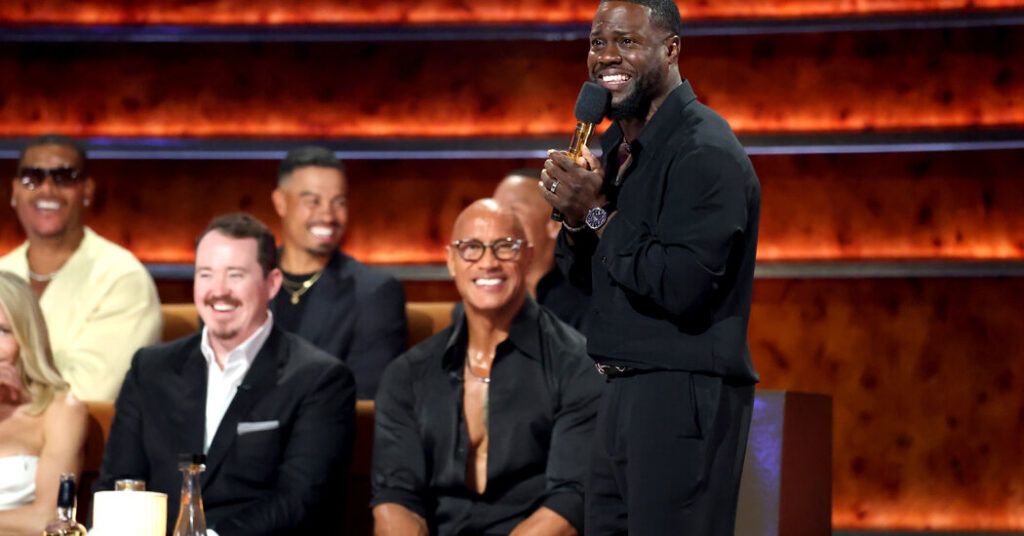
Since the Tom Brady roast at the 2024 festival was a hit, it’s no surprise that the main event capping off the week was another live roast, this time of Kevin Hart, host of the last one. Brady returned to get revenge and so did several of the participants. Actors (Teyana Taylor), musical artists (Usher), athletes (Draymond Green) and comics made brutal fun of Hart and everyone else on the dais. It would have been nice if they had one gay comic since the episode when Hart dropped out as Oscar host over past homophobic tweets frequently came up for ridicule. But often the point of the joke was merely to call him gay. No one had a breakout moment the way Nikki Glaser did two years ago (though Sheryl Underwood’s boisterously funny set should introduce her to new audiences), but considering the fact that Netflix employed 17 writers, there were some solidly constructed burns in this aggressively tasteless evening.
Hart projected a game, hammy energy, performing umbrage in a way that came off as artificial, especially when contrasted with the seemingly real hostility between some of the participants: Chelsea Handler laid into Tony Hinchcliffe, accusing him of bigotry and criticizing his support of the president. He looked uncomfortable, then he fired back.
The highlight of the evening was the surprise appearance of Katt Williams, who has been beefing with Hart for years. Walking onstage in a cape, hat and sparkly jacket to the theme from “Shaft,” he went hard. “Just because Kevin went to Diddy parties does not mean he did something wrong,” Williams said. “The fact that he gets all quiet when you bring it up, that means he did something wrong.” Williams tried to make a quick exit, but Hart stopped him and said, “Let’s end the beef.” They hugged, unpersuasively.
Gossip
Netflix’s embrace of podcasting was reflected in the festival, with many stand-ups bantering, flattering and, at their most fun, dishing dirt. The most elite gossip was served up by Chris Rock on “Fly on the Wall,” the podcast of David Spade and Dana Carvey. Rock has crossed paths with just about every mega star in popular culture and spilled personal stories about going to McDonald’s with Michael Jordan, attending a Black church with Courtney Love (which did not make him popular among Black women, he said), talking on the phone to Michael Jackson, hanging out with Madonna.
You surely know about his fight with Will Smith. But did you know that Tupac Shakur “kind of stepped” to Rock at the 1996 MTV Video Music Awards afterparty because the rapper was upset about a bit in the special “Bring the Pain.” But as Rock told it, the real issue was that they were sleeping with the same woman. “He always won that battle,” Rock said.
Earlier in the week, Rock performed at the Comedy Store on a bill with Louis C.K.; Dave Chappelle; Shane Gillis; and Ye, formerly known as Kanye West — which generated considerable chatter. Rock referred to the night of comics as “the canceled all-stars.” Asked what Ye, who has been widely condemned for repeated antisemitic sentiments, said onstage, Rock said on the podcast that the rapper was “talking about how he loooves ‘Seinfeld.’”
John Mulaney
There’s a sarcastic register in John Mulaney’s tool kit that has deepened with age. In his new hour, he often lingered in this wry voice, building arguments with it, adding absurdity upon absurdity until the ironic distance seems to shrink and his tone became less smirky than coherent and righteous. It’s one of the many small miracles of form that explain why Mulaney is setting the pace in standup right now. As a precocious performer, he could seem older than he was, getting laughs out of that incongruity. Now he has a distinctive, age-appropriate voice: as a persnickety, cranky and aloof dad.
His jokes were thick with clever locutions and sharp pivots. These were chunks of comedy built on dense paragraphs that moved with confidence and quickness, whether the focus was kids’ birthday parties or sweeping historical takes on our political mood.
Mulaney isn’t a topical or personal comic, but he dabbles in both, getting laughs out of hot-take premises like why old people shouldn’t vote: “Would you order for the table if you were about to leave the restaurant?” But his greatest strength here is as a sharp, hilarious cultural critic. There’s a very funny bit on “The Wizard of Oz” and a spectacular unpacking of the demonic possession genre that will make you never see “The Exorcist” the same way again.
Rising Stars
Part of the fun of big festivals is seeing performers on the rise. They tend to be hungrier, harder working, funnier. Opening for Jeselnik, Megan Gailey made a persuasive case for Charles Barkley as the Democrats’ best hope for president and had a funny joke about how men won’t shut up about their colonoscopies. “Colonoscopy?” she asked, unimpressed. “That’s what Catholic girls call college.”
At the intimate Lab at the Hollywood Improv, the very funny Sophie Buddle waded into a joke that mentioned transgender people, then paused to wonder if it would be amusing if she became as obsessed with the subject as Chappelle is. “I’m not famous enough to have opinions that crazy,” she joked, “but if I get famous, I’m going to start an even bigger fight with an even smaller group of people.”
Music
Speaking of Chappelle, whose political views were mocked at multiple shows, including by the cracked clowns of the show “Stamptown,” he delivered a work-in-progress hour that covered President Trump, forgiveness and his failed attempt to get Chris Rock and Will Smith to reconcile on “Saturday Night Live.” And yes, he was still relitigating past scandals. Chappelle generates so much discourse that one of his central legacies is often ignored. No other comic has done more to incorporate music into comedy shows. He featured music acts on his sketch show and made the concert documentary “Dave Chappelle’s Block Party,” and he’s kept this up in his live sets. Here, he played the role of M.C. as well as comic, introducing tight sets by Black Star, Killer Mike and Lizzo, who performed her hits before ending with a collaboration in which she played the flute and Chappelle led the crowd in breathing exercises. (Lizzo said Chappelle had invited her an hour before.)
Robert F. Kennedy Jr.
No one in the Trump administration (including possibly the president himself) took more hits at the festival than the health secretary. The return of the measles got a lot of attention as did imitations of his voice, not to mention his friendships with various comedian podcasters. Sarah Silverman called him the world’s “oldest nepo baby” and read poems the journalist Olivia Nuzzi has said Kennedy wrote for her. Jeff Ross imitated his gravelly voice at the roast. And Mulaney borrowed one of Trump’s favorite expressions, saying Kennedy cheated on his wife “like a dog,” then Mulaney mocked the crowd for gasping. “First 20 rows of the Hollywood Bowl with the pearl clutch? Is that the line for you? He may poison children but a Kennedy cheating?”
Theater
The growing ambition of standup comedy this century is due in no small part to the rise of the solo show, dominated by personal confession or narrative storytelling. Jerrod Carmichael has been at the forefront of this movement, shifting from conventional club sets to intimate, conversational jokes. His new hour at the festival was unpolished, moving awkwardly between stories about his relationship to stale punchlines about Meghan, the Duchess of Sussex. But he explored his central theme — the deeply unromantic side of love — with enough comic insight to intrigue.
To open her chaotic solo show about getting breast cancer, Grace Helbig carried a giant photo of Hugh Jackman, which set a theatrical and somewhat random mood. A charismatic personality, she told the story of her fame as a YouTuber, before revealing her illness. Interestingly, the show is darker about life as a content creator, with a certain grimness about internet fame lurking beneath her frenetic, self-deprecating delivery, a point that could be explored more. She said getting sick provided a relief of sorts, a fascinating idea that she tossed out, then quickly moved on from, like someone scrolling from one video to the next.
Jason Zinoman is a critic at large for the Culture section of The Times and writes a column about comedy.
The post At Netflix Is a Joke, the Attention Economy Rules the Festival appeared first on New York Times.