Since President Donald Trump last visited Beijing more than eight years ago, U.S.-China merchandise trade has fallen by more than one-third. The partial commercial deal he signed with Chinese leaders failed to live up to advance billing. And the United States gave up trying to convince Beijing to remake its state-led economic model, choosing instead to ape some of China’s features.
After a bruising trade war consumed most of 2025, Trump and Chinese President Xi Jinping agreed last fall to an uneasy economic truce. The White House, struck by Xi’s demonstrated willingness to push back hard on Trump’s tariffs, now wants the relative calm to last.
Whether it can will be decided at the two leaders’ scheduled summit this week in the Chinese capital.
Their discussions are expected to include the customary haggling over potential Chinese purchases of American products, including commercial jetliners and soybeans, as well as a proposal for a joint Board of Trade that would bring government oversight to their commerce. The two presidents also will likely talk about ways to adjust tariffs that have grown to double-digit percentages on both sides.
Whatever upbeat diplomatic rhetoric attends this week’s ceremonies in Beijing, however, more friction appears inevitable.
Trump already plans to introduce new tariffs this summer, including on Chinese goods, to replace the levies the Supreme Court struck down earlier this year.
After struggling to decipher the unconventional American president in his first term, Chinese officials have learned to wield their economic leverage, warning U.S. business leaders recently that they will retaliate “each and every time” Washington acts on trade or investment, according to an American executive who asked not to be named discussing confidential talks.
The first Trump administration aimed to coerce China into reorienting its economic model to boost domestic consumption, which would suck in imports, while reducing subsidies for exporters. Today, the Trump team appears ready to settle for erecting higher barriers against Chinese goods.
“The big change with Trump 2.0 is that China has really stopped trying to appease the administration. …We’re going to try to get some wins. But it’s really about managed trade, and it’s less about systemic change in the Chinese system,” said Myron Brilliant, a senior counselor at DGA-Albright Stonebridge Group.
The president has de-emphasized fundamental change in China’s state-led economy at the same time he has pushed for greater involvement in the workings of the U.S. private sector. Under Trump, the federal government has taken an unusual ownership stake in Intel, a semiconductor maker, and several critical minerals companies. The government also secured a “golden share” in Nippon Steel’s takeover of US Steel, which allows the president to veto any plant closures or headquarters relocation.
Trump has steered the government into financial partnerships with Westinghouse, designed to promote deployment of its nuclear reactor technology, and traded government export licenses for a cut of the profits from sales to China of Nvidia’s and AMD’s computer chips. Along with the president’s demands that U.S. trading partners, including Europe and Japan, invest hundreds of billions in U.S. projects as a condition of tariff deals, the new economic playbook represents a major shift in Washington’s orientation.
While falling well short of the government interventions that are common in China — and that multiple U.S. presidents have decried as unfair trade — Trump’s economic activism marks a sharp departure from the market-centric approach of his predecessors.
“The entire conversation about fairness is disappearing because, one, not only do they think they wouldn’t get the Chinese to budge on these issues, but even more so because the U.S. has decided that it will itself intervene heavily in the American economy,” said Scott Kennedy, senior adviser at the Center for Strategic and International Studies in Washington.
Trump entered the White House in 2017 having promised a break with decades of bipartisan support for integration between the world’s two largest economies. He began imposing unprecedented tariffs on Chinese goods in 2018 and later took additional measures to hamstring China’s technology development by placing two of the country’s leading companies, Huawei and ZTE, on a Commerce Department blacklist.
Many of Trump’s tariffs survived both the January 2020 signing of a “phase one” China trade deal and the Biden administration. U.S. imports from China peaked in 2018, then fell for two years before rebounding amid the pandemic-era spending spree by housebound Americans.
The pandemic also disrupted global supply chains, demonstrating the risks for Americans of depending upon Chinese factories for critical products including personal protective equipment, pharmaceuticals and rare earth minerals. Encouraged by both the Trump and Biden administrations, U.S. companies sought suppliers outside China.
Within days of returning to the White House last year, Trump imposed additional tariffs on Chinese goods, first citing Beijing’s role in the global fentanyl trade and later as part of his broader “Liberation Day” announcements affecting goods from most nations.
Trump’s strategy was premised on the idea that China needed the U.S. more than the U.S. needed it. When China, almost alone among major nations, retaliated against Trump’s tariffs – by restricting shipments of the rare earths that U.S. automakers and healthcare giants require – the administration was caught off guard and quickly sued for peace.
Earlier this month, China’s willingness to defy the U.S. was again on display when the Ministry of Commerce for the first time ordered Chinese companies to ignore U.S. financial sanctions after the Treasury Department penalized several Chinese refiners for allegedly purchasing Iranian crude oil.
“To do it right before the summit with Trump, that’s a clear warning shot to the U.S. that you’re not going to be able to get away with this kind of thing. I think it probably also is an attempt to build leverage and give them something to hold over the U.S. in the talks,” said Jake Werner, director of the Quincy Institute’s East Asia program.
In the days before the summit, White House officials suggested they are eager to maintain the delicate status quo rather than address the numerous irritants in the relationship.
“I think what both sides want is stability,” a senior White House official said, referring to the one-year truce over rare earths exports that Trump and Xi reached at their October meeting in South Korea.
The U.S. president now appears focused on getting along with Beijing. With the war in Iran driving costs higher for U.S. consumers, Trump would face political risks from any additional economic disruption.
“During this visit, President Trump will continue doing what he has done over the past year, rebalancing the relationship with China and prioritizing reciprocity and fairness to restore American economic independence,” said Anna Kelly, a White House spokeswoman.
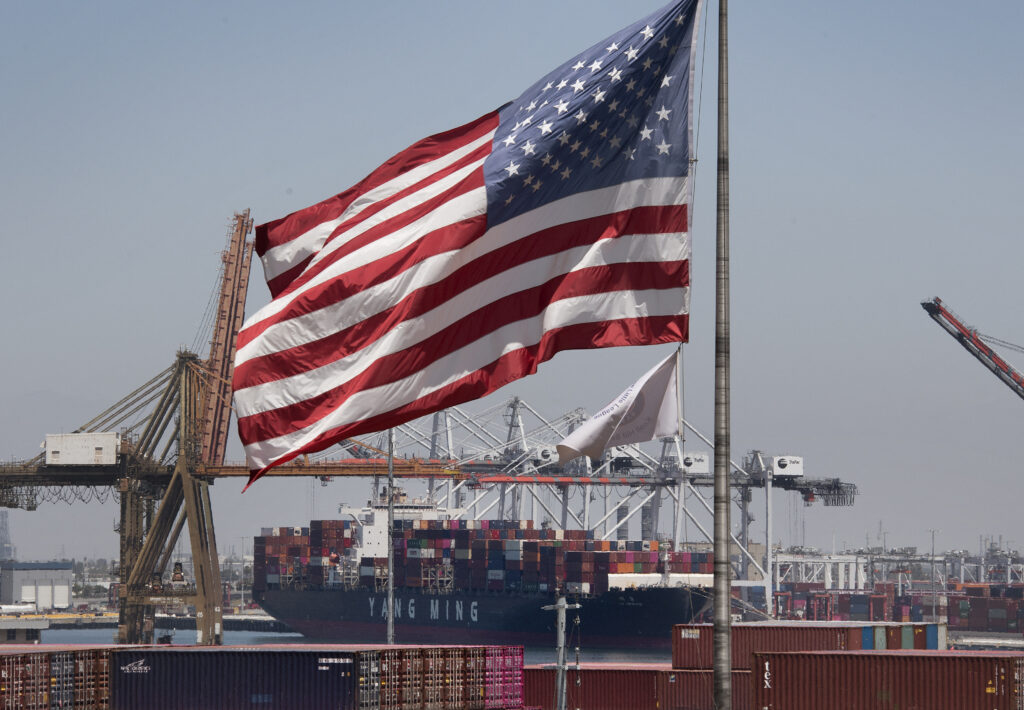
The overhaul of U.S.-China commerce that Trump set in motion nine years ago was aimed at reducing the bilateral trade deficit he blamed for hollowing out American factory communities. By that measure, it has been a success. The $375 billion U.S. trade deficit with China in 2017 shrank to $202 billion last year and is on pace to drop to $134 billion this year, which would be the lowest figure since 2003, according to Census Bureau statistics.
Chinese goods, which accounted for nearly one-quarter of all U.S. imports before Trump’s first trade war, made up just 7.5 percent of them in the first quarter of this year, according to economist Chad Bown of the Peterson Institute for International Economics.
But even as the deficit with China dropped, overall U.S. trade became even more imbalanced. The total U.S. trade deficit in 2017 of more than $792 billion grew to more than $1.2 trillion last year.
The laptops and monitors that Americans once bought from Chinese factories increasingly originate in Vietnamese workshops. As companies such as Apple reacted to Trump’s tariffs by diversifying their supply chains, India began shipping more smartphones to the U.S. than China.
The White House has credited the president’s tariffs for the decline in Chinese imports, noting last month that China no longer had the largest trade surplus with the U.S. of any trading partner.
But despite the economic conflict with the world’s largest economy, China has continued to gain global manufacturing market share. The Chinese goods that once landed on U.S. shores now find customers in Southeast Asia or Europe.
As China’s domestic demand weakened amid a property bubble that collapsed in 2021, the government stepped up financial support for its manufacturers. By the beginning of this year, the volume of China’s global exports was 70 percent larger than before the pandemic.
Chinese-made lithium-ion batteries, railway equipment, ships, toys, automobiles and household appliances have flooded global markets at the expense of producers in advanced economies and the developing world, according to Capital Economics in London. In 2025, China’s overall trade surplus hit $1.2 trillion, the largest ever by any nation.
“It’s just not sustainable for the rest of the world to absorb all of these exports because that will mean devastation in the manufacturing sectors of many countries that are on the receiving end,” said Eswar Prasad, former head of the IMF’s China unit and now a Cornell University professor.
China’s global export dominance is the mirror image of the chronic U.S. trade deficit. Such a lopsided global economy historically has raised the risk of weaker growth or even financial crisis, according to the International Monetary Fund.
“The world cannot take a China with a $1 trillion dollar trade surplus,” Treasury Secretary Scott Bessent said last month, calling global imbalances “the greatest risk” to the world economy.
Administration officials blame subsidized manufacturing for tilting global markets against U.S. companies and plan to respond later this summer with new tariffs. The U.S. Trade Representative last week held public hearings on policies used by China, as well as 14 other nations and the European Union, that result in “structural excess capacity” in manufacturing.
But Prasad, like most economists, said such measures are unlikely to deliver the global rebalancing that the administration seeks. That will occur only if both the U.S. and China change their domestic economic policies, with the U.S. saving more and consuming less, while China redirects its support from factories to households.
“But neither country seems willing to take those steps,” he said.
Rebecca Tan in Singapore contributed to this report.
The post As he prepares to meet Xi, Trump no longer pushes for change in China’s system appeared first on Washington Post.