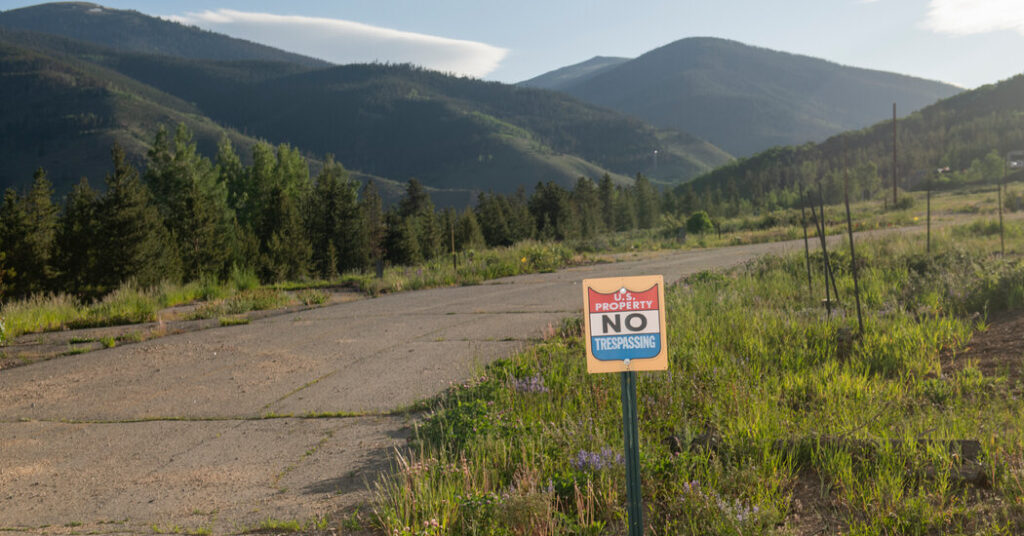
The Trump administration on Monday said it would repeal a Biden-era rule that allowed public lands to be leased for conservation purposes, abandoning an effort to protect millions of acres from both industrial development and the effects of climate change.
The rule, issued by the Bureau of Land Management, had prioritized the use of federal lands for conservation, recreation and renewable energy development. Since returning to office, though, President Trump has championed their use for oil and gas drilling, coal mining, logging and livestock grazing.
The regulation applied to roughly 245 million acres of public lands overseen by the bureau, which make up about one-tenth of the country. It did not apply to national parks, which are overseen by the National Park Service.
In a notice in the Federal Register on Monday, the B.L.M. said the rollback would be finalized on Tuesday. Representatives for the Interior Department, which includes the B.L.M., did not immediately provide a comment from Secretary Doug Burgum.
The B.L.M., sometimes called the country’s largest landlord, has for decades offered leases for the development of public lands, including for oil drilling and cattle ranching. But some of those activities have fragmented wildlife habitat and contaminated watersheds. At the same time, climate change has fueled more frequent and more severe wildfires and drought across the West.
The Biden-era rule, finalized in April 2024, sought to put conservation on equal footing with development for the first time since the B.L.M. was established in 1946. It allowed the agency to offer two new types of leases for restoring degraded ecosystems and for offsetting environmental damage, though none of the new leases were awarded before the rule was wiped off the books.
Several Republican-led states and industry groups had assailed the rule as a land grab and challenged it in federal court. On Monday, they applauded the Trump administration’s move to scrap the regulation.
“Today, the Trump administration is embracing energy production on public lands because the resources Americans collectively own can be used for our nation’s economic benefits,” Melissa Simpson, the president of the Western Energy Alliance, a Denver-based trade group that represents oil and gas companies, said in a statement.
Ms. Simpson said the oil and gas industry supported a different conservation effort: the Great American Outdoors Act, a bipartisan law that Mr. Trump signed during his first term. The law provided up to $9.5 billion over five years to help clear up maintenance backlogs at national parks, wildlife refuges and other public lands. Much of that money came from revenue from drilling and mining on public lands and in federal waters.
Conservation groups sharply criticized the rollback.
“By rolling back the public lands rule, the administration is admitting loudly and clearly that they think public lands are just there for corporations and for their donors to profit from,” said Tracy Stone-Manning, the president of the Wilderness Society, who served as the B.L.M. director during the Biden administration.
Trump Administration: Live Updates
Updated
- Trump proposes suspending the federal gas tax until prices fall.
- Sixteen chief executives plan to join Trump in China.
- The man charged with a plot to kill Trump at the correspondents’ dinner pleaded not guilty.
Athan Manuel, the director of the Lands Protection Program at the Sierra Club, said it was “very frustrating” that the rule was being scrapped before it could have a significant impact. It would have “restored some balance to a bureau that we used to call the Bureau of Logging and Mining or the Bureau of Leasing and Minerals,” he said.
After proposing to rescind the rule in September, the Trump administration solicited public comments for 60 days. Of the 43,746 public comments it received, nearly 98 percent were opposed to rolling back the regulation, according to an analysis by the Center for Western Priorities, an advocacy group.
For instance, tribes in northwest Alaska wrote that the move “threatens to fragment habitat” for salmon, caribou and other species that they rely on for hunting and fishing. And Mike Mershon, the president of the Montana Wildlife Federation, wrote that the proposal would leave federal lands in the state more vulnerable to drought, floods, wildfires and invasive species.
Still, some public comments were supportive of rolling back the rule. Janet VanCamp, then the chair of the Board of Commissioners in White Pine County, Nev., a Republican-leaning area, wrote that the rule would have hindered efforts to thin forests to prevent wildfires. And Leslie Tanner, a fifth-generation rancher and farmer in Wyoming, wrote that “it’s been a source of infuriating frustration to witness the infestation of conservation lunatics take control of our lands.”
The Senate is scheduled to vote late Monday to confirm Steve Pearce, Mr. Trump’s pick to lead the B.L.M. Mr. Pearce, a former Republican congressman from New Mexico, has faced scrutiny over his past statements about selling off public lands to reduce the national debt.
At his confirmation hearing in February, Mr. Pearce did not disavow those comments. But he also pledged that he would not try to sell “large swaths of land,” saying the law does not allow such sales.
Maxine Joselow covers climate change and the environment for The Times from Washington.
The post Trump Administration to Scrap Rule That Elevated Land Conservation appeared first on New York Times.