It’s a simple proposition: Whatever our views of the Middle East conflict, we should be able to unite in condemning rape.
Supporters of Israel made that point after the brutal sexual assaults against Israeli women during the Hamas-led attack on Israel on Oct. 7, 2023. Donald Trump, Joe Biden, Benjamin Netanyahu and many U.S. senators, including Marco Rubio, condemned that sexual violence, and Netanyahu rightly called on “all civilized leaders” to “speak up.”
And yet in wrenching interviews, Palestinians have recounted to me a pattern of widespread Israeli sexual violence against men, women and even children — by soldiers, settlers, interrogators in the Shin Bet internal security agency and, above all, prison guards.
There is no evidence that Israeli leaders order rapes. But in recent years they have built a security apparatus where sexual violence has become, as a United Nations report put it last year, one of Israel’s “standard operating procedures” and “a major element in the ill treatment of Palestinians.” A report out last month, from the Euro-Med Human Rights Monitor, a Geneva-based advocacy group often critical of Israel, concludes that Israel employs “systematic sexual violence” that is “widely practiced as part of an organized state policy.”
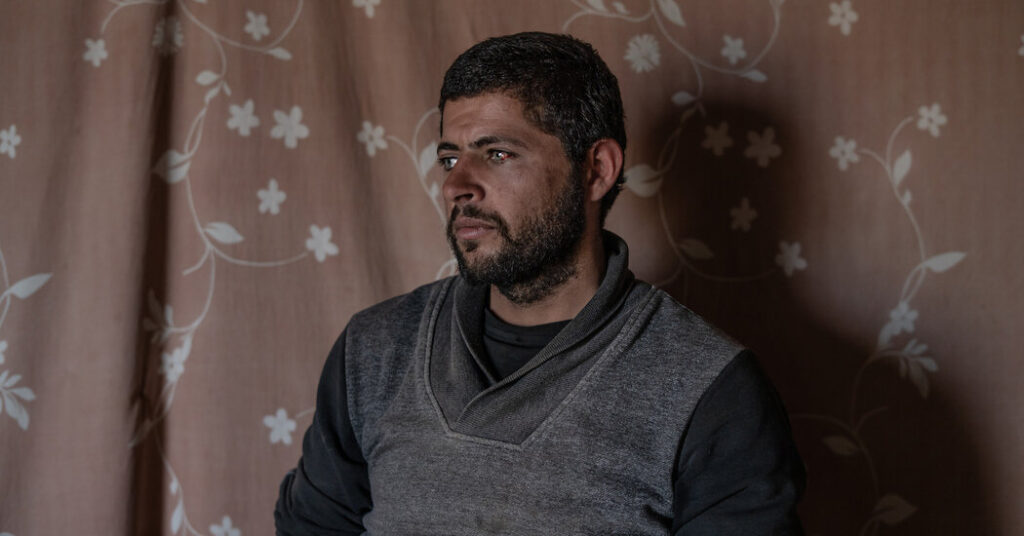
What does this standard operating procedure look like? Sami al-Sai, 46, a freelance journalist, says that as he was being taken to a prison cell after his detention in 2024, a group of guards threw him to the ground.
“They were all hitting me, and one stepped on my head and neck,” he said. “Someone pulled my pants down. They pulled down my boxers.” And then one of the guards pulled out a rubber baton used to beat prisoners.
“They were trying to force it into my rectum, and I was bracing myself to prevent it, but I couldn’t,” he said, speaking with increasing anxiety. “It was so painful.” The guards were laughing at him, he said. “Then I heard someone say, ‘Give me the carrots,’” he recalled, adding that they then used a carrot. “It was extremely painful,” he said. “I was praying for death.”
Al-Sai was blindfolded, he said, and heard someone say in Hebrew, which he understands, “don’t take photos.” That suggested to him that someone had pulled out a camera. One of the guards was a woman who, he said, grabbed him by the penis and testicles, and joked, “these are mine,” and then squeezed until he screamed from pain.
The guards left him handcuffed on the ground, and he smelled cigarette smoke. “I realized it was their smoking break,” he said.
After he was dumped into his cell, he concluded that the spot where he had been raped had been used before, for he found other people’s vomit, blood and broken teeth crushed into his skin.
Al-Sai said that he had been asked to become an informant for Israeli intelligence, and he believes that the purpose of his arrest and imprisonment under the administrative detention system was to pressure him to agree. Because he prided himself on his journalistic professionalism, he said, he refused.
I’ve had a career covering war, genocide and atrocities including rape, sometimes in places where the scale of sexual violence is far greater than anything committed by either Hamas militants or Israeli guards or settlers. In the Tigray conflict in Ethiopia a few years ago, 100,000 women may have been raped. Mass rape is now unfolding in Sudan.
Yet our American tax dollars subsidize the Israeli security establishment, so this is sexual violence in which the United States is complicit.
I became interested in reporting on sexual assaults against Palestinian prisoners after Issa Amro, a nonviolent activist sometimes called “the Palestinian Gandhi,” told me when I previously visited that he had been sexually assaulted by Israeli soldiers and that he believed this was common but underreported because of shame.
By one count, Israel has detained 20,000 people in the West Bank alone since the Oct. 7 attacks, and more than 9,000 Palestinians were still being held as of this month. Many have not been charged but were detained under ill-defined security grounds, and since 2023, most have been denied visits from the Red Cross and lawyers.
“Israeli forces systematically employ rape and sexual torture to humiliate Palestinian female detainees,” the Euro-Med report said. It cited a 42-year-old woman who said she had been shackled naked to a metal table as Israeli soldiers forcibly had sex with her over two days while other soldiers filmed the attacks. Afterward, she said, she was shown photos of her being raped and told they would be published if she did not cooperate with Israeli intelligence.
It’s impossible to know how common sexual assaults against Palestinians are. My reporting for this article is based on conversations with 14 men and women who said they had been sexually assaulted by Israeli settlers or members of the security forces. I also spoke to family members, investigators, officials and others.
I found these victims by asking around among lawyers, human rights groups, aid workers and ordinary Palestinians themselves. In many cases it was possible to corroborate the victims’ stories in part by talking to witnesses or, more commonly, to those whom the victims had confided in, such as family members, lawyers and social workers; in other cases it was not possible, perhaps because shame left people reluctant to acknowledge abuse even to loved ones.
Save the Children commissioned a survey last year of children ages 12 to 17 who had been in Israeli detention; more than half reported witnessing or experiencing sexual violence. Save the Children said that the true figure was probably higher because stigma left some unwilling to acknowledge what had happened to them.
The Committee to Protect Journalists, a respected American organization, surveyed 59 Palestinian journalists who had been released by Israeli authorities after the Oct. 7 attacks. Three percent said they had been raped, and 29 percent said they had endured other forms of sexual violence.
The Israeli government rejects suggestions that it sexually abuses Palestinians, just as Hamas denied raping Israeli women. Israel welcomed a United Nations report documenting sexual assaults against Israeli women by Palestinians but rejected the report’s call to investigate Israeli assaults against Palestinians. Netanyahu has denounced “baseless accusations of sexual violence” made against Israel.
Israel’s Ministry of National Security declined to comment for this article. The prison service “categorically rejects the allegations” of sexual abuse, said a spokesman who declined to be named, adding that complaints are “examined by the competent authorities.” The spokesman declined to say whether any prison staff member had ever been fired or prosecuted for sexual assaults.
The Palestinians I interviewed recounted various kinds of abuse beyond rape. Many reported that they often had their genitals yanked or were beaten on the testicles. Hand-held metal detectors were used to probe between men’s naked legs and then smashed into their private parts; some men had to have their testicles amputated by doctors after beatings, according to the Euro-Med monitor.
One reason these abuses don’t receive more attention is threats by Israeli authorities, who periodically warn prisoners on release to keep quiet, according to Palestinians who have been freed. Another reason, Palestinian survivors told me, is that Arab society discourages discussing the topic for fear of hurting the morale of prisoners’ families and undermining the Palestinian narrative of defiant and heroic detainees.
Conservative social norms also inhibit discussion: Two victims told me that a prisoner who acknowledges being raped would harm the ability of his sisters and daughters to find husbands.
One farmer initially agreed to let me use his name in this article. Released early this year after months in administrative detention — with no charges filed — he related what he said happened one day last year: A half-dozen guards immobilized him by holding his arms and legs while pulling down his pants and underwear and inserting a metal baton into his anus. The rapists were laughing and cheering, he said.
Several hours later, he said, he fainted and was taken to the prison clinic. After he woke up, he said, he was raped once more, again with the metal baton.
“I was bleeding,” he recalled. “I broke down completely. I was crying.”
After being returned to his cell, he said, he asked a guard for pen and paper to write a complaint about the assaults. The request was denied. And that evening, a group of guards came to the cell.
“Who is the one who wants to file a complaint?” one guard jeered, he said, and another guard pointed him out. “The beating started immediately,” he recalled. And then they raped him with the baton for a third time that day, he said.
He recalled one saying, “Now you have even more to put in your complaint.”
A few days after I interviewed him, the farmer called to say that he didn’t want his name used after all. He had just been visited by Shin Bet and warned not to cause trouble, and he also feared that his family would react badly to the attention.
“Rampant sexual abuse of Palestinian prisoners is a thing; it’s been normalized,” said Sari Bashi, an Israeli American human rights lawyer who is the executive director of the Public Committee Against Torture in Israel. “I don’t see evidence that it has been ordered. But there’s persistent evidence that the authorities know it’s happening and are not stopping it.”
Another Israeli lawyer, Ben Marmarelli, told me that based on the experiences of the Palestinian detainees he has represented, rape of Palestinian prisoners with objects “is going on across the board.”
Bashi said her organization has filed hundreds of complaints detailing horrific abuse against Palestinian detainees — and not in a single case did these lead to charges filed. Impunity, she said, creates a “green light” for abusers.
One Palestinian prisoner from Gaza reportedly was hospitalized in July 2024 with a tear in his rectum, cracked ribs and a punctured lung. Investigators obtained a prison video purportedly showing the abuse. The authorities detained nine reservist soldiers — but Israel’s right-wingers erupted in outrage, with a mob of furious protesters, including politicians, breaking into the prison to show support for the guards. The last charges against the soldiers were dropped in March, and last month the military approved the soldiers’ return to duty.
Netanyahu hailed the dropping of charges as the end of a “blood libel.” “The State of Israel must hunt down its enemies — not its heroic fighters,” he said.
Bashi described the outcome this way: “I would say that dropping the charges — that’s giving permission to rape.”
That prisoner, who afterward reportedly required a stoma bag to collect his waste, was returned to Gaza, and an acquaintance of his said that he spent months in a hospital recovering from his internal injuries. The acquaintance said that the former prisoner declined to be interviewed.
Prosecutions and public attention can curb such violence. In 1997, police officers in New York City raped a Haitian immigrant, Abner Louima, with a stick so brutally that he required hospitalization and surgeries. New Yorkers were outraged, Mayor Rudy Giuliani visited Louima in the hospital and police officers were prosecuted in a landmark case. That sent a powerful message throughout the police force: Those who assault detainees may be punished. And that’s the message that must be sent throughout the Israeli security forces.
If the Trump administration insisted on a resumption of Red Cross visits to prisoners, if the U.S. ambassador visited rape survivors with cameras in tow, if we conditioned arms transfers on an end to sexual assault, we could send a moral and practical message that sexual violence is unacceptable no matter the identity of the victim. For starters, the ambassador could ensure that those Palestinians who dared to speak for this article are not brutalized again for their courage.
How does this kind of violence happen? Decades of covering conflict has taught me that a combination of dehumanization and impunity can propel people into a Hobbesian state of nature. I’ve encountered this drift toward savagery in killing fields from Congo to Sudan to Myanmar, and I think it also roughly explains how American soldiers came to sexually abuse prisoners at Abu Ghraib in Iraq.
The blunt reality is that when there are no consequences, we humans are capable of immense depravity toward those we are taught to scorn as subhuman.
Itamar Ben-Gvir, Israel’s national security minister, called detainees “scum” and “Nazis” and boasted of making prison conditions harsher for Palestinians. When such attitudes prevail, sexual abuse can become one more tool to inflict pain and humiliation on Palestinians.
Ben-Gvir declined, through a spokeswoman, to comment on sexual assaults by security services.
B’Tselem, an Israeli human rights organization, documented “a grave pattern of sexual violence” toward Palestinians. It cited the account of a Gaza prisoner, Tamer Qarmut, who said he had been raped with a stick. Torture, B’Tselem said, “has become an accepted norm.”
A former Israeli officer in a prison infirmary described in testimony to the Israeli group Breaking the Silence what that kind of acceptance means in practice: “You see normal, pretty ordinary people reaching a point where they abuse people for their own amusement, not even for an interrogation or anything. For fun, to have something to tell the guys, or revenge.”
Most of the rape and other sexual violence has been directed at men, if only because Palestinian prisoners are more than 90 percent male. But I spoke to one Palestinian woman who was arrested at the age of 23 after the Hamas attack in October 2023. She said that the soldiers who arrested her threatened to rape her, her mother and her young niece. Her prison ordeal began with a strip-search conducted by female guards, “but then a male soldier came in, when I was completely naked,” she added.
For the next few days, she said, she was repeatedly stripped naked, beaten and searched by teams of male and female guards alike. The pattern was always the same: Several guards, men and women together, would come to her cell, forcibly strip her naked, handcuff her hands behind her back and bend her forward at the waist, sometimes forcing her head into the toilet. In this position, she would be beaten and groped all over, she said.
“They had their hands all over my body,” she said. “To be honest, I don’t know if they raped me,” she said, because she sometimes lost consciousness from the beatings.
The aim of the abuse was twofold, she thinks: to crush her spirit and also to let Israeli men molest a naked Palestinian woman with impunity.
“I’d be stripped and beaten several times a day,” she said. “It was as if they were introducing me to everyone who worked there. At the beginning of each shift, they would bring the guys to strip me.”
When she was about to be released from prison, she said, she was called into a room with six officials and given a stern warning never to give interviews.
“They threatened that if I spoke up, they would rape me, kill me and kill my father,” she said. Not surprisingly, she declined to be named in this article.
Some of the worst sexual abuse appears to have been directed at prisoners from Gaza. A Gaza journalist shared with me his account of the abuse he suffered after he was detained in 2024.
“No one escaped sexual assaults,” he said. “Not all were raped, I would say, but everyone went through humiliating, filthy sexual assaults.” On one occasion, he said, the guards zip-tied his testicles and penis for hours while beating his genitals. For days afterward, he said, he urinated blood.
On one occasion, he said, he was held down, stripped naked, and as he was blindfolded and handcuffed, a dog was summoned. With encouragement from a handler in Hebrew, he said, the dog mounted him.
“They were using cameras to take photos, and I heard their laughs and giggles,” he said. He tried to dislodge the dog, he said, but it penetrated him.
Other Palestinian prisoners and human rights monitors have also cited reports of police dogs being coached to rape prisoners. The journalist said that when he was released, an Israeli official warned him: “If you want to stay alive when you return, do not speak to the media.”
So why was he willing to speak?
“There are moments when remembering feels unbearable,” he said. “My heart felt it might stop while talking to you about it just now. But I remember there are people still in there. So I speak up.”
Multiple accounts indicate that sexual violence has been directed even at Palestinian children, who are typically imprisoned for throwing stones. I located and interviewed three boys who had been detained, and all described being sexually abused.
One, a shy boy in a Hilfiger shirt who was 15 years old at the time of his arrest, declined to say whether he had also witnessed actual rapes. But he said threats were routine: “They’d say, ‘Do this or we’ll put this stick up your butt.’”
The other boys told very similar stories of sexual violence as part of beatings and noted that the threats of rape were directed not only at them but also at their mothers and siblings.
Israeli settlers are not an official arm of the state in the same way that the prison system is, but the Israel Defense Forces increasingly protect settlers as they attack Palestinian villagers and use sexual violence to drive Palestinians to flee. “Sexualized violence is used to pressure communities” to leave their land, according to a new report by the West Bank Protection Consortium, a coalition of international aid groups led by the Norwegian Refugee Council.
The consortium surveyed Palestinian farmers and found that more than 70 percent of households that had been displaced reported that threats to women and children, particularly of sexual violence, were the decisive reason for leaving. “Sexual violence,” said Allegra Pacheco of the coalition, “is one of the mechanisms driving people from their land.”
In a remote Jordan Valley hamlet of Bedouin farmers, I met a 29-year-old farmer, Suhaib Abualkebash, who recounted how a gang of about 20 settlers rampaged through the homes of his family, beating adults and children alike, stealing jewelry and 400 sheep — and also cut off his clothes with a hunting knife and then tightly zip-tied his penis and yanked.
“I was afraid they would cut off my penis,” Abualkebash told me. “I thought this was the end for me.”
Some may wonder whether Palestinians fabricated accusations of sexual assaults to defame Israel. To me that seems far-fetched, because none of those I interviewed sought me out or knew who else I was speaking to, and they were reluctant to speak. Yet there is some evidence that Israel’s sexual abuse has become so frequent that norms are changing and Palestinian victims are becoming a bit more willing to speak out.
“For six months I couldn’t speak about it, even to my family,” said Mohammad Matar, a Palestinian official who told me that settlers stripped him, beat him and poked him with a stick in the buttocks while talking about raping him. During the attack, the assailants posted a photograph on social media of him blindfolded and stripped to his underpants.
With time, Matar decided to speak out to try to break the stigma. He now keeps a blown-up print of the settlers’ photo of him on the wall of his office.
To try to make sense of what I found, I called up Ehud Olmert, who was prime minister from 2006 to 2009. Olmert told me he didn’t know much about sexual violence against Palestinians but was not surprised by the accounts I had heard.
“Do I believe it happens?” he asked. “Definitely.”
“There are war crimes committed every day in the territories,” he added.
So we return to the point I noted at the beginning of this column: Supporters of Israel were right in 2023 that whatever our views about the Middle East, we should be able to repudiate rape.
“Where the hell are you?” Netanyahu asked the international community then, demanding that it condemn sexual violence committed by what the Israeli government has called the “Hamas rapist regime.”
Hamas has indeed brutally violated human rights. Israeli officials should look to their own violations as well — in particular at what a 49-page United Nations report last year called Israel’s “systematically” subjecting Palestinians to “sexualized torture” committed with at least “an implicit encouragement by the top civilian and military leadership.”
Think of it this way: The horrific abuse inflicted on Israeli women on Oct. 7 now happens to Palestinians day after day. It persists because of silence, indifference and the failure of American and Israeli officials alike to answer Netanyahu’s query: Where the hell are you?
The Times is committed to publishing a diversity of letters to the editor. We’d like to hear what you think about this or any of our articles. Here are some tips. And here’s our email: [email protected].
Follow the New York Times Opinion section on Facebook, Instagram, TikTok, Bluesky, WhatsApp and Threads.
The post The Silence That Meets the Rape of Palestinians appeared first on New York Times.