1.
The glacier’s rippling mass sprawled from the hills and volcanoes of the Antarctic interior out into the Southern Ocean, covering an area the size of Britain. Won Sang Lee stood on its ice, his tall frame wrapped in a red polar suit, and watched his team at work. Nine scientists, engineers and guides, some of whom had been planning this mission with him for more than half a decade. Now, they were at its final stage: drilling through the melting glacier to reach the vast ocean cavity beneath it.
They were tired, hungry. They kept themselves going with tea, crackers and protein bars. They’d crossed the world’s wildest ocean, flown in helicopters over the wasteland of the glacier’s wounded ice, then toiled for days through lashing winds, all for a shot, a single shot, at piercing the ice at the bottom of the Earth. Periodically, they heard booms as the glacier shifted and crevassed under their feet.
The team’s scientists knew that warm currents were eating away at this glacier, the Thwaites, from below. They also knew that, sometime in the coming decades, Thwaites could give out entirely, causing so much ice to heave into the ocean over several centuries that it might raise global sea levels by more than 15 feet.
At other Antarctic glaciers, the ice’s retreat is too gradual to notice. “Thwaites, you can feel it,” Dr. Lee, 52, said. “It’s going to be gone, sooner or later. Not on centennial, millennial time scales. It might be within our lifetime, or the next generation.”
But when? And how soon thereafter might the world’s coastal cities be swamped? Dr. Lee and his team thought data from the ice-lidded cavern under the glacier could provide some clues.
They first used jets of hot water to melt a foot-wide hole through the half-mile-thick ice. Then they began lowering a cable studded with instruments down into it.
At long last, the cable was unspooled to the right length. The never-setting sun beat down. The air was still. Peter Davis, one of the team’s oceanographers, got up to check whether the instruments on the mooring had made it into the ocean under the glacier.
Dr. Davis knelt in the snow and connected to the instruments from his laptop. He clicked around, typed a bit, rubbed his hands together.
He was silent for a long time. Then he lifted his head.
“I think it might be stuck.”
2.
Dr. Lee discovered his love for observing nature as a boy in Seoul. Roaming the mountains near the capital, he was always sticking his hands into holes in the ground, looking for gold or monsters or who knows what. If a hole looked shallow, he’d dig down deeper. All this terrified his parents, who worried he’d get bitten by snakes. But it was the beginning of a fascination with rocks and the insides of the Earth that led him to study geophysics.
He applied to be South Korea’s first astronaut, and, when that fell through, a chance job opening landed him at the Korea Polar Research Institute.
Antarctic exploration appealed to him for the same reason space exploration did: because it was hard. Hard to get there, hard to do the work. Every scrap of knowledge was hard-won.
Two centuries after people first sighted the frozen continent, there were still plenty of areas where no human had set foot and no ship had sailed, including at Thwaites. Even after 15 Antarctic voyages, Dr. Lee hungered to conquer the unknown, to go places and do things others could not. Things like drilling through a fast-melting glacier.
He’d been dreaming of boring through Thwaites for nine years, almost half his career as a polar scientist. In early 2022, he and a team from the British Antarctic Survey made a first attempt, but never got onto the glacier. Heavy sea ice blocked the path of their ship, the Araon. Dr. Lee led other expeditions, traveled to other glaciers. But Thwaites kept calling. Few other nations had committed the resources that South Korea had to studying it. Dr. Lee was determined to see this work through.
He wanted to show that his country could advance polar science despite being newer to it than Europe or the United States. “We have to run fast because we were late,” he said.
Then, last December, he and his team were weeks away from setting off for Antarctica again when he got a shock. His father died. The elder Lee had been a barber, and an ardent supporter of his son’s work. “He was curious about everything,” Dr. Lee said. Suddenly, there was a funeral to arrange. The idea of spending eight weeks at the end of the Earth felt preposterous, even irresponsible.
He was flooded with emotions he couldn’t quite process. Regret, for instance. His father had often asked about his research in Antarctica. Why hadn’t he shared more with him, answered him more patiently? Dr. Lee wasn’t sure he could manage his feelings and still lead a team to Thwaites.
But his mother and his wife told him it would be a mistake to stay home. His father, they felt, would have wanted him to go.
On Dec. 24, Dr. Lee flew to New Zealand. Three days later, he and his teammates watched from aboard the Araon as civilization shrank to a speck on the horizon behind them.
3.
Thwaites, when the ship reached it on the morning of Jan. 8, was a vision of otherworldly beauty. The burly cliffs of ice were bathed in golden sun and surrounded the Araon on three sides, like an embrace. The water was miraculously clear of sea ice, and the ship parked nose to nose with the glacier. As far as Dr. Lee could tell, no other vessel had ever sailed so close to Thwaites’s mighty front.
Already, though, there was a problem. Tendrils of stubborn cloud were covering Thwaites’s surface, making it too dangerous for the Araon’s helicopters to land on the ice. For day after agonizing day, the drilling team was stuck aboard the ship, where there was a decent coffee machine, a pocket-size gym and Korean barbecue on Saturdays, but few other distractions.
Some 30 other scientists and engineers were traveling on the Araon with the drillers, and they took the opportunity to start on their projects: collecting cores of the sea ice, deploying underwater robots, flying a radar over Thwaites to scan its cracks and injuries. As the voyage’s chief scientist, Dr. Lee helped decide where the ship went each day and which teams’ projects could move ahead.
But the drilling was the top priority, and the Araon had to leave Antarctica in early February whether the drillers had completed their work or not. Dr. Lee was itching to get onto the ice, though there was little he could do but check the weather and pray the sea ice didn’t shift and block the ship from sailing right up to Thwaites again. He considered it bad luck to shave during expeditions, and his increasing scruffiness became a kind of signboard of the days crawling by.
Peter Davis, the oceanographer, was determined not to get spooked by the delays. At just 38, he was in charge of preparing and installing the instruments under Thwaites. All polar missions had their challenges, he said. The key was not to despair. “With all the best fieldwork, you just sneak through, and then you get it done.”
On Jan. 18, the heavens delivered. The clouds cleared, and, over 24 hours and roughly 40 flights, the helicopter pilots slung more than 17 tons of gear, fuel and food onto the glacier. As the scientists hauled crates and duffel bags onto the landing pad, Dr. Davis fizzed with pent-up energy. Dr. Lee was more guarded. The weather, he allowed, unsmiling, was “looking better than we thought.”
A scientist and two guides were flown first onto the glacier to survey for crevasses. They marked off an area, two football fields long and 50 yards wide, where it seemed safe to pitch tents and work.
Hours later, the guides were at the edge of the site when they heard a sound like thunder. The ice around them was breaking apart. Every step the scientists took beyond the camp’s boundaries might be their last. They knew this was a risk they’d face: This part of Thwaites was sliding toward the sea at 30-plus feet a day, causing its surface to stretch and fracture. But did the glacier really need to remind them of that so soon, or so loudly?
Nervously, the guides tightened the boundaries.
4.
The team worked for eight days to transform its patch of white nothingness into a drill site, to replace the glacier’s muffled silence with the rattle and thrum of generators.
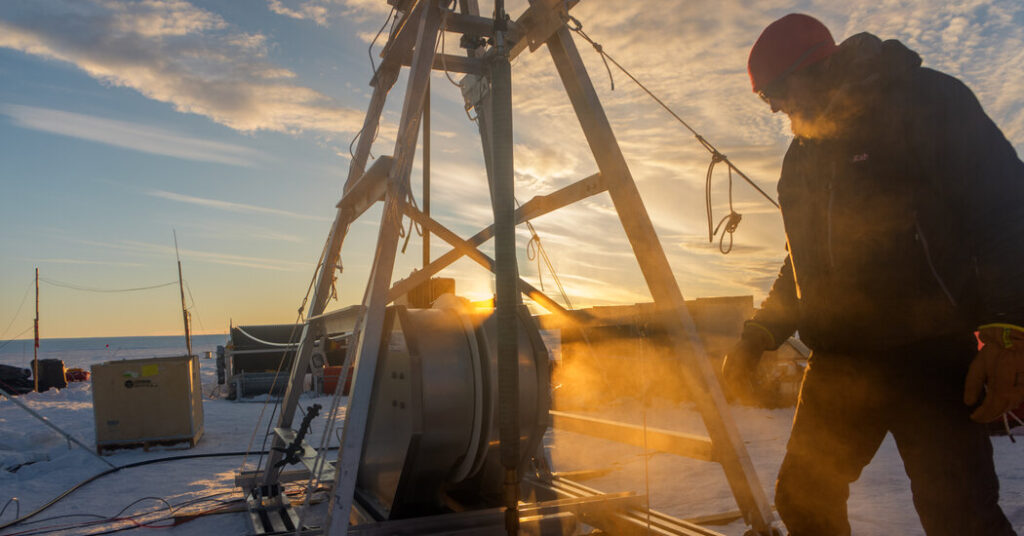
Once the whipping winds had settled, the engineers started shooting heated water out of a long hose suspended from a tower. With the hose’s heavy brass nozzle in his gloved hand, one engineer traced out a small circle, melting away the beginnings of a hole.
“All right!” he called out. The hose started to descend, and for two days, the team labored around the clock to deepen the tiny hole inch by inch.
On the second afternoon of drilling, Dr. Lee sat on an aluminum box under the blue tent that housed the controls. He trained his phone camera at a small LED display showing the depth of the water down the hole. When the red numbers dropped, it would signal that the drill had melted through the base of the ice, causing the hole’s water to flow into the ocean. Dr. Lee wanted to capture the breakthrough moment.
He looked out the open flap of the tent, up into the brilliant clear sky. “It’s a perfect day for celebrating something,” he said.
Standing next to him was Keith Makinson, an oceanographer and drilling engineer, who smiled at his remark but didn’t respond. This phase of the mission was Dr. Makinson’s and two other engineers’ to lead, and he still had too much to think about before he could celebrate, starting with the fact that the team was effectively drilling blind.
The sensor that indicated how deep the hose was inside the hole had stopped giving sensible readings. Now the engineers could only estimate, by counting the rotations of the wheel that guided the hose, how close they were to boring all the way through.
After nearly four decades drilling through glaciers across Antarctica, Greenland and the Alps, Dr. Makinson, 59, was retiring soon, and he’d come to Thwaites for one last job, the most ambitious of his career. There was just so little time to get it all done. And now the weather forecast was looking iffy once again, which meant they had to wrap up soon to leave enough time to fly everything back onto the ship.
In the 42 hours since the hose began blasting away, Dr. Makinson and the two other drilling engineers hadn’t slept much. They fought through the brain fog with mugs of Yorkshire Tea made with melted snow. Everybody else napped on rotation.
The big moment arrived without warning, given the broken sensor: At around 4:20 p.m. on Jan. 30, the red numbers on the LED suddenly dropped. The hose had penetrated the bottom of the ice. The team’s portal to the dark realm under Thwaites was open.
“Finally!” Dr. Lee cried. He gave a deep sigh of relief, then grinned from ear to ear.
Dr. Makinson wasn’t quite ready to relax. He and the other engineers now needed to pull the hose back up to the surface while continuing to pump hot water through it to keep the hole from freezing again. After that, they would send down a camera on a cable to inspect the hole for obstructions. Then, the main event: installing the instruments that would stay under the glacier.
Dr. Lee was already thinking ahead to the coming day, the mission’s last. A little rest, a little science, and then — the team had brought whiskey for a victory toast — “Thwaites Bar.” He laughed and patted Dr. Makinson on the back.
Dr. Makinson tried to muster some enthusiasm. “Down to the last few hours now,” he said.
5.
When the nozzle emerged from the borehole eight hours later, dripping and steaming in the cold air, a new clock started. Unless the team sent the hose down again, the hole would seal up within two days. It was Dr. Davis’s turn to get to work.
Before installing the mooring that they’d leave beneath Thwaites, he was sending down a cable with a smaller set of sensors to take preliminary measurements. He crouched in the snow and operated the winch. Under a yellow tent nearby, Yixi Zheng, a 30-year-old postdoctoral researcher, watched on her laptop as data rolled in.
The two scientists lowered the sensors through the hole and down to the seafloor before raising them up again. They did this five times, creating five detailed profiles of the temperature and salinity of the water under the glacier, plus the speed of the currents. It was the first such data ever collected from this part of Thwaites, and it showed that the water bathing the glacier’s undersides was freakishly turbulent and warm.
Dr. Davis hurried into the yellow tent to look at Dr. Zheng’s screen. “There’s lots of action,” he said. “Plenty of heat to drive melting.” Even if they accomplished nothing else at Thwaites, this data alone was a “great achievement,” Dr. Zheng said.
It was 6 a.m. on Jan. 31 now, a new day. The camp had turned cold overnight even if it hadn’t gone dark. It was minus 8.4 degrees Celsius, about 17 Fahrenheit. After a week and a half of sun and snow and wind, everyone had ruddy, burnished faces.
The original plan had been to spend eight hours sending the hose down the hole again to widen it. But with time running out, the team decided to go straight to deploying the main mooring: 29 instruments, strung out along more than 3,800 feet of cable, all of it connected to a tower that would transmit the data from the glacier’s surface.
The first piece to go down the hole was a rusty chain weighing nearly 190 pounds. It was hooked to the bottom of the cable and would serve as an anchor, holding the instruments steady in the water under the ice. As their teammates reeled out the cable, Dr. Davis and an engineer knelt at the top of the hole, attaching instruments one by one to the cable as it went down. Another engineer monitored the load — that is, the weight the cable was supporting — in the control tent.
This was slow, repetitive work. The cable disappeared down the hole with what seemed like unfathomable slowness, though actually it was around 20 feet a minute.
Dr. Davis’s hands flew as he screwed down clamps and tightened zip ties. “Couldn’t have asked for any better weather,” he said.
At one point, an engineer noticed the load reading had dropped. Had the instruments gotten snagged somewhere inside the hole? Not likely, Dr. Davis thought: The walls shouldn’t be that narrow. The team kept going.
Dr. Lee tried to play cheerleader. “Thwaites Bar will be opening at 5 p.m.!” he declared, to no reply. Everyone was weary. A hush had fallen over the ice.
Shortly after 1 p.m., the cable was spooled out to the team’s desired length. Time for Dr. Davis to connect to the instruments and check where they were.
He knelt in the snow and stared into his laptop screen.
Nearly all of the sensors were at the same depth in the hole, roughly three-quarters of the way through the glacier. None were in the ocean. They were stuck.
Something was blocking the instruments from descending farther and probably had been for a while. The rest of the cable had simply piled up on top of it.
“I think the reality is that we’re almost certainly frozen in,” Dr. Makinson, the drilling engineer, said quietly.
Dr. Davis stared into the distance, his mouth agape. Polar science was risky, he knew that. So far in his career, though, he’d never tasted failure himself. The thought wouldn’t stop reverberating in his skull: They had gotten so far. They were so close to triumph. It could not be ending like this.
The engineers tried rewinding the cable, but it didn’t rise very far. They could try gunning the motor to play tug of war with the glacier, but then the whole rig might come crashing down. Someone could get hurt.
Dr. Davis turned to Dr. Lee. It was his equipment, his expedition. “Won Sang, what’s your preference?”
Dr. Lee hadn’t been saying much as the team’s labors crumbled. Now, the end was becoming clear.
“Just stop,” he said. “Leave it there.”
Maybe they could drill another hole to recover the instruments, Dr. Zheng suggested.
“We don’t have water,” Dr. Lee said, cutting her off. There was a hardness in his voice now. To make more hot water for drilling, they’d have to melt more snow, and that would mean hours of shoveling, hours they didn’t have.
Dr. Zheng persisted. Maybe they could push back their return to the ship.
“No,” Dr. Lee said. The chief scientist had called it. The mission was over.
6.
It took another two days to pack up everything and fly it back onto the Araon. When Dr. Lee stepped off the helicopter, he was overcome with emotion. After all he and his colleagues had been through, they’d made it back safely, and for that he was grateful. It made him feel like someone out there was looking after them: namely, his father.
He’d been trying the whole voyage not to think about his father. Now, suddenly, he wanted nothing more than to share this moment with him. He leaned against the wall of the helicopter hangar and wept.
The Araon lingered around Thwaites for another week as the other scientists wrapped up their work. The radar team managed to scan the ice farther up the glacier than anyone had ever done by helicopter. Another team used a machine of its own devising to gather the first detailed underwater data from an area of Thwaites that had deteriorated into a parade of giant blocks, each one 100 feet tall and a mile across.
The members of the drilling team couldn’t help but wonder what might have been had they been able to spend an extra day or two (or four) on the glacier.
The engineers would definitely have widened the borehole again before sending the mooring down, Dr. Makinson said. They’d skipped that step, and as a result, the hole had refrozen somewhat, perhaps even enough to stop a key part of the mooring from passing through.
The chain! The rusty chain at the bottom of the cable. It was a weight, nothing more. But it may have been just bulky enough to get stuck. That would also explain why the engineers’ load reading had dropped. Thwaites had grabbed the chain in its clutches.
Dr. Makinson had made his peace with that. “I do feel proud of what we’ve done,” he said: the first-of-its-kind data Dr. Davis and Dr. Zheng collected, the hole the engineers drilled. At almost exactly 1,000 meters, or 3,280 feet, it was the deepest ever bored through the floating end of a glacier. Not a bad way, Dr. Makinson thought, to cap a career.
As for the entombed mooring — well, he had dealt with setbacks on the ice before. Dr. Davis hadn’t. Two weeks after returning from the glacier, the younger scientist was still finding it hard to shake the emotions from that day. The built-up stress and mental strain. The whiplash of feeling elated that they’d gotten the mooring in, then crushed, moments later, when they realized they hadn’t. Those feelings would probably overshadow his happier memories of the trip for some time to come, he said.
All any of them could do now was hope that, as the warming ocean eroded the bottom of the ice, the stranded instruments might someday thaw out, fall into the sea and start collecting data, liberated by the same processes that were destroying the glacier.
With his colleagues, Dr. Lee sounded optimistic that the instruments would emerge from what he called “hibernation,” though privately he wasn’t so sure. As a leader, he felt he had to stay upbeat to keep his team motivated. But losing the mooring had affected him, too. After coming back to the ship from the glacier, he’d broken his own rule and shaved. Going scruffy hadn’t helped him much this time. “I don’t want to have another failure in the future,” he said.
Dr. Lee was already angling to drill again at Thwaites, probably in four years’ time. The glacier wasn’t getting any safer or more accessible. More of the ice was losing its footing on the bedrock and coming apart. That, and the hostile weather, he couldn’t do much about. But during their two weeks on the glacier, he and his colleagues had proved they could handle just about everything else. This, he felt, was reason enough to try again.
Here was the thing Dr. Lee had learned long ago about polar science: Failure was part of the process. What gave him the greatest satisfaction as a researcher, he said, was seeing “progress at every step.” Even his failures weren’t truly failures so long as they moved him forward. But it wasn’t always easy to communicate this, not to government officials, not to the public.
And not to his father. Dr. Lee had regretted not sharing more with him about his work. Given the chance, what would he tell him now about what had happened on Thwaites?
He thought for a moment, then smiled. His father, he realized, already knew the story of this expedition. It was a familiar one from his boyhood days in the mountains around Seoul: He dug a hole. He peered down into it. Then he reached inside.
Raymond Zhong reports on climate and environmental issues for The Times.
The post The Hole in the Ice at the End of the Earth appeared first on New York Times.