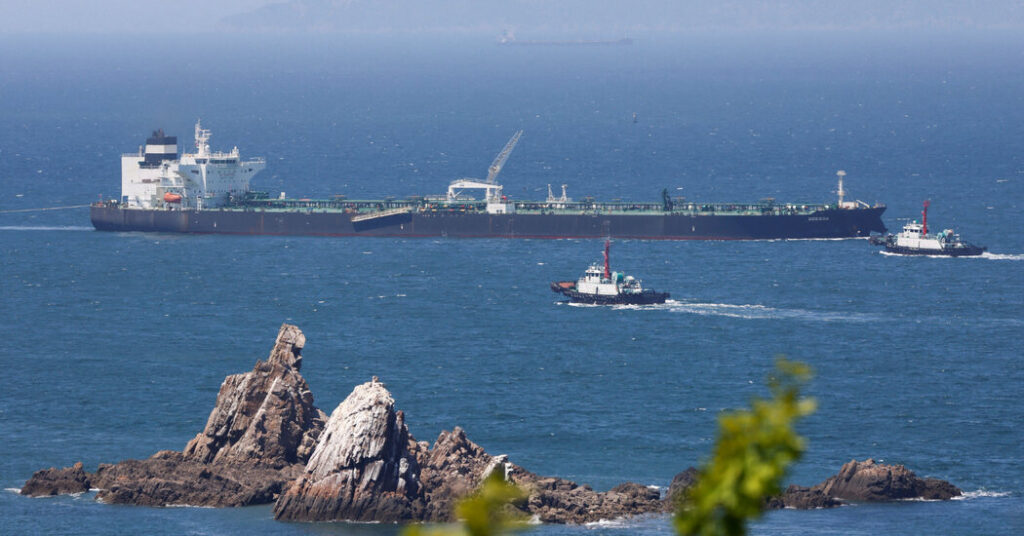
The peace talks between the United States and Iran have been stuck for a month. On Sunday, President Trump dismissed Iran’s most recent demands as “TOTALLY UNACCEPTABLE!” According to Iran’s state broadcaster, the country’s leaders wanted the U.S. to pay war reparations, end sanctions and — crucially — recognize Iran’s sovereignty over the Strait of Hormuz.
Iran’s chokehold on the strait and the U.S. blockade are a source of global economic pain. But the ships occasionally making it out — a Russian oligarch’s yacht, two German cruise ships and the odd L.N.G. tanker — have also become a source of fascination. How did they pull it off? Who is allowed out, and why?
For such a narrow, critical waterway, it’s striking how difficult it is to fully understand what’s happening. Today my colleague Jenny Gross, one of our business reporters, writes about how the strait is offering us a glimpse into the shady world of shipping.
Extremely important and remarkably lawless
By Jenny Gross
Since the war began, my main focus as a reporter has been chasing down the fates of the more than 1,500 ships that got stuck in the Persian Gulf.
My colleagues and I spend our days poring over databases of ship crossings and interviewing analysts, shipowners and operators — and yet we still miss a fair amount.
Consider one Iran-flagged tanker, the Huge. The ship surprised analysts when it turned up in Southeast Asia on May 3, having seemingly slipped through the Strait of Hormuz just before the start of the U.S. blockade. Few had tracked the more than 300-meter-long ship during its weekslong journey; the Huge had turned its location transponder off.
Some ships report false positions or paint fake names on their hulls. Other ships hide the origins of the oil they are carrying by transferring it from ship to ship in the middle of the sea. And others sail under the flags of different countries without those countries’ permission.
Some do all of the above.
All this to say — if we don’t have a clear picture of what’s happening in the strait, it’s not because we’re not trying. It’s because these ships don’t want to be seen.
The International Maritime Organization, a U.N. agency, sets out rules that govern the shipping industry, including through the Strait of Hormuz. Most companies abide by those rules. But some do not, because ships operate in international waters and across jurisdictions, making rules easier to circumvent for those looking to evade sanctions or carry illicit cargo.
The current murkiness in the Strait of Hormuz is revealing some of this darker side of global shipping. The sector is extremely important and can also be remarkably lawless. In parts of the sector, shady actions have become somewhat routine. It’s just that most of the time, the world isn’t paying such close attention.
How to disappear a tanker
I usually start my days by looking at a map of red, green and blue arrows on MarineTraffic, a firm that uses vessels’ transponders to track which ships have transited the strait and by what route. What I see gives me some idea of what ships are where. But it’s not a complete picture.
On Thursday, for example, transits through the strait appeared to drop to zero. But a satellite analysis by Windward AI found that nine heavy commercial vessels had, in fact, moved through the strait that day. They did so without switching on their location trackers, a key part of the global system that keeps tabs on vessel activity and traffic.
Another way vessels avoid detection is through spoofing, which involves falsifying data from the transponder that transmits the ship’s name, location, route and other identifying information. Telltale signs of spoofing include ships appearing to be in odd places. Recently, that included one ship that digitally appeared in Iran’s capital city, Tehran. Another showed up in the Saudi Arabian desert.
These tactics have long been deployed by ships trying to evade detection, such as those surreptitiously transporting oil in violation of sanctions.
But the logjam in the Strait of Hormuz — and the U.S. government’s interest in breaking it — has prompted shipping companies with no ties to Iran to shut off their transponders or use other tactics to obscure their locations. In fact, a U.S. official told my colleague Eric Schmitt last week that, during “Project Freedom,” the U.S. government itself recommended that some ships trying to exit the strait go dark for their own protection.
‘A huge risk problem for everybody’
When ships do not follow the rules, operating outside the reach of international law, it’s more than just a niche problem. These deceptive tactics enable illicit trade around the world, allowing sanctioned countries like Russia, Iran and Venezuela, as well as nonstate actors like drug cartels, to covertly ship oil, using what are known as “ghost fleets” or “shadow fleets.”
“The rules upon which global trade is based are not that enforceable,” said Richard Meade, the editor of Lloyd’s List, a shipping publication.
These practices also make the seas less safe by increasing the chances of collision — and by creating “a huge risk problem for everybody,” according to Andreas Enger, chief executive of the Norwegian shipping company Höegh Autoliners, in a recent call.
What the situation in the strait illustrates is how effective these tactics can be. If they can help vessels make their way, largely unseen, through a waterway just a few dozen kilometers wide — a strait that’s at the center of one of the world’s most important news stories — imagine the challenges of tracking down a ship on the open ocean that doesn’t want to be found.
MORE TOP NEWS
Ask a correspondent
A few weeks ago, we asked you for questions for our China correspondent David Pierson ahead of this week’s summit between Trump and President Xi Jinping. He will be answering your questions all week.
How badly has China been hit by the closure of the Strait of Hormuz? — Cameron Tran, United States
Despite being the largest importer of crude oil through the Strait of Hormuz, China has weathered the crisis relatively well. It has been stockpiling oil since last year. China currently has the world’s largest inventory of strategic oil reserves, estimated to be the equivalent of nearly four months of seaborne crude imports. The country has also aggressively invested in renewable energy and boasts the largest fleet of electric vehicles in the world. China’s demand for refined oil, gasoline and diesel actually fell over the past two years.
That said, as the war drags into its third month, China is starting to feel some of the effects. Restaurants and hotels are reporting fewer guests. Car sales, considered a key indicator of China’s economic health, plunged in April.
OTHER NEWS
-
Trump said the cease-fire in Iran was on “life support” as talks stumbled again over the weekend. Follow our live updates.
-
Prime Minister Keir Starmer of Britain vowed to stay in his job, despite his party’s losses in local elections, as he announced plans to nationalize British Steel.
-
Most of the people who were on a cruise ship with a hantavirus outbreak have returned to their home countries or are on the way. Here’s what to know.
-
E.U. foreign ministers agreed to impose sanctions on Israeli settlers accused of violent attacks on Palestinians.
-
Prime Minister Narendra Modi of India, under pressure from the economic fallout of the war in Iran, asked Indians to spend less on fuel, fertilizer and travel.
-
Narges Mohammadi, an Iranian human rights activist and Nobel Peace Prize laureate, was transferred to a hospital in Tehran after her health deteriorated in prison.
-
Google said it thwarted a widespread cyberattack after criminals used A.I. models to locate a major software flaw for the first time.
TOP OF THE WORLD
The most clicked link in your newsletter yesterday was about the Chinese-sponsored telescope in Argentina.
NOSTALGIA TRIP OF THE DAY
A new Beatles museum
From the outside, 3 Savile Row looks like just another London townhouse. But to Beatles fans, it’s a place of pilgrimage: the studio where the band recorded the album “Let It Be,” and the site where, in 1969, the Fab Four walked onto the roof to play their last gig. It will open to the public as a museum next year.
AROUND THE WORLD
Going the distance in Kenya
The Great Rift Valley in Kenya has produced some of the world’s greatest distance runners. It’s in the air: Experts say the region’s 2,400-meter altitude is a sweet spot where the oxygen is thin enough to help your lungs without breaking down your body.
My colleague John Eligon, who is a recreational marathoner, went to Iten in the Rift Valley to train with the runners there and find out why the experience is so special. What he found was a running community unlike any other, where the sport was embedded in the fabric of everyday life. Watch the video.
RECOMMENDATIONS
Watch: Billie Eilish teamed up with James Cameron to create a concert movie with 3-D camera technology.
Discover: What style of garden suits you? Take our quiz.
Listen: This week’s noteworthy new songs includes tracks from the Rolling Stones and Charli XCX.
Cope: Try these seven moves to ease shoulder pain.
RECIPE
That bunch of cilantro or mint threatening to wilt in the fridge is ideal for making herby, luxurious hariyali paneer. Unlike tomato-based curries, green (or hara) curries like this one rely on crushed-up nuts for richness. This recipe uses a formidable shortcut: cashew butter.
WHERE IS THIS?
Where is this rainforest?
TIME TO PLAY
Here are today’s Spelling Bee, Mini Crossword, Wordle and Sudoku. Find all our games here.
NBC is producing a prime-time game show based on Wordle, which will be filmed in Manchester, England. Read about it here.
That’s it for today. See you tomorrow! — Katrin
Jenny Gross was our guest writer today.
We welcome your feedback. Send us your suggestions at [email protected].
Katrin Bennhold is the host of The World, the flagship global newsletter of The New York Times.
The post Shady Shipping appeared first on New York Times.