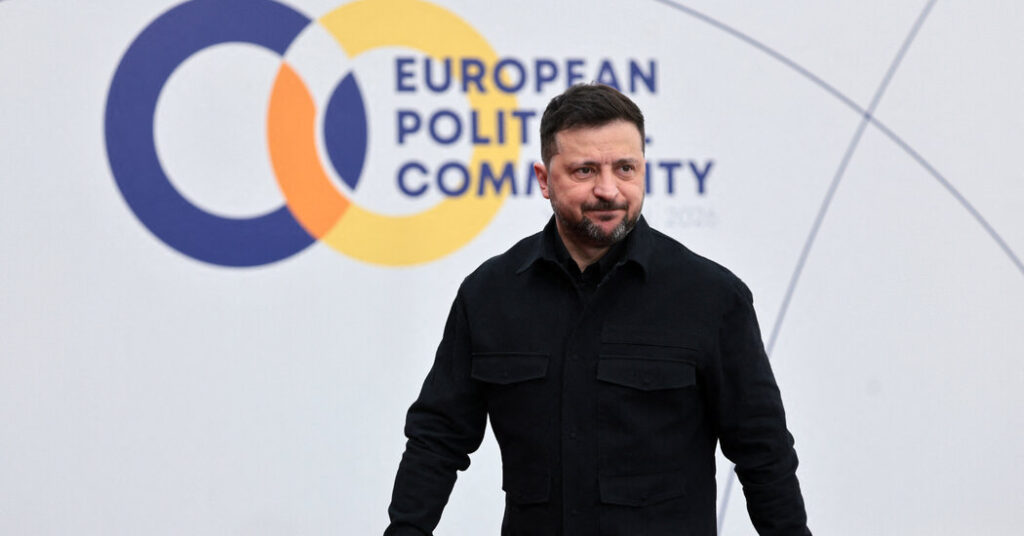
The trouble was a long time coming. More than a year ago, after the inauguration of President Trump, the United States stopped being the kind of partner it used to be for Ukraine in the war against Russia. But now, President Volodymyr Zelensky of Ukraine seems to be stepping back from that relationship as well, distancing his country from what was once its biggest ally.
Call it a trial separation, largely set in motion by the U.S.-Israeli war with Iran. American-backed peace talks to end the fighting in Ukraine have been halted since late February, when the first bombs fell on Tehran. With the negotiations now on life support, Mr. Zelensky has publicly criticized the United States in ways that would have been unthinkable last year, when Ukraine was waging a delicate fight against the Trump administration’s push for a quick peace that favored Russia.
Since the war in Iran started, U.S. negotiators have had “no time for Ukraine,” Mr. Zelensky has complained. An American decision to suspend sanctions on some Russian oil in the hopes of easing economic tensions from the war in Iran gives the Kremlin “a sense of impunity,” he protested. In pushing Ukraine to trade territory for peace, the Trump administration “still chooses a strategy of putting more pressure on the Ukrainian side” than on Russia, he grumbled.
Ukraine now seems to be preparing for a longer war with Russia, which launched the full-scale invasion more than four years ago, as well as for a future with less American assistance.
The peace talks “are dead,” said Harry Nedelcu, a senior director at Rasmussen Global, a European political advisory firm. “There’s no real negotiation anymore. There’s no talks anymore. Russia has no incentive to do it now. And neither is the United States now appearing as a reliable, reasonable broker between the two.”
One reason for Ukraine’s growing outspokenness is simple. It no longer needs the United States as much, after years of efforts to build up its own defense production. Kyiv is also openly looking elsewhere for support.
In the past month, Mr. Zelensky has been drumming up backing around Europe. He has thanked countries including Germany and Italy for helping Ukraine as the war against Iran threatened Kyiv’s supply of weapons. He has reached agreements to help countries in the Middle East defend themselves against Iranian drones, deals that could build new security relationships.
The winding path to a potential breakup with the United States is littered with setbacks and indignities for Ukraine. A month after taking office, Mr. Trump and his entourage humiliated Mr. Zelensky in a meeting at the White House. Mr. Trump has repeatedly tried to rewrite history by claiming that Ukraine, not Russia, started the war. The Trump administration has curried favor with Russia while cutting aid to Ukraine by 99 percent.
Until recently, Ukraine’s leaders largely bit their tongues, hoping to avoid a full rupture. The United States still provides vital battlefield intelligence. Washington is uniquely positioned to mediate between Moscow and Kyiv. And while the American government no longer gives weapons to Kyiv, it allows Ukraine to buy them with money from other Western allies.
Provoke the Trump administration, the thinking went, and not only could that assistance vanish but Mr. Trump might also dispense with Ukraine entirely and throw American weight fully behind President Vladimir V. Putin of Russia.
As Kyiv has observed Mr. Trump’s erratic foreign policy (a grab at Greenland here, an assault on Iran there), it has learned that it must be more self-reliant.
Ukraine has beefed up its weapons industry and signed deals to share drone expertise with other countries, hoping to reap billions of dollars to plow back into its defense companies. At the same time, Russia’s advances have largely stalled.
Ukraine now produces most of the drones it uses. Alyona Getmanchuk, Ukraine’s ambassador to NATO, said Kyiv’s domestically produced interceptor weapons knocked down more than 60 percent of Russian drones. “We feel more self-sufficient now,” Ms. Getmanchuk said.
Even if the flow of U.S.-made arms dried up — a growing risk given the strain on weapons stocks from the war in Iran — Ukraine could manage, according to Maksym Skrypchenko, president of the Transatlantic Dialogue Center, a research group in Kyiv.
“If one morning, we wake up without any of those, it wouldn’t be a disaster like it used to be before,” Mr. Skrypchenko said. “It’s not like the Biden era when we depended so much on U.S. stuff.”
American intelligence would be the hardest thing to replace, analysts say. European alternatives, however, could eventually step in, Mr. Skrypchenko said.
Kyiv also needs American-designed Patriot interceptor missiles, the only real defense it now has against Russian ballistic missiles. While Ukraine is trying to build its own interceptor missiles, that will take time. But whatever the state of U.S.-Ukraine relations, the United States has a limited number of Patriots to provide to Kyiv anyway.
As for peace talks, Volodymyr Fesenko, a Ukrainian political analyst, stressed that negotiations were still important, and that Kyiv could not walk away from all cooperation with Washington.
“You could say the U.S. is not the best partner, not the best mediator in peace negotiations,” he said. “But the United States — and the Trump administration — is the only real moderator and the most influential one in the peace process. And in this sense, we have no alternative.”
Even as the negotiations have accomplished little, Ukraine has kept up its diplomatic dance with the United States.
When Mr. Trump proposed a three-day cease-fire starting on Saturday, Mr. Zelensky agreed, despite widespread skepticism in Ukraine that it would hold, let alone help advance peace. Kyiv and Moscow accused each other of violating the cease-fire on the first day.
On Friday, Mr. Zelensky reiterated his hope that Mr. Trump’s negotiators — Steve Witkoff, his special envoy, and Jared Kushner, his son-in-law — would visit Kyiv, the Ukrainian capital. Both have traveled to Moscow several times, but have yet to confirm a trip to Kyiv. On Sunday, Mr. Zelensky sounded almost like a headmaster, noting that a prisoner exchange agreement struck as part of the cease-fire must still take place and saying that “we expect the American side to play an active role in ensuring it’s fulfilled.”
Mr. Zelensky has acknowledged that the war against Iran diverted the negotiators’ focus from Ukraine and, at times, resulted in actions harmful to Kyiv.
Shortly after that war began in February, the Trump administration issued the exemption for sanctions on the sale of Russian oil already at sea. Kyiv said the exemption would lift Moscow’s revenues while doing little to lower prices.
In early April, shortly before the exemption was set to expire, Ukrainian officials visited Washington and pressed the Americans not to extend it, according to two Ukrainian officials familiar with the meetings. They were told the exemption would expire, said the officials, who spoke on the condition of anonymity to discuss private diplomatic talks.
The Trump administration then extended the waiver. Mr. Zelensky slammed the move in a social media post, saying, “Every dollar paid for Russian oil is money for the war.” In an interview with Italian radio and on social media, he said, “Russia played the Americans again — played the president of the United States.”
The episode underscored that Kyiv could not count on Washington, the two Ukrainian officials said.
Asked about the waiver extension and the cooling relationship more broadly, a White House official sent an email statement saying Mr. Trump was optimistic about a peace deal.
Other body blows to Ukraine came courtesy of Vice President JD Vance. Mr. Vance last month characterized the war in Ukraine as “haggling at this point over a few square kilometers of territory.” He questioned whether the land in the eastern Donetsk region, which forms the backbone of Ukraine’s future defenses, was worth the huge loss of life to defend.
In a news briefing, Mr. Zelensky replied, “With all due respect, the vice president is not involved in the negotiations.”
If he were involved, Mr. Zelensky added, Mr. Vance would probably have a deeper understanding of “what the territory of an independent Ukraine actually is.”
Days later, Mr. Vance said ending U.S. financial support for Kyiv and making Europe foot the bill for Ukraine’s defense was “one of the things I’m proudest that we’ve done in this administration.”
While the fallout from the Iran war has challenged Mr. Zelensky, it has also left him emboldened. Not only has he openly criticized Washington, but Kyiv has also continued its campaign of strikes against Russian oil infrastructure, despite American calls to halt the attacks.
In many ways, Mr. Zelensky’s moves have resembled those of other European leaders who have tentatively backed away from Mr. Trump.
Europe has replaced the United States as the largest funder of Ukraine’s war effort. A recent $106 billion E.U. loan heavily weighted toward military spending will give Kyiv greater ability to plan for a war that few expect to end soon.
Ms. Getmanchuk, Ukraine’s ambassador to NATO, said the deeper cooperation between Ukraine and Europe could ultimately position Kyiv as a pillar of European security.
At the end of April, in Exhibit A of the new world order, Mr. Trump spoke on the phone with Mr. Putin for 90 minutes. No call to Mr. Zelensky followed.
Oleksandra Mykolyshyn, Nataliia Novosolova and Cassandra Vinograd contributed reporting.
Kim Barker is a Times reporter writing in-depth stories about the war in Ukraine.
The post Fed Up, Zelensky Takes Gloves Off With the Trump Administration appeared first on New York Times.