As Britain’s prime minister, Keir Starmer, sought to rescue his embattled premiership, he said on Monday that the government would nationalize British Steel, which houses the country’s last crude steel production facilities.
It is the latest intervention to maintain the operations of the steel-making complex in Scunthorpe, in the East Midlands of England. Last year, the government invoked emergency measures to seize control of the day-to-day running of the plant after its Chinese owner, Jingye, appeared set to close the blast furnaces. The plant was hours from shutting, the government has said.
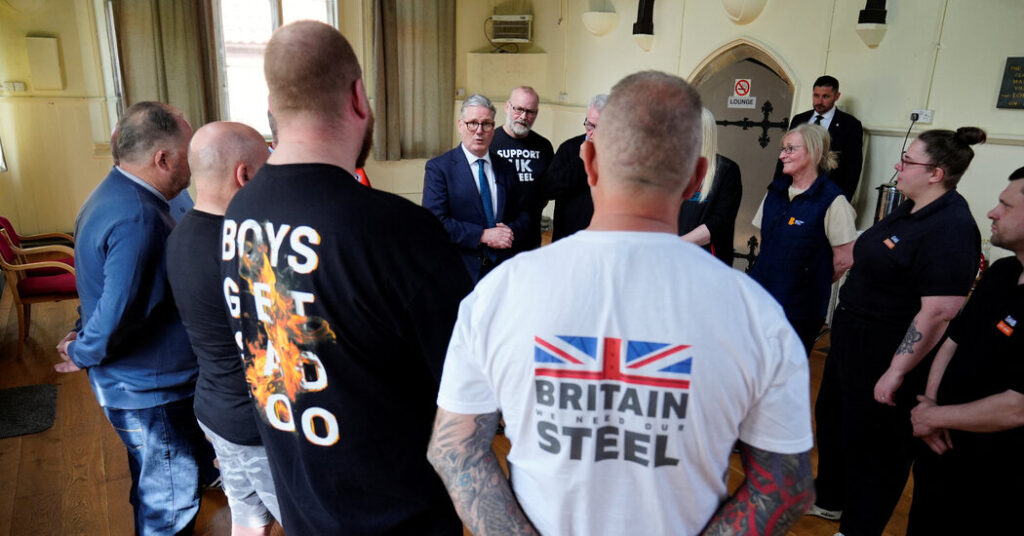
The Scunthorpe plant is responsible for thousands of jobs, and its blast furnaces mean it is the country’s last facility capable of making crude steel. Britain’s steel industry has been in decline for decades. It has suffered from the high cost of energy needed to run plants and struggled to compete against the glut of cheaper steel production in China. More recently, it has also been hampered by U.S. tariffs on steel. But the government has said it wants to revitalize the steel sector and make up to half of Britain’s steel demand domestically.
“Steel is the ultimate sovereign capability,” Mr. Starmer said in a speech on Monday. “Strong nations, in a world like this, need to make steel.”
The government took over the Scunthorpe plant in April 2025, fearing that Jingye was getting ready to stop feeding the furnaces with raw materials like coke, a derivative of coal. Such a move would have effectively terminated the plant’s operation and made it exceedingly difficult to restart. Jingye had claimed that it was losing 700,000 pounds (about $952,000) a day running the plant.
The government recalled lawmakers from vacation on a Saturday to pass legislation to give it the power to begin running the plant. Since then, the government has spent more than £400 million on the facility to pay for raw materials and salaries.
“What we did in Scunthorpe last year was one of the proudest things we have done in government,” Mr. Starmer said on Monday.
British Steel employs about 4,000 people, and its steel is used to make most of the rail needed by Network Rail, which manages most of the country’s railway network. The government had said it was looking for private buyers for British Steel to invest with the government to modernize the facility and reduce its carbon emissions. But that search failed.
The move announced by Mr. Starmer on Monday would bring British Steel back into public ownership for the first time since 1988. The legislation is expected to be set out on Wednesday in the King’s Speech, which the government uses to lay out its legislative agenda.
Owning and decarbonizing the steel facility, which includes measures such as converting to furnaces powered by electricity instead of coke, will require significant investment from the government.
UK Steel, a trade group, said nationalization was a “decisive step” to secure the future of a vital part of the steel supply chain.
“Nationalization is not an end goal,” Gareth Stace, the director general of the group, said in a statement. The government must produce an investment strategy that outlines the transition to “low-carbon steelmaking” and addresses high energy costs, he said.
Eshe Nelson is a Times reporter based in London, covering economics and business news.
The post Britain Will Nationalize Its Last Major Steel Mill, Prime Minister Says appeared first on New York Times.